Let's cut through the jargon. Cost Per Acquisition (CPA) is simply the price tag for winning a new customer. Think of it as the ultimate report card for your marketing spend—it tells you exactly how much you paid to get someone to click 'buy now.'
Your Guide to Understanding Cost Per Acquisition
Let's break this down with a simple analogy. Imagine you're running a lemonade stand. You spend $10 on flyers and get two new customers. Your Cost Per Acquisition is $5. Simple, right?
At its core, CPA is just that: the total cost of a marketing campaign divided by the number of new customers it brought in. This single metric cuts through the noise and reveals the raw financial efficiency of your efforts. It answers the one question every marketer needs to know: "Is my advertising actually profitable?"
This isn’t just an academic exercise. Knowing your CPA is non-negotiable for anyone running ads, especially as the digital space gets more crowded. In fact, customer acquisition costs have shot up by as much as 60% over the last five years, making every dollar count more than ever.
To help you get a quick handle on this, here's a simple breakdown of what CPA is all about.
CPA at a Glance
| Concept | Brief Explanation |
|---|---|
| Definition | The total cost to acquire one paying customer from a specific campaign. |
| Formula | Total Marketing Spend / Number of New Customers Acquired = CPA |
| Purpose | Measures the financial efficiency and profitability of an advertising campaign. |
| Importance | Helps with budget allocation, performance tracking, and forecasting growth. |
This table gives you the basics, but the real power of CPA comes from putting it into practice.
Why CPA Is Your Most Important Report Card
Tracking CPA is what separates hoping for results from engineering them. It gives you a clear, data-backed verdict on your campaigns, empowering you to make smarter decisions that directly fatten your bottom line.
A well-managed CPA helps you:
- Allocate Budgets Wisely: You can confidently shift spending away from underperforming channels and double down on the ones that deliver profitable customers.
- Measure Campaign Health: Think of CPA as an early warning system. A rising CPA might signal ad fatigue, new competition, or even a broken landing page.
- Forecast Scalable Growth: When you know your acquisition cost, you can accurately predict how much you need to spend to hit specific revenue targets. It's the key to growing without guessing.
Cost Per Acquisition isn’t just about cost; it's about value. It connects your marketing spend directly to revenue, forcing a focus on what truly drives business growth rather than just vanity metrics like clicks or impressions.
Setting the Stage for Smarter Advertising
In this guide, we're going to dive deep into calculating, benchmarking, and—most importantly—improving your CPA. We'll explore how modern AI-driven platforms are helping brands master this challenge by automating the tedious work of creative testing and scaling what works. By mastering key performance marketing metrics like CPA, you set the stage for sustainable and profitable growth.
This foundation is crucial. A low CPA isn't just about saving money; it's about building a more resilient and efficient marketing engine. As you learn to measure and optimize this number, you'll gain a powerful advantage in a crowded market, ensuring every ad dollar you spend fuels real, tangible results.
Calculating Your True Cost Per Acquisition
Before you can master your Cost Per Acquisition, you have to get the calculation right. It's the most critical first step. While it might sound like a complex marketing metric, the universal formula is refreshingly simple and serves as the foundation for all your performance analysis.
At its core, the math is straightforward:
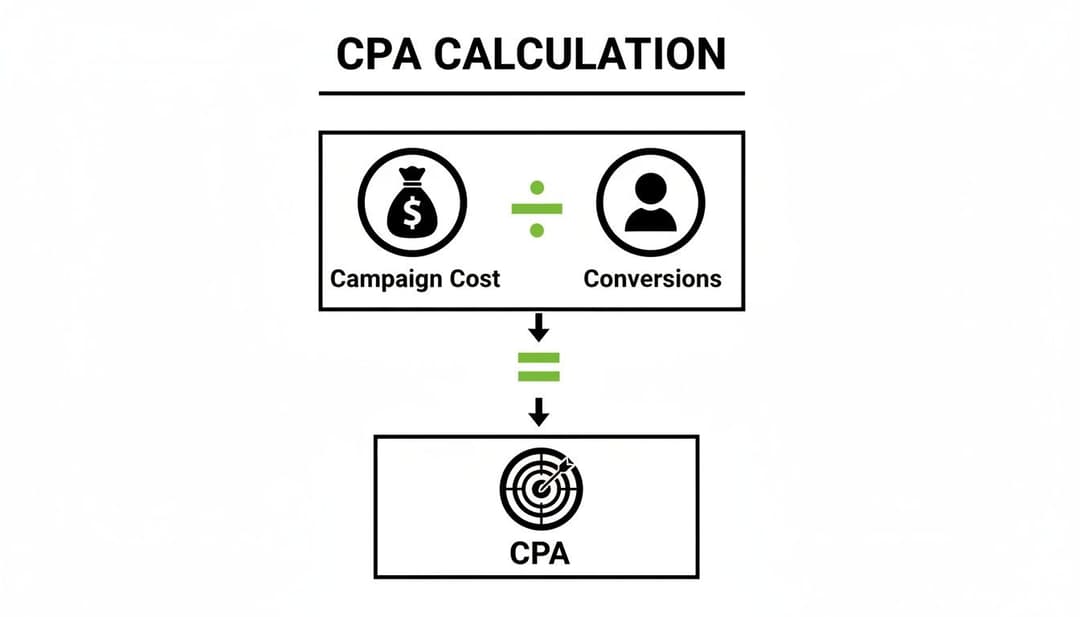
Total Campaign Cost ÷ Number of Conversions = Cost Per Acquisition (CPA)
This formula gives you a clear, unfiltered look at how much you’re spending to hit a specific goal. But the real magic isn’t in the division; it's in how you define your terms.
The Two Pillars of an Accurate CPA Calculation
To get a number that actually reflects your business's health, you have to be precise about what you're plugging into the formula. This means defining both "cost" and "acquisition" with intention.
- Total Campaign Cost: This is not just your ad spend. A true cost includes every related expense. Did you hire a freelance designer for your creatives? Pay for a new analytics tool to track results? All of those direct costs need to be rolled in.
- Number of Conversions: What does an "acquisition" actually mean for your business? For an e-commerce store, it's almost always a first-time purchase. For a SaaS company, it might be a new paid subscription. For a B2B service, it could be a booked and qualified sales call. Define this action clearly and stick with it for consistent measurement.
Nailing down these components is how you turn a generic metric into a powerful business indicator. It also helps you compare CPA to other vital numbers, like your Return on Ad Spend (ROAS), for a more complete picture of profitability.
Putting the CPA Formula into Practice
Let's walk through a couple of real-world examples to see how this works, starting simple and then adding a few layers.
Example 1: The Straightforward E-commerce Brand
Imagine a direct-to-consumer (DTC) brand running a Meta Ads campaign to sell a new line of sneakers.
- Total Meta Ad Spend: $2,000
- New Customers Acquired (Sales): 100
Using the formula: $2,000 ÷ 100 = $20 CPA
Simple enough. The brand paid exactly $20 to acquire each new customer from this campaign. They can now compare that number to their average order value to see if they were profitable from day one.
Example 2: The Complex B2B Scenario
Now, let's look at a B2B software company. Their goal isn't a direct sale from an ad but generating a qualified demo for their sales team. The calculation gets more nuanced here.
- Total Meta Ad Spend: $5,000
- Creative Production Costs: $500
- Portion of Sales Team Salaries (for follow-up): $1,500
- New Closed Deals (Customers): 10
Here, the total cost isn't just the ad spend. It's a "blended" cost that includes both marketing and sales efforts needed to close the deal.
- Total Campaign Cost: $5,000 + $500 + $1,500 = $7,000
Now we can run the calculation: $7,000 ÷ 10 = $700 CPA
This blended CPA gives a much more realistic view of what it truly costs to land a new customer. Getting this number right is foundational, and comparing it against benchmarks provides valuable context. For instance, recent benchmarks show the average CPA on Google Ads is $31.75, while Facebook Ads averages a $34.99 Cost Per Lead—figures many DTC brands watch closely. You can find more insights on benchmarking your cost per acquisition.
By defining your terms and including all the relevant costs, you empower yourself to calculate a CPA that accurately reflects your business's performance and profitability.
CPA vs. CAC vs. CPL: What’s the Difference?
In the world of marketing metrics, acronyms can start to blend together. Cost Per Acquisition (CPA), Customer Acquisition Cost (CAC), and Cost Per Lead (CPL) sound similar, but they are absolutely not interchangeable. While they're related, each one measures a distinct, crucial milestone along the customer journey.
Think of it like dating. CPL is the cost of getting someone’s phone number—a clear sign of initial interest. CPA is the cost of the first date, a very specific and important conversion. CAC, however, is the total cost of the entire relationship, from the first hello to a long-term commitment. Each metric tells a unique part of the story, and you need all three to see the full picture.
Comparing Key Acquisition Metrics
To really nail down the differences, let's break down these three key metrics side-by-side. Each one serves a different purpose, from gauging top-of-funnel interest to measuring overall business health.
| Metric | What It Measures | Typical Formula | Best Used For |
|---|---|---|---|
| Cost Per Lead (CPL) | The cost to generate a new prospect or lead. | Total Ad Spend / Total New Leads | Gauging top-of-funnel campaign efficiency for lead generation. |
| Cost Per Acquisition (CPA) | The cost to drive a specific action, usually a first sale. | Total Campaign Cost / Total Conversions | Optimizing individual campaigns and ad sets for profitability. |
| Customer Acquisition Cost (CAC) | The total cost to acquire one new paying customer. | (Total Marketing + Sales Costs) / New Customers Acquired | Assessing the overall health and sustainability of the business model. |
Understanding when to use each metric is what separates good marketers from great ones. CPL tells you if you're good at starting conversations, CPA tells you if you're good at getting a "yes" to a first date, and CAC tells you if your entire dating strategy is actually working long-term.
CPL: The Cost of a Handshake
Cost Per Lead (CPL) measures how much you spend to generate a new lead. This is your classic top-of-funnel metric. It's all about capturing interest, not closing the deal just yet.
A lead could be anyone who:
- Signs up for your email newsletter.
- Downloads a free guide or ebook.
- Fills out a contact form to learn more.
You calculate CPL by dividing your total ad spend by the number of new leads generated. It’s perfect for gauging how efficiently your campaigns are building an audience and filling your pipeline with potential customers.
CPA: The Cost of a First Purchase
This brings us to Cost Per Acquisition (CPA), the star of this guide. CPA measures the cost to secure a specific, valuable action—most often, a first-time purchase. It’s much more bottom-of-funnel than CPL and is almost always tied directly to a specific campaign or channel.
This visual breaks down the simple but powerful formula for calculating your campaign-specific CPA.
This narrow focus is actually CPA's greatest strength. It gives you a crystal-clear look at the performance of an individual ad set, channel, or marketing initiative, linking specific costs to specific revenue-driving actions.
CAC: The Total Cost of a New Customer
Finally, Customer Acquisition Cost (CAC) gives you the 30,000-foot view. It accounts for every single expense required to win a new customer across all your marketing and sales efforts over a set period. We're talking way beyond just ad spend here.
CAC is the all-in metric. It includes marketing salaries, sales commissions, software subscriptions, and creative costs—everything that contributes to acquiring a new paying customer.
Because it's so comprehensive, CAC is a high-level business health metric. It answers the big question: "Overall, how much does it cost our entire company to land one new customer?" Understanding your customer acquisition cost calculation is essential for long-term financial planning and proving the value of your entire growth engine.
While CPA helps you optimize individual campaigns day-to-day, CAC tells you if your entire acquisition strategy is sustainable and profitable in the long run. Using all three metrics together gives you a complete, multi-layered view of your marketing funnel's performance, from the very first touch to the final sale.
Finding Your Ideal Cost Per Acquisition
"What's a good Cost Per Acquisition?" It's the million-dollar question every marketer asks. And while it's tempting to hunt for a magic number, the real answer is far more useful: a "good" CPA is whatever is profitable for your business.
That's it.
An amazing CPA for a SaaS company selling high-ticket software could bankrupt an e-commerce brand selling t-shirts. The number is totally meaningless without context. Forget chasing universal benchmarks—your real goal is to find the CPA that fuels sustainable, profitable growth for your specific business.
The LTV to CPA Ratio: The Gold Standard
So, how do you know if your CPA is healthy? You put it up against another critical metric: Customer Lifetime Value (LTV). LTV is the total amount of money you can expect a single customer to spend with you over their entire relationship with your brand.
The relationship between what you pay for a customer and what they're worth to you is everything.
The most reliable benchmark for a sustainable business is the LTV to CPA ratio. As a solid rule of thumb, you want to see a ratio of at least 3:1. For every dollar you spend to acquire a customer, that customer should generate at least three dollars in lifetime value.
Let's break that down with a few scenarios:
- Scenario A (Healthy): Your LTV is $300 and your CPA is $75. You've got a 4:1 LTV:CPA ratio. This is a strong, scalable model. You have plenty of room to cover all your other business costs and still bank a healthy profit.
- Scenario B (Break-Even): Your LTV is $100 and your CPA is $100. Your LTV:CPA ratio is 1:1. You're just trading dollars here, leaving no margin for profit or other expenses. You're running on a treadmill, not growing a business.
- Scenario C (Unsustainable): Your LTV is $50 and your CPA is $75. Your ratio is less than 1:1. You're literally paying to lose money with every new customer. This is a fast track to going out of business.
That 3:1 ratio isn't just a random number. It builds in a buffer to cover all the other costs of doing business—your products, your team's salaries, your software stack—while still leaving a solid profit margin. It's the bedrock of a financially sound growth plan.
Using Industry Benchmarks for Context
While your own profitability is the ultimate truth, industry benchmarks can give you a helpful reality check. They help you understand the competitive landscape and set realistic starting points, especially if you’re launching new campaigns with no historical data to go on.
Just remember to treat these numbers as a compass, not a map. They’ll point you in a general direction, but they can't see the unique terrain of your business.
Average Cost Per Acquisition by Industry (Google Ads)
| Industry | Average CPA |
|---|---|
| Technology | $133.52 |
| B2B | $116.13 |
| E-commerce | $45.27 |
| Education | $72.70 |
| Finance & Insurance | $81.93 |
| Health & Medical | $78.09 |
Use these as a starting point. If your CPA is miles higher than your industry average, it might be a signal to take a hard look at your targeting, ad creative, or landing page experience. But if your LTV supports a higher CPA? Don't be afraid to spend more to acquire those high-value customers.
Your Own Data Is the Ultimate Benchmark
At the end of the day, the only benchmark that truly matters is your own historical performance. Industry averages are great for a gut check, but your past data tells the real story of what actually works for you.
Start tracking your CPA trends month-over-month and quarter-over-quarter. This practice alone will empower you to:
- Set Realistic Goals: You can establish internal benchmarks based on what you’ve actually achieved before, making your targets much more attainable.
- Identify Performance Shifts: A sudden spike in your CPA can be an early warning sign for problems like ad fatigue or new competition, letting you act before things spiral.
- Measure True Impact: You can accurately tell if new strategies, campaigns, or creative tests are actually moving the needle in the right direction.
By focusing on your LTV to CPA ratio and using your own data as your guide, you stop asking "what is a good CPA?" and start answering the only question that matters: "What is a profitable CPA for my business?"
Proven Strategies to Lower Your CPA on Meta Ads
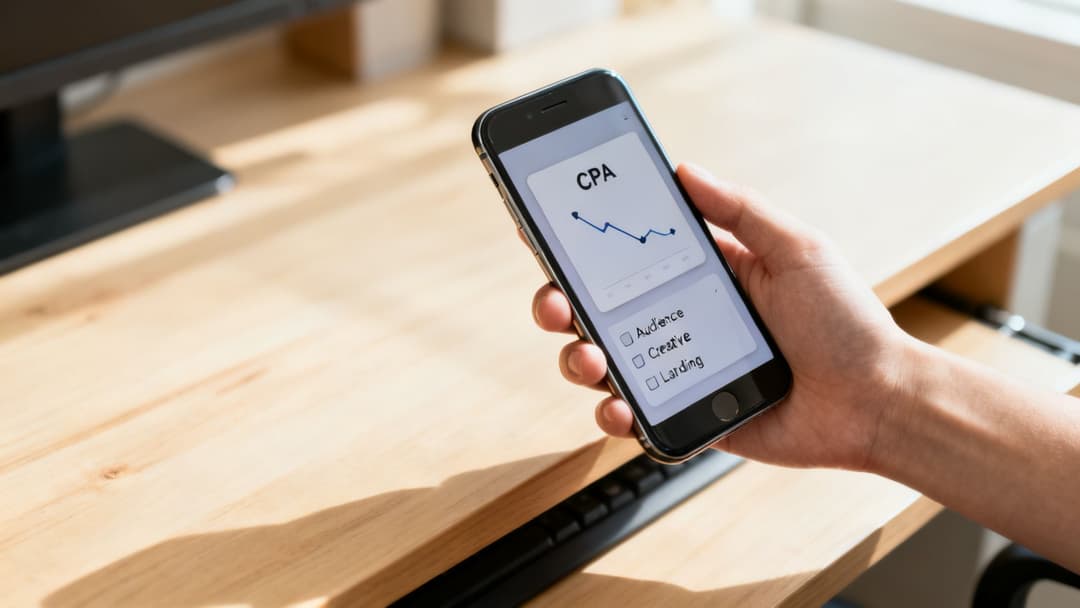
Knowing your target CPA is just the starting line. The real race begins when you start actively pushing that number down. On a platform as competitive as Meta, a lower Cost Per Acquisition is your ticket to more efficient spending, higher profits, and the ability to truly scale your campaigns.
This isn't about finding some magic button. Dropping your CPA is a systematic process of testing and sharpening every part of your advertising funnel. From the audience you target to the landing page they hit after the click, every single element plays a crucial role.
Let’s get into five proven strategies that will directly knock down your acquisition costs. By focusing on these areas, you can build a more resilient and profitable advertising engine.
Refine Your Audience Targeting
The fastest way to burn through your budget and send your CPA skyrocketing is by showing ads to the wrong people. Precision targeting isn't just a best practice; it's the foundation of an efficient campaign, ensuring your money is spent only on users who are most likely to convert.
To sharpen your aim, you need to go beyond the basics. Focus on these high-leverage audiences:
- Lookalike Audiences: Don't just build lookalikes from website visitors. Create them from your best customers—past purchasers, high LTV clients, or users who have taken multiple valuable actions. An audience that mirrors your top buyers is infinitely more valuable than one that just looks like casual browsers.
- Detailed Targeting: Think beyond broad interests. Start layering demographics, interests, and behaviors to paint a vivid picture of your ideal customer. Instead of just targeting "fitness," you might target users interested in "CrossFit," who also follow specific fitness influencers and have recently purchased workout gear online.
The whole point of advanced targeting is to boost your ad's relevance score. When Meta sees users are actually engaging with your ad, it rewards you with better placements and lower costs, which directly slashes your CPA.
Optimize Your Ad Creative for Engagement
In a doomscrolling world, your ad has maybe three seconds to stop the thumb. Weak, generic creative gets ignored, which Meta’s algorithm flags as a poor user experience—and you pay the price with higher costs. But powerful creative grabs attention and pre-qualifies clicks, meaning the people who tap through are already warmed up and more likely to convert.
Start by running A/B tests to figure out what actually resonates with your audience. Test these core elements:
- Hooks: The first 3 seconds of your video or the headline on an image ad.
- Formats: Static images vs. user-generated content (UGC) vs. slick, polished videos.
- Calls-to-Action (CTAs): The specific instruction telling the user exactly what to do next.
Once you find a winning formula, you can dig deeper into Facebook ad optimization to scale your results. To further hone your approach, explore these actionable strategies to reduce customer acquisition cost and give your ROI a serious boost.
Streamline Your Landing Page Experience
Your ad's job is to earn the click. Your landing page's job is to secure the conversion. A high CPA is often just a symptom of a leaky landing page. If users are clicking but bouncing before they buy, you're just paying for traffic that disappears into thin air.
Your page needs a crystal-clear value proposition, persuasive copy, and social proof like reviews or testimonials. Most importantly, the message on your landing page must perfectly match the promise you made in your ad. Any disconnect is a guaranteed way to lose trust, kill conversions, and inflate your CPA.
Build Powerful Retargeting Funnels
Hardly anyone buys on the first visit. In fact, for many industries, 97% of first-time visitors will leave without making a purchase. That’s where retargeting comes in. It’s your chance to re-engage these warm prospects at a much lower cost than finding a brand-new customer.
Create custom audiences based on what users did (or didn't do). Did they view a specific product? Add to their cart? Watch 75% of your video ad? Serve them tailored ads that overcome their objections or just offer a friendly reminder. Because these users already know who you are, they convert at a much higher rate, which dramatically lowers your overall blended CPA.
Using AI to Automate Your CPA Reduction
Let’s be honest: manually testing every ad variable—creatives, copy, headlines, audiences—is a slow, expensive grind. It’s a frustrating way to try and lower your Cost Per Acquisition.
For every winning combination you stumble upon, you’ve probably burned through your budget testing dozens that went nowhere. This is where automation stops being a buzzword and becomes a necessity.
Instead of guessing what might work, AI-powered platforms like AdStellar AI do the heavy lifting for you. They implement optimization strategies at a scale that’s just not humanly possible. This isn’t about replacing your strategy; it’s about giving it a supercharged engine to execute it efficiently.
Accelerate Creative Testing and Discovery
The old way of testing ads is painfully linear. You create a few variations, run them for a week, pore over the data, and then start the whole process over again.
This sluggish feedback loop means it can take weeks, even months, to find a high-performing ad combo. By the time you do, you’re likely already dealing with creative fatigue.
AI flips this entire model on its head by running massive, parallel tests.
- Generate Variations Instantly: AI can spit out hundreds of creative variations in minutes, mixing and matching your best images, videos, headlines, and ad copy.
- Launch Campaigns in a Click: Forget building each ad one-by-one in Meta Ads Manager. You can push dozens or even hundreds of unique combinations live with a single click.
- Pinpoint Winners Faster: The AI analyzes performance data in real time, quickly figuring out which creative elements and audience segments are driving the lowest CPA.
This accelerated process helps you discover what actually resonates with your audience in a fraction of the time, letting you jump from testing to scaling much faster. Digging into how to use AI for Facebook Ads gives you even more context on just how much this tech is changing the game for performance marketers.
From Manual Guesswork to Automated Scaling
Once you’ve found your winning ad components, the next challenge is scaling them up without your CPA creeping back sky-high. This is another spot where manual management often trips up.
An AI system can monitor your campaigns 24/7, making data-driven decisions faster than any human ever could.
This screenshot from AdStellar AI shows exactly how it breaks down campaign performance, giving you a clear, at-a-glance overview of key metrics like CPA, ROAS, and conversions.
The dashboard immediately shows which campaigns are hitting their goals. This lets you quickly spot your top performers and cut the wasted spend on ads that are just dragging you down—without getting lost in the weeds of Ads Manager.
AI automation creates a powerful feedback loop. Performance data from live campaigns is instantly used to inform the next wave of creative tests. It's a system that gets smarter with every dollar you spend, constantly refining its understanding of what drives conversions for your business.
This means the system can automatically shift your budget toward the best-performing ad combinations. It can spot when an ad is starting to fatigue and swap in fresh creative before performance tanks.
The result is a more stable and consistently low CPA, getting rid of the manual guesswork that costs so much time and money. By automating these tactical adjustments, you free up your team to focus on big-picture strategy, confident that your campaigns are being optimized around the clock.
Common Questions About CPA (And Answers You Can Actually Use)
Once you get the hang of Cost Per Acquisition, you start running into real-world questions as you track and optimize your campaigns. Let's tackle some of the most common ones that come up, so you can put what you've learned into practice with confidence.
How Often Should I Be Checking My CPA?
There's no single right answer here—it really depends on whether you're thinking like a day-to-day campaign manager or a long-term strategist. You need both perspectives.
For active campaigns on platforms like Meta, you should be checking your CPA daily or weekly. This is your tactical view. It lets you spot an underperforming ad, diagnose a targeting issue, or shift your budget before you burn through too much cash.
But for the bigger picture, you'll want to calculate a blended CPA monthly or quarterly. This is your strategic view. It helps you see long-term trends, understand the impact of major changes you've made, and set smarter performance goals over time.
Is It Possible for My CPA To Be Too Low?
Surprisingly, yes. Seeing a super low Cost Per Acquisition feels great, but it isn't always a good thing. Sometimes, an extremely low CPA is a red flag that your targeting is way too narrow.
If you’ve got a fantastic CPA but your sales volume is barely moving, you might be missing out on a much bigger opportunity. This is often a sign that it’s time to carefully broaden your audience or increase your ad spend. The goal isn't just to find the absolute lowest CPA possible; it's to find that sweet spot between efficiency and scalable growth.
The Biggest Mistake Marketers Make with CPA
The most common trap is looking at CPA in a vacuum, completely ignoring Customer Lifetime Value (LTV). A campaign with a higher CPA might actually be incredibly profitable if it's bringing in high-value customers who stick around and buy again. On the flip side, a low-CPA campaign could be attracting bargain-hunters who buy once and churn. Always weigh your CPA against LTV to see the real story of your profitability.
Ready to stop guessing and start systematically lowering your CPA? AdStellar AI is built to launch, test, and scale your Meta ad campaigns faster than ever. We help you generate hundreds of creative combinations, let AI pinpoint the winners, and then automatically scale what works to drive down your acquisition costs. See how it works at https://www.adstellar.ai.