So, what exactly are white-label Facebook Ads?
Think of it as a strategic partnership. A specialized agency runs Facebook ad campaigns for your clients, but all the work—from reports to results—is presented under your brand name. You get to sell expert-level advertising services as your own without ever hiring an in-house ads team. It's one of the fastest ways to expand your service offerings and scale your agency.
Unpacking the Value of White-Label Facebook Ads
Imagine a boutique coffee shop famous for its incredible pastries. The thing is, they don't actually bake them. A master baker delivers them every morning, and the coffee shop sells them under its own brand. Customers are delighted, profits go up, and the shop never had to build a kitchen or hire a pastry chef.
That’s the white-label Facebook Ads model in a nutshell. Your agency is the coffee shop, and you partner with a specialized ad provider—the 'baker'—to deliver amazing results for your clients, all under your brand.
This approach lets you instantly add a high-demand service to your lineup, making your agency stickier and more valuable to clients. You sidestep the massive costs and headaches of building an ads team from scratch, from hiring and training to managing expensive software. The value is simple but powerful: it’s your brand, powered by their expertise.
Who Are the Key Players?
To really get it, you need to know who's involved. This arrangement usually has three distinct parties:
- The Agency (You): You own the client relationship. You’re the face of the operation, handling all the communication, strategy, and billing. As far as the client is concerned, it’s all you.
- The White-Label Partner: This is the behind-the-scenes crew. They're the specialists who live and breathe the Facebook Ads Manager, handling the technical execution from campaign setup to daily optimization and reporting. They are completely invisible to your client.
- The End Client: This is your customer. They get top-tier advertising services and see it as a win for their business, strengthening their loyalty to your agency.
More Than Just Reselling
It's easy to confuse white-labeling with reselling, but they're worlds apart. Reselling is just passing along another company's branded service for a markup. The client usually knows a third party is involved, which can dilute your brand's authority.
A true white-label partnership, on the other hand, is a seamless extension of your brand. The partner's work is woven directly into your agency’s identity. The proposals, the reports, the results—everything carries your logo and your voice. This creates a cohesive, professional experience that builds trust.
Ultimately, white-label Facebook Ads are a strategic shortcut to growth. You get to offer a sophisticated service that drives recurring revenue, boosts your brand's reputation, and delivers real, tangible results for clients. It smashes through the operational bottlenecks—like hiring, training, and retaining talent—that stop so many agencies from scaling. By leaning on an expert partner, you can get back to focusing on what you do best: building great client relationships and growing your business.
Finding Your Ideal Whitelabel Business Model
Picking the right way to structure your whitelabel Facebook Ads service is one of those make-or-break moments for your agency. This isn't just an operational detail; it's a decision that will directly shape your profitability, your ability to scale, and what your team's day-to-day actually looks like. There’s no single "best" answer, only the one that fits your agency's skills, client base, and future goals like a glove.
The model you choose dictates how hands-on you'll be, the kind of margins you can expect, and how fast you can get a new client up and running. So, let’s unpack the three main ways agencies are successfully delivering white-labeled ad services right now.
H3: The Done-For-You Service Model
Think of this as the "all-inclusive resort" of whitelabeling. With the Done-For-You (DFY) model, you bring on a specialized provider who handles pretty much everything behind the scenes. Your agency gets to focus on what it does best—managing the client relationship, big-picture strategy, and closing deals. Meanwhile, your partner is in the trenches managing campaign setup, audience targeting, creative testing, and reporting.
This model is a godsend for agencies wanting to add a new, high-demand revenue stream without the headache and expense of building an entire ads department from scratch. If your team's genius is in SEO, web design, or content, the DFY model lets you start selling Facebook Ads tomorrow.
But that convenience comes at a price. Your profit margins will naturally be slimmer since your provider takes a healthy cut. You also give up some granular control over the campaigns, which means clear and constant communication is non-negotiable to make sure client feedback gets where it needs to go.
H3: The Technology-Powered Model
The Technology-Powered model is for agencies that already have the in-house talent but want to hit the accelerator. Instead of outsourcing the work to another team, you bring in a powerful AI platform like AdStellar to give your own media buyers superpowers. It gives them the leverage to launch, test, and scale campaigns at a pace that's simply not humanly possible.
For instance, your team could use an AI tool to spit out hundreds of ad variations in minutes, test dozens of audiences at once, and get instant, data-backed feedback on which creatives are actually working. This approach delivers maximum control and higher profit margins because you aren't paying another agency's retainer.
The catch? You still need smart people on your team who live and breathe ad strategy. The platform automates the grunt work, freeing up your experts to focus on the stuff that really moves the needle: high-level strategy and client growth. If you want to dig deeper, you can learn more about how AI tools for marketing agencies are changing the game.
H3: The Hybrid Model
Just like it sounds, the Hybrid Model cherry-picks the best parts of the other two approaches. It's all about blending outsourced strategic expertise with in-house, tech-powered execution. An agency might hire a fractional ads strategist for high-level guidance while their own team uses a platform like AdStellar to handle the day-to-day campaign management.
This strikes a fantastic balance. You get top-tier strategic thinking without the salary of a full-time senior hire, and your team keeps its hands on the ad accounts and owns the client relationship.
The Hybrid Model is ideal for agencies that are scaling quickly. It provides the strategic oversight needed to ensure quality while leveraging technology to handle a growing volume of work without burning out the team.
Comparing Whitelabel Facebook Ads Business Models
Choosing your path forward can feel daunting, but breaking down the options side-by-side makes the decision much clearer. The table below compares the three primary models to help you see which one aligns best with your agency's current resources and future ambitions.
| Model | Best For | Pros | Cons | Typical Pricing |
|---|---|---|---|---|
| Done-For-You Service | Agencies without in-house ad experts who want to add a new service quickly. | Fast to launch; low internal overhead; access to specialized expertise. | Lower profit margins; less direct control; dependent on partner's quality. | Flat monthly retainer + % of ad spend. |
| Technology-Powered | Agencies with in-house media buyers who want to increase efficiency and scale. | Maximum control; higher profit margins; builds internal expertise. | Requires skilled staff; initial learning curve for the platform. | Monthly SaaS subscription fee (per seat or account). |
| Hybrid Model | Scaling agencies that need strategic guidance but want to manage execution internally. | Access to expert strategy without a full-time hire; balanced control and cost. | Requires careful coordination between consultant and internal team. | Consultant retainer + SaaS subscription fee. |
Ultimately, the right model depends on your agency’s unique DNA—your team's skills, your financial goals, and the level of control you want to maintain over your clients' results.
This decision tree gives you a simple way to visualize the core choice: do you build out your own ad services, or do you partner up so you can double down on your core strengths?
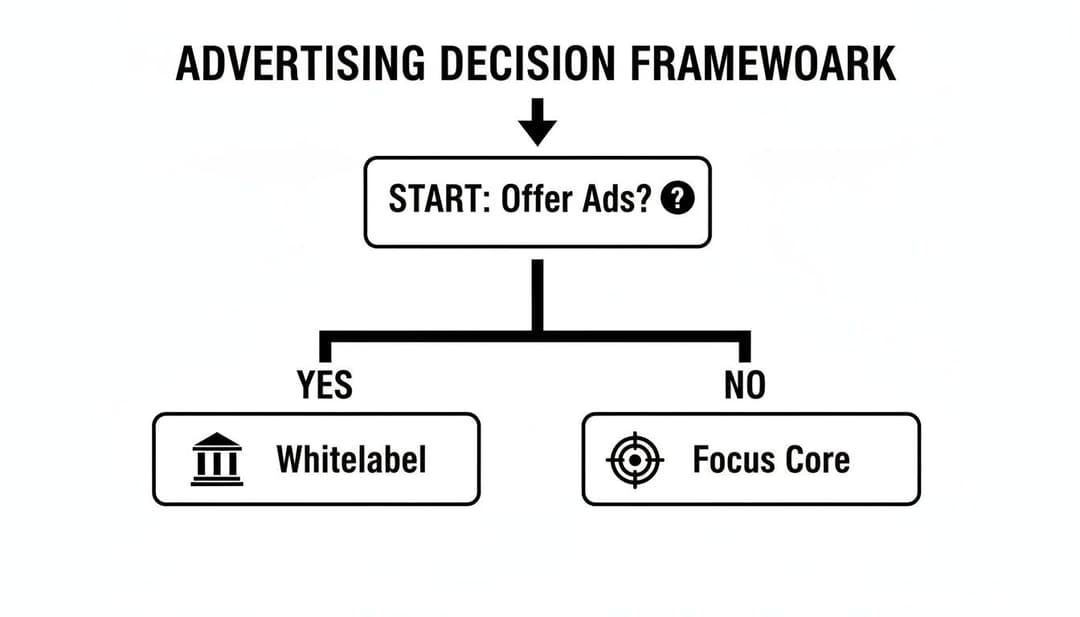
The biggest takeaway here is that saying "no" to offering ads can be just as strategic as saying "yes." It allows an agency to go deeper on what it’s already great at. Whether you go with a flat retainer, a project fee, or a cut of ad spend, the right model is the one that sets your agency up for success today and tomorrow.
Building Your High-Efficiency Tech Stack
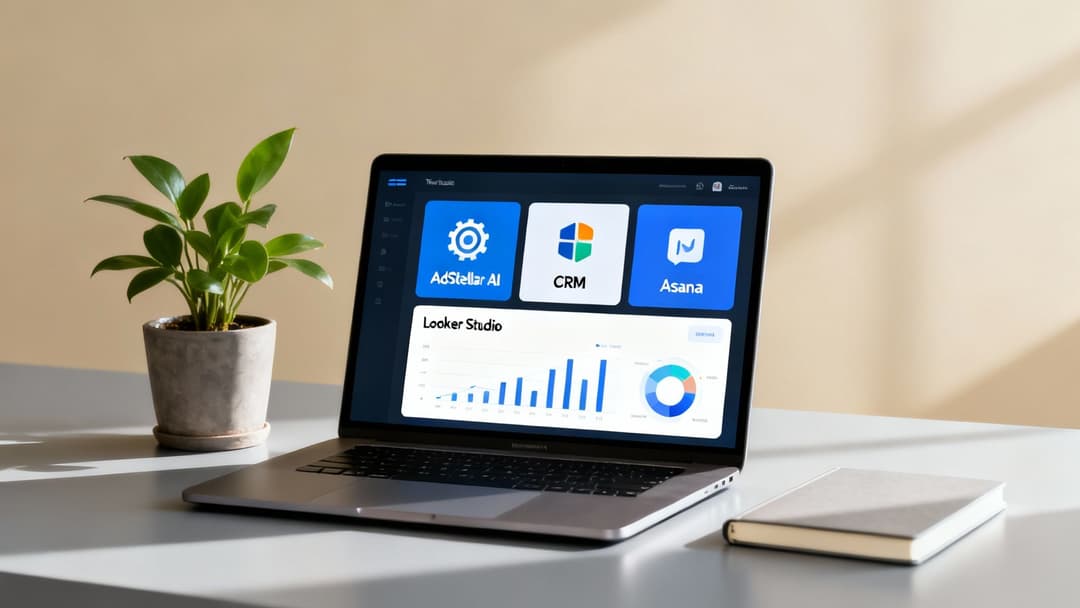
Running a successful white‑label Facebook ads service isn't about throwing more people at the problem. It's about building a smarter operational engine. A modern, scalable agency runs on a slick tech stack that handles the repetitive grunt work, keeps projects on track, and delivers crystal-clear results to clients.
Get the tools right, and you'll break the old link between headcount and revenue. Suddenly, you can manage a bigger client roster with a smaller, more focused team.
The Cornerstone: An AI Ad Platform
At the heart of this engine is a powerful, AI-driven platform for managing campaigns. This is the non-negotiable piece that swaps hours of tedious manual work for intelligent automation. Without it, you're stuck building campaigns one by one, which is a surefire way to cap your agency's growth.
This is exactly why platforms like AdStellar AI are so critical. They're built to automate the most time-sucking parts of Facebook advertising—from bulk ad creation and audience testing to optimizing your creatives on the fly. This frees up your team to focus on high-level strategy, which is what clients are really paying for.
Imagine your client needs 100 unique ad variations for a new campaign. Doing that by hand means endless hours of duplicating ad sets, swapping images, and tweaking headlines. With an AI platform, you can spin up hundreds of creative, copy, and audience combos in minutes and launch them all with a single click.
But it's not just about moving faster; it's about getting better results. AI tools can rapidly test all those variations to find the winning combinations, giving you a data-backed edge that’s tough to beat. This cycle of rapid testing and optimization is what separates the top-tier agencies from everyone else. You can explore our guide on social media advertising software to see exactly how these tools operate.
The goal is to build a system where technology handles the sheer volume and complexity. This lets your human experts provide the strategic oversight and insights that create real value for clients. It’s how you deliver incredible results without burning out your team.
Essential Supporting Tools
While the ad platform is the engine, you still need the rest of the car to get anywhere. A well-oiled tech stack ensures that every part of your service—from client comms to project management—feels seamless and professional.
Here are the other key pieces you'll need for a high-efficiency stack:
- Client Relationship Management (CRM): A tool like HubSpot is your command center for client relationships. It keeps all your communication in one place, tracks your sales pipeline, and makes sure no lead or client email ever gets lost in the shuffle.
- Project Management System: Platforms like Asana or Trello are essential for keeping your internal workflows from descending into chaos. They give everyone a clear view of tasks, deadlines, and who's responsible for what, ensuring every client campaign stays on track.
- Reporting and Analytics Dashboard: You have to prove your value, and that means delivering transparent, professional reports. A platform like Looker Studio lets you build custom, branded dashboards that pull data straight from your campaigns, showcasing your results with clear, easy-to-digest visuals.
Integrating for Profitability
When these tools are all talking to each other, you create a seriously profitable machine. Your CRM hands off a new client to your project management tool, which kicks off a workflow. Your team then uses the AI ad platform to launch the campaigns. Finally, all that performance data flows into your reporting dashboard, which you use to circle back and wow the client.
This integrated system keeps client results front and center. Take Return on Ad Spend (ROAS), for example—it’s the metric that separates profitable campaigns from money pits. The average Facebook ROAS is around 2.79, but a healthy target to shoot for is between 3–5. As a rule of thumb, a ROAS below 2 often means the campaign isn't profitable once you factor in all your costs. Your tech stack should make tracking and optimizing for this number practically effortless.
Proving Your Value with Data-Driven Insights
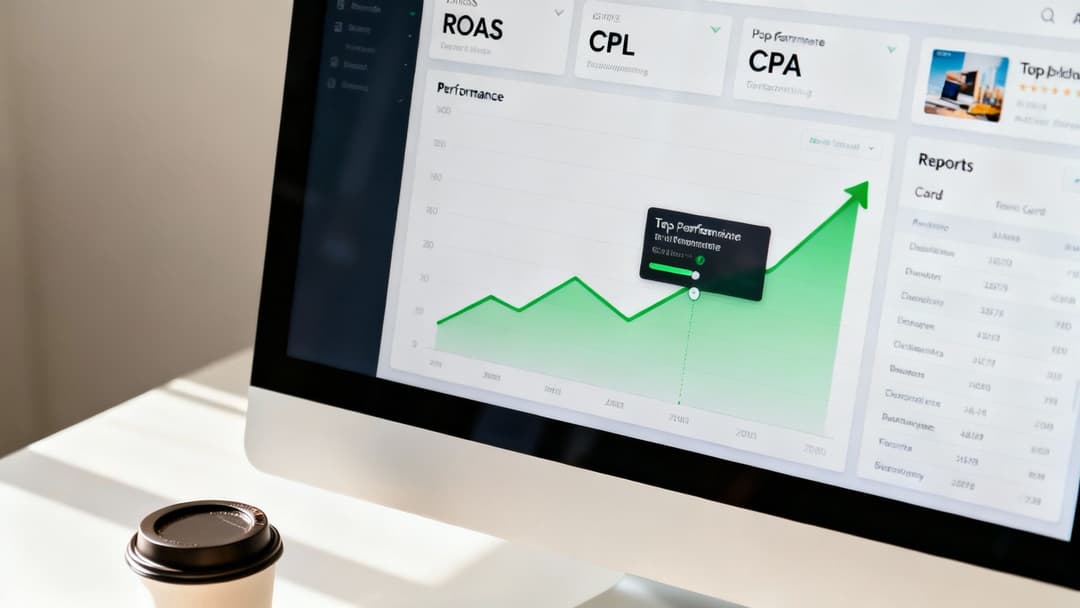
Let's be honest: client relationships are won and lost in the performance report. When you're offering whitelabel Facebook ads, your ability to show undeniable value is what turns a one-off project into a long-term, profitable partnership. It’s all about building trust through transparency and shifting the conversation from what you’re doing to the results you’re delivering.
This means you have to get past the surface-level vanity metrics like likes and impressions. Sure, they indicate activity, but they don't pay your client's bills. Your reports need to tell a compelling story about how your work directly impacts their bottom line.
Focusing on What Truly Matters
Your reporting narrative has to revolve around the metrics that connect ad spend to actual business growth. This is how you prove your agency's worth and justify your fees, month after month.
The three most critical KPIs to master are:
- Return on Ad Spend (ROAS): This is the ultimate measure of profitability. For every single dollar the client puts into ads, how much revenue are they getting back? A strong ROAS is the clearest signal of a winning campaign. Learn more about how to calculate ROAS.
- Cost Per Lead (CPL): For any service-based business or B2B client, this metric is king. It tells you exactly how much it costs to generate a new, qualified prospect, giving them a clear picture of their lead generation efficiency.
- Cost Per Acquisition (CPA): This is the go-to metric for e-commerce and direct-sale businesses. It measures the total cost to land a paying customer, leaving no doubt about campaign profitability.
These are the metrics that transform your reporting from a simple data dump into a strategic conversation. Agencies have to get really good at proving their value with solid, data-driven insights, pulling in comprehensive sales insights to sharpen strategies and showcase results.
Setting Realistic Expectations with Data
A huge part of this process is setting clear, realistic expectations right from the start. The Facebook advertising world sees some wild cost swings, so it's vital to educate clients on industry benchmarks.
Right now, the average cost-per-click (CPC) is around $0.51, while the average cost-per-thousand-impressions (CPM) is about $8.77. But these numbers can change in a heartbeat. For instance, feed ads often have a much higher CPC of $3.35 compared to story ads at $1.83, which just reflects different user engagement patterns.
By grounding your performance goals in real-world data, you build credibility and head off misunderstandings down the road. It shows clients you're a strategic partner, not just someone taking orders.
Leveraging AI for Smarter Insights
Manually sifting through ad data to find winning patterns is a massive time sink. This is where AI-powered tools like AdStellar AI’s 'AI Insights' feature become an absolute game-changer. The platform automates this whole process, surfacing the top-performing ads, audiences, and copy based on the KPIs you actually care about.
This lets your team act decisively. Instead of guessing, you get clear, data-backed recommendations on where to move the budget. You can instantly double down on what’s working and cut the campaigns that are wasting money, directly boosting your client's ROI. This capability turns your reporting meetings into a showcase of proactive, intelligent optimization.
Capitalizing on High-Impact Formats Like Reels
In digital advertising, the line between average results and becoming a client's secret weapon is drawn by how well you ride the latest platform waves. When you're running whitelabel Facebook ads, mastering the formats that grab the most eyeballs isn't just a good idea—it's everything. And right now, nothing dominates the screen quite like Facebook Reels.
Reels have completely rewired how people consume content, and the ad world has scrambled to keep up. Just look at the numbers. Advertising pulls in about 97.5% of Meta's total revenue. In that massive ocean of ads, Reels have become an absolute powerhouse, now accounting for 25–45% of total Meta impressions for advertisers running a full suite of placements. You can dig into more stats like these over at ElectroIQ.com.
This shift is a golden opportunity for your agency. Reels consistently pull in better engagement, more organic eyeballs, and a much friendlier Cost Per Mille (CPM) than old-school feed posts. For your clients, it’s simple: their message gets in front of way more people for a lot less cash.
Crafting Reels-Optimized Ad Creative
A lot of your clients won't have a slick library of video content ready to go. Don't let that stop you. The best Reels ads rarely have Hollywood-level production. In fact, raw, authentic-looking content usually crushes the polished stuff. The trick is to create for the Reels environment, not just drop a standard ad into it.
Stick to these simple rules:
- Win the First Three Seconds: Your window to stop the scroll is tiny. Hit them with a powerful visual hook, a bold on-screen question, or an unexpected movement right from the jump.
- Keep it Moving: Use quick cuts, dynamic transitions, and constant on-screen motion to keep their attention locked. Even a static image can be brought to life with animated text or simple zoom effects.
- Use Big, Bold Text: Most people watch with the sound off. Your message has to land visually. Use large, easy-to-read text overlays to communicate the core offer and tell them exactly what to do next.
Getting the technical specs right is also a big deal. For a full breakdown, check out our guide on the correct Facebook ad video size to make sure everything looks perfect.
Scaling Reels with AI
This is where your white-label service goes from being helpful to indispensable. Trying to manually create and test a dozen different Reels variations is a soul-crushing time-suck. This is where an AI platform like AdStellar AI completely flips the script.
Instead of just guessing what works, AI lets your agency scientifically find the winning formula. You can generate and test hundreds of Reels variations—different hooks, calls-to-action, music, and visuals—to see exactly what makes the audience tick. It's the ultimate shift from creative guesswork to data-driven precision.
Forget about your team spending hours buried in a video editor. With AdStellar, they can pump out multiple ad concepts in minutes. The platform launches all these variations, crunches the performance data in real time, and tells you exactly which ads are bringing in the best results for your clients. This lets you shift budget to the winners on the fly, making your clients’ ad spend work harder and proving your worth as a true strategic partner.
Setting Up Your Legal and Branding Framework
When you’re running a white-label service, your success hinges on more than just killer ad results. It’s built on a rock-solid foundation of clear agreements and invisible, behind-the-scenes execution. This is the framework that protects your agency, gives your clients total confidence, and turns a good partnership into a great one.
Getting these operational details right from the start isn’t just about ticking boxes. It’s about setting crystal-clear expectations to prevent misunderstandings and scope creep down the road. Think of it as your first line of defense against client disputes and your best tool for building long-term trust.
Nailing the Service Level Agreement
Your Service Level Agreement (SLA) is the official rulebook for the partnership. It’s the document that spells out every single detail of your white-label Facebook ads service, making sure you and your client are on the exact same page. It’s the blueprint for a successful relationship.
A bulletproof SLA needs to be unambiguous on a few key points:
- Scope of Work: What’s included and, just as importantly, what’s not? Spell out if your service covers ad creative, copywriting, and landing page optimization, or if it’s strictly campaign management. Specificity here prevents those awkward “can you just…” requests later.
- Communication Protocols: How and when will you talk? Are there weekly calls? Monthly email reports? Who are the main points of contact? Defining these boundaries manages expectations and, frankly, protects your team’s time.
- Performance Expectations: Lay out the key performance indicators (KPIs) you’ll be tracking and reporting on. You can’t guarantee a specific ROAS—and you shouldn’t—but you can commit to professional management and totally transparent reporting.
- Response Times: Define your agency’s commitment to answering emails or urgent messages. A common professional standard is a guaranteed response within 24 business hours.
An effective SLA isn't for when things are going great; it’s for when things go wrong. It gives both parties a clear, pre-agreed path to a solution, protecting the relationship when it matters most.
Protecting Confidentiality and Access
Beyond the SLA, a couple of other documents are non-negotiable for building security and trust. A Non-Disclosure Agreement (NDA) is standard practice and should be one of the first things signed. It ensures any sensitive business information your client shares with you stays completely confidential. This simple step provides huge peace of mind.
Just as critical is how you handle account access. Best practice is to have the client grant your agency partner-level access to their own Meta Business Manager. This is the most secure and professional way to operate, and it ensures the client always maintains ultimate ownership over their ad account and all its data.
Ensuring Flawless Agency Branding
Finally, every single thing the client sees has to look and feel like it came from your agency. In a true white-label relationship, your fulfillment partner is a ghost. That means every touchpoint—from the initial proposal and contract to the weekly updates and monthly performance dashboards—must carry your logo, your colors, and your agency’s voice.
This consistency reinforces the client’s belief that you are the expert running the show. It builds your brand equity and makes your agency look bigger and more capable than it might be. A perfectly executed branding strategy makes the entire client experience feel seamless, professional, and 100% your own.
Still Have Questions About Whitelabel Ad Services?
Jumping into something new like whitelabel Facebook ads is bound to bring up some questions. It's totally normal. You're probably wondering about pricing, who really owns the client relationship, and if the quality can actually stack up.
Getting these things straight is the last step before you can confidently start offering a new, scalable ad service that your clients will love. Let’s tackle the big questions head-on.
How Should I Price My Whitelabel Ad Services?
Nailing your pricing is obviously critical. There isn't one magic number, but most agencies find success with one of three battle-tested models. The trick is to know what your partner is charging you, add a healthy margin for your own team's time and client management, and make sure the final price feels like a steal for the value you're delivering.
Here are the most common ways to structure your pricing:
- Flat Monthly Retainer: This is great for predictable revenue. Your agency knows what’s coming in, and the client has a fixed cost they can budget for. Simple and clean.
- Percentage of Ad Spend: This is a classic for a reason. Usually somewhere between 15-20%, this model directly ties your fees to the client's investment. As they grow and spend more, you earn more.
- Hybrid Fee: A nice middle ground. This combines a smaller flat retainer to cover your base costs with a lower percentage of ad spend, giving you stability plus a performance incentive.
Whichever path you take, just make sure your final price accounts for both the hard cost from your provider and the soft costs of your own time.
Who Truly Owns the Client and Ad Account?
This one is non-negotiable, so let's be crystal clear. In any whitelabel setup, your agency must always own the client relationship. Period. You're their strategic guide, their main point of contact, and the face of the results. Your provider should be a ghost—completely invisible to your client.
As for the ad account, the gold standard is to have the client grant your agency partner-level access to their own Meta Business Manager. This is the smartest way to do it for a few reasons.
First, the client keeps total ownership of their data and assets, which they'll appreciate. Second, it gives your agency all the permissions you need to run campaigns like a pro. And finally, it makes everything portable. If you ever decide to switch providers, you won't lose a single byte of that valuable historical data.
Can a Whitelabel Service Match In-House Quality?
Absolutely, but it all comes down to doing your homework. The quality isn't automatically lower just because it's outsourced; it’s simply tapping into a different source of expertise. A fantastic partner can run circles around a brand-new internal team.
The key is to demand proof. When you're talking to a potential provider, ask to see their case studies. Better yet, ask if you can chat with one of their current agency partners to get the real, unfiltered story on their performance and how reliable they are.
The same rule applies if you're looking at a tech-driven solution. A platform like AdStellar AI should use the client's own historical ad data to fuel its automated decisions. This ensures every recommendation is based on what's already proven to work for that specific account, not some generic template. That's what turns an automated service into a genuine strategic advantage.
Ready to scale your agency's ad services with unmatched efficiency and control? AdStellar AI is the AI-powered platform that lets your team launch, test, and optimize Meta campaigns 10x faster. Automate your ad management and deliver superior results for your clients.