Finding the right artificial intelligence marketing companies can feel overwhelming. The market is saturated with platforms all claiming to automate campaigns, optimize audiences, and generate winning ad creative. Sifting through marketing jargon to identify the tools that actually solve your specific problems-like scaling Meta Ads without ballooning your ad spend or breaking through creative fatigue-is a significant challenge for performance marketers and agencies.
This curated list cuts through the noise. We've compiled a detailed resource focusing on the top AI marketing platforms that deliver tangible results. Whether you're a B2B SaaS marketer focused on acquisition or an e-commerce brand looking to maximize ROAS, this guide will help you pinpoint the best solution for your needs.
Inside, you will find a thorough analysis of 12 leading companies, including Jasper, Smartly.io, AdCreative.ai, and Mutiny. Each review covers:
- Core AI Capabilities: What the platform actually does (e.g., creative automation, budget optimization, audience segmentation).
- Best-Use Cases: Scenarios where the tool excels for performance marketing teams.
- Pricing & Integration: An honest look at costs and how well it connects with platforms like Meta Ads.
- Pros & Cons: A balanced assessment based on real-world application, not marketing fluff.
As you explore these tools, it's worth noting the advancements in adjacent technologies. For instance, many of the top AI video generators are fundamentally changing how marketers produce content for platforms like YouTube, complementing the ad management solutions we cover here. This guide provides direct links, screenshots, and a comparison table to help you make an informed decision quickly and confidently. Let's get started.
1. AdStellar AI
AdStellar AI presents a powerful, end-to-end solution for teams looking to accelerate their Meta advertising performance. Positioned as one of the most focused artificial intelligence marketing companies available, it’s purpose-built to automate the high-volume, repetitive tasks involved in launching, testing, and scaling campaigns on Facebook and Instagram. Its core value is speed and data-driven decision-making, allowing performance marketers to compress testing cycles that would normally take weeks into just a few days.
The platform connects directly to your Meta Ads Manager via a secure OAuth connection, ingesting historical performance data to establish a baseline. From there, its automation modules take over. Teams can upload creative assets and copy frameworks to generate hundreds of ad variations across different audiences in minutes, then deploy them with a single click. This bulk creation and launch capability is a significant advantage for agencies managing multiple clients or e-commerce brands needing to test product-market fit rapidly. For those wanting to dig deeper into its mechanics, AdStellar offers a detailed guide on how their AI for ads technology works.
Key Features & Use Cases
- Bulk Ad Creation & Deployment: This is AdStellar’s standout feature. A practical use case involves a DTC brand uploading 10 images, 5 headlines, and 5 primary text variations. The platform can generate all possible combinations and pair them with predefined audiences, creating hundreds of ads ready for a massive A/B test almost instantly.
- AI Insights & Performance Ranking: After launch, the system analyzes incoming data and ranks creatives, copy, and audiences against your primary KPI, such as ROAS, CPA, or CPL. This moves teams away from guesswork and toward data-backed budget allocation.
- Automated Campaign Building & Scaling: The "AI Launch" feature builds new campaigns using only top-performing components from previous tests. Furthermore, its models identify emerging winners and can automatically scale spend, reducing manual oversight.
- Centralized Workflow: The platform includes dedicated modules for campaigns, creatives, and audiences, along with a searchable media library. This creates a unified workspace, which is particularly useful for agencies needing to maintain organization across different client ad accounts.
Pricing and Access
AdStellar AI does not list pricing publicly. Access to the platform and detailed plan information is available by requesting a demo through their website. This approach suggests a focus on tailored solutions for mid-market to enterprise-level clients or agencies with significant ad spend.
Pros & Cons
| Pros | Cons |
|---|---|
| Massive Speed & Scale: Generate and launch hundreds of ad variations in minutes, dramatically accelerating testing. | Meta-Centric: The platform is built exclusively for the Meta ecosystem (Facebook & Instagram), requiring other tools for cross-channel campaigns. |
| Data-Driven Optimization: AI ranks all ad components by performance metrics (ROAS, CPL), helping you allocate budget effectively. | Requires Existing Data: Maximum effectiveness depends on historical performance data; new ad accounts may see a longer ramp-up period. |
| End-to-End Automation: Features like one-click campaign launch and auto-scaling reduce manual work and the potential for human error. | |
| Centralized Workflow: A unified interface for campaigns, creatives, and audiences improves team collaboration, especially for agencies. |
2. Smartly.io
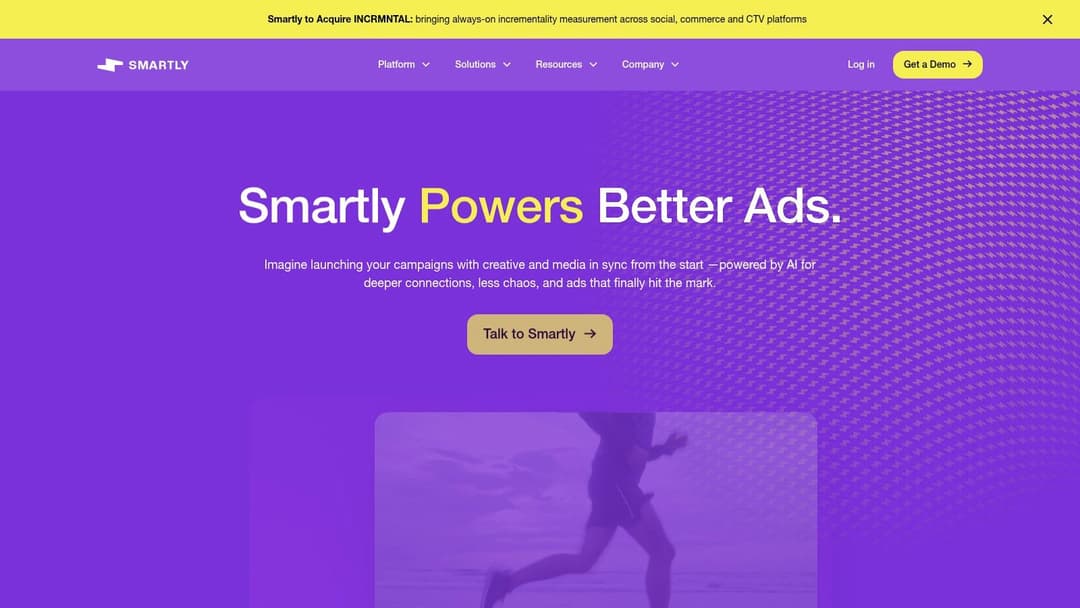
Smartly.io is a specialized creative and media automation platform built for large-scale advertisers on paid social, display, and retail media channels. It's the go-to choice for brands and agencies that find the native tools on platforms like Meta, TikTok, and Snap insufficient for their complex workflows, high-volume creative needs, and cross-channel campaign management. This platform excels at orchestrating large, intricate advertising operations with precision.
Core AI Capabilities & Use Cases
The platform's strength lies in its automation features, which are critical for scaling performance. Its creative automation tools allow teams to produce thousands of ad variations from a single template by pulling data from product feeds or other sources. This is a game-changer for e-commerce brands with extensive catalogs running dynamic retargeting (DR) campaigns.
Another key area is its cross-channel optimization. The system analyzes performance data across networks to reallocate budgets and refine targeting, moving beyond single-platform optimization. Many of the best artificial intelligence marketing companies focus on a single channel, but Smartly.io provides a more unified view.
Best Use Case: An enterprise e-commerce brand with a catalog of over 10,000 SKUs using Smartly.io to automatically generate and test localized ad creatives for 20 different global markets across Meta, Pinterest, and Snap, all managed from a single dashboard.
Pricing, Pros & Cons
- Pricing: Smartly.io uses enterprise-oriented pricing, typically a percentage of ad spend. This model requires a significant media budget, making it less accessible for smaller businesses. Implementation and training services may also represent an additional cost.
- Pros: It is proven at an enterprise scale for managing complex team structures and workflows. The platform also features deep integrations with major paid social channels and is expanding its retail media network support.
- Cons: The pricing structure is a barrier for companies without substantial ad spend. The total cost of ownership can be higher when you factor in the necessary implementation and team training.
For those evaluating how such systems fit into a broader strategy, you can get more details on the functionality of an AI-powered marketing platform to understand the core components.
Website: https://smartly.io
3. Skai (formerly Kenshoo)
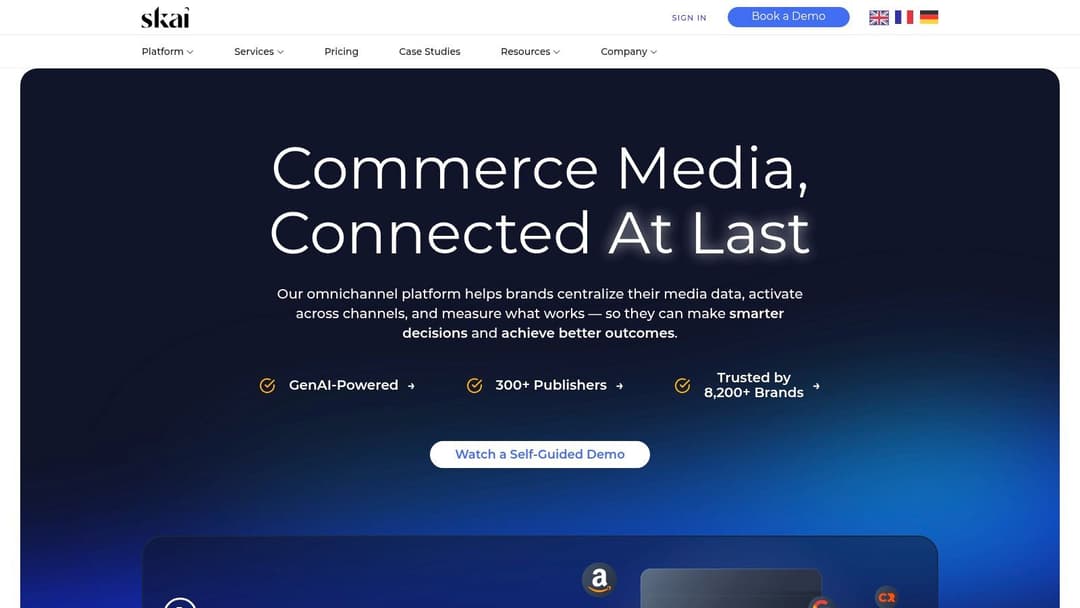
Skai, formerly known as Kenshoo, is an omnichannel advertising platform designed for managing search, social, retail media, and app campaigns from a central hub. It serves as a single system of record for large teams needing strong budgeting, forecasting, and advanced optimization that goes beyond what native channel tools offer. Its main strength is unifying disparate channels into a single, coherent strategy.
Core AI Capabilities & Use Cases
Skai's AI focuses on cross-channel planning and bid optimization. Its unified platform allows advertisers to set budgets and pacing goals across Google, Meta, and Amazon, with the system making real-time adjustments to hit targets. The AI-driven bidding algorithms and bulk editing features are critical for managing large-scale campaigns efficiently.
The platform provides full-funnel visibility by integrating retail media data with traditional search and social performance. This allows for more accurate measurement and incrementality testing, helping marketers understand the true impact of their ad spend. Many artificial intelligence marketing companies specialize in one area, but Skai's value is in its broad, integrated approach.
Best Use Case: A large agency managing a multi-million dollar ad budget for a CPG brand across search, social, and multiple retail media networks. The agency uses Skai to automate budget allocation, pace spending daily, and run incrementality tests to prove the value of each channel.
Pricing, Pros & Cons
- Pricing: Skai typically uses a flat annual pricing model based on the program size and complexity. This offers predictable costs compared to the percentage-of-spend models common in the industry.
- Pros: The platform has mature, battle-tested workflows built for large advertisers and agencies. Its flat pricing structure is a significant advantage for budget planning at scale.
- Cons: The system's best value is realized at higher spend levels and with greater campaign complexity; it can be overwhelming for small teams. Unlocking its full benefit requires dedicated onboarding and training.
Website: https://skai.io
4. Madgicx
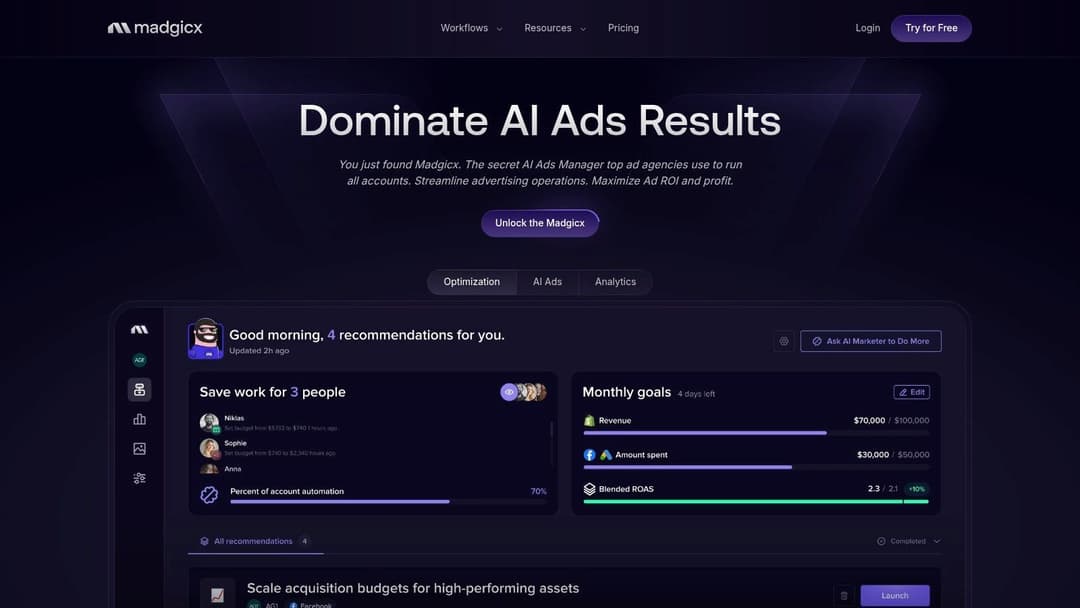
Madgicx is an AI-assisted platform designed for advertisers who heavily rely on Meta and, increasingly, Google Ads. It serves e-commerce teams and agencies that require automated optimization and built-in creative insights without the cost or complexity of developing custom tools. The platform acts as an intelligent layer on top of native ad managers, focused on simplifying workflows and surfacing performance-driving actions.
Core AI Capabilities & Use Cases
The platform's standout feature is its AI “media buyer” automation, which manages campaign budgets and bidding strategies based on predefined rules and performance targets. This allows teams to scale campaigns with less manual intervention. Its creative intelligence tools are also a core component, scoring ad creatives and providing suggestions for improvement based on historical performance data.
Madgicx also provides frameworks for audience and budget automation, enabling structured testing to identify top-performing segments and allocate spend effectively. This makes it one of the more accessible artificial intelligence marketing companies for teams needing quick, actionable insights directly within their campaign management flow.
Best Use Case: A mid-sized e-commerce brand using Madgicx to automate its Meta Ads budget allocation, identify winning ad creatives through its AI scoring system, and launch new audience tests with just a few clicks from a unified dashboard.
Pricing, Pros & Cons
- Pricing: Madgicx offers tiered subscription plans based on monthly ad spend, starting from around $49/month for smaller budgets and scaling up. It includes a free trial, but some users have noted a need to carefully review billing terms to avoid unexpected charges.
- Pros: The setup is fast and intuitive, especially for teams already centered on Meta advertising. Its rich creative analytics are integrated directly into the workflow, making it easy to connect creative performance with business results.
- Cons: The platform's value is most apparent for advertisers with a heavy Meta focus; its Google Ads features are less mature. Potential users should be diligent in understanding the trial and subscription terms before committing.
For a deeper dive into how AI applies specifically to this channel, explore our guide on Facebook Ads artificial intelligence to see how these tools work in practice.
Website: https://madgicx.com
5. Trapica
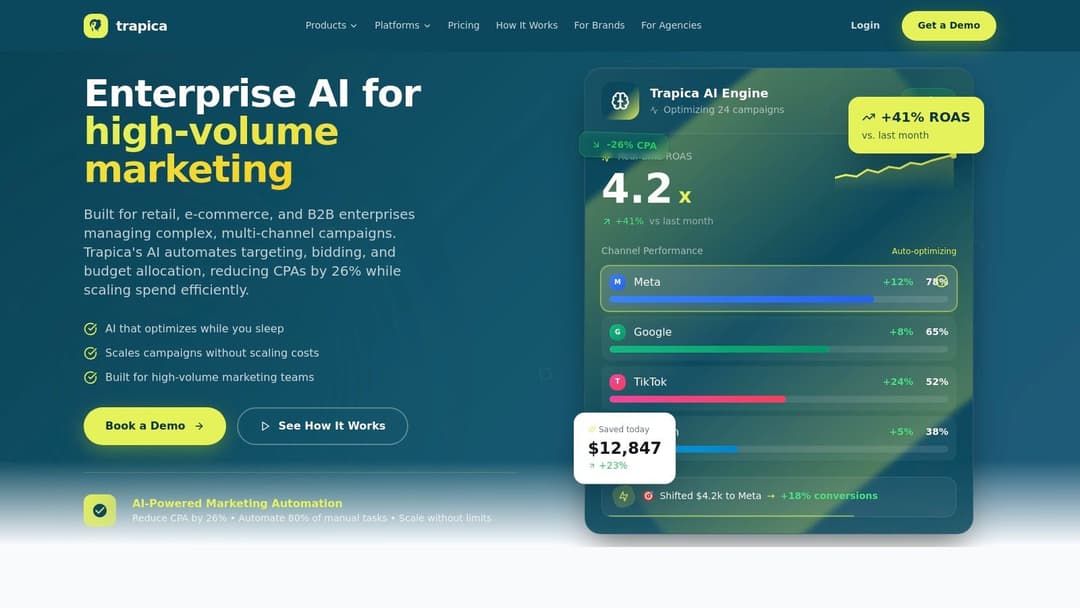
Trapica presents itself as an autonomous optimization platform designed to act as an autopilot for performance marketing teams. It focuses on cross-channel campaign management, automatically adjusting targeting, budgets, and creatives across major platforms like Meta, Google, and TikTok. The platform is built for teams that want AI-driven optimization but still require transparency and the ability to maintain strategic control over their campaigns.
Core AI Capabilities & Use Cases
Trapica's main function is its autonomous campaign optimization engine. It analyzes real-time data to identify underperforming audiences and creatives, reallocating budget to the top-performing combinations. A key feature is its predictive audience generation, where the AI models lookalike segments based on conversion data, aiming to find new customer pools before audience fatigue sets in.
The system also provides creative performance insights by analyzing visual elements, copy, and calls-to-action to recommend which components drive the best results. This allows creative teams to iterate based on data rather than just intuition. Many artificial intelligence marketing companies offer single-channel tools, but Trapica's value comes from its ability to unify these functions across different ad networks.
Best Use Case: A B2C subscription brand uses Trapica to manage a $300k monthly budget across Meta and Google Search. The platform's AI automatically shifts spend from low-performing ad sets on Meta to high-converting keyword campaigns on Google, all while A/B testing new creative variations without manual intervention.
Pricing, Pros & Cons
- Pricing: Trapica is positioned for the enterprise market with pricing based on ad spend, similar to many platforms in this category. This model makes it a significant investment and generally inaccessible for small businesses or startups with limited media budgets.
- Pros: It provides true cross-channel budget and targeting automation from a single interface. The platform offers transparent controls and reporting, which is a major benefit for enterprise teams needing governance and oversight.
- Cons: The enterprise-level pricing is a primary barrier to entry. For the AI to function effectively, it demands clean, consistent data and disciplined campaign structures, which can be a challenge for teams with messy ad accounts.
Website: https://www.trapica.com
6. Quantcast Platform
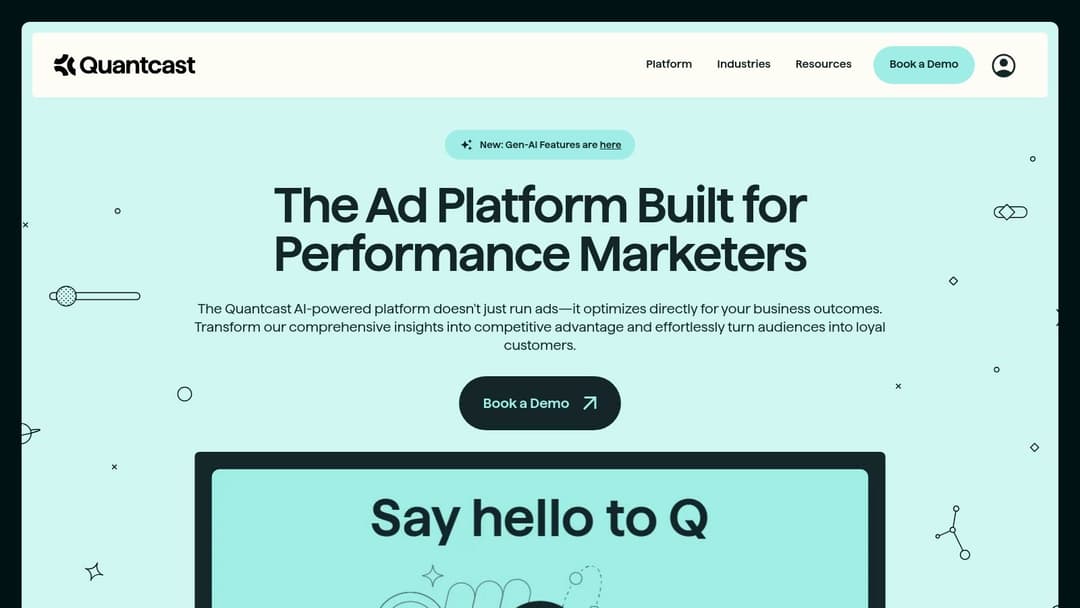
The Quantcast Platform is an AI-driven advertising solution focused on planning, activating, and measuring campaigns across the open internet. It's built for performance and prospecting, using real-time audience modeling to find and influence potential customers. The platform provides a unified workflow, making it a strong choice for advertisers looking to move beyond walled gardens and tap into broader web audiences with programmatic display.
Core AI Capabilities & Use Cases
Quantcast's core strength is its proprietary live data set, which powers its predictive audience modeling. The system analyzes real-time behavioral signals across the web to identify and build custom audience segments most likely to convert. This differs from static segment-based targeting by continuously adapting to user behavior. Its intelligent bid management also adjusts in real-time to secure impressions efficiently.
The platform's integrated nature is a key differentiator. Marketers can move from audience planning and forecasting to campaign activation and measurement without leaving the system. This closed-loop approach provides clearer attribution and faster insights, which is why it is often considered among the top artificial intelligence marketing companies for open-web advertising.
Best Use Case: A direct-to-consumer brand aiming to acquire new customers outside of major social platforms. The team uses Quantcast to identify lookalike audiences based on their existing customer data and launches a programmatic display campaign to reach them across a network of publisher sites, with real-time measurement tracking new conversions.
Pricing, Pros & Cons
- Pricing: Quantcast offers clear pricing with transparent platform and media fees, which can be a mix of CPM and other performance models. It is available through both managed service (with minimum spend requirements) and a self-serve platform.
- Pros: The system is built on a large-scale, real-time behavioral data foundation, offering superior prospecting capabilities. It also provides both self-serve flexibility and managed execution options to suit different team needs.
- Cons: It is best suited for teams with meaningful budgets dedicated to open-web advertising. While powerful, some advanced planning and measurement features have a learning curve and require proper setup to maximize their value.
Website: https://www.quantcast.com
7. Persado
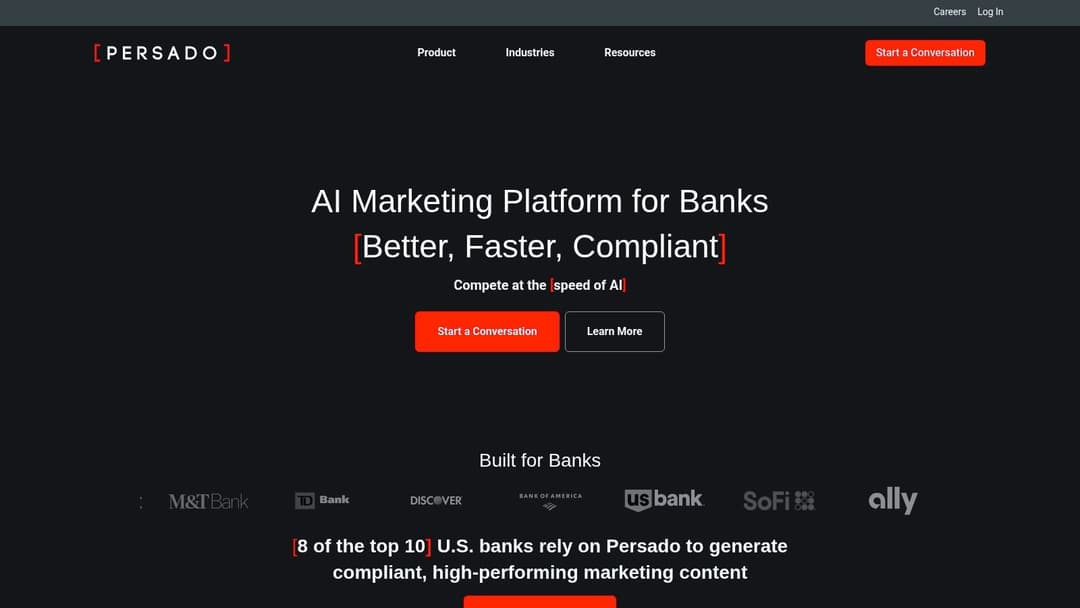
Persado positions itself as a "Motivation AI" platform, moving beyond simple copy generation to focus on the language that drives customer action. It specializes in generating and personalizing on-brand marketing language for high-stakes channels like email, web, and app notifications. The platform is particularly effective for enterprise clients in regulated industries such as financial services and healthcare, where both performance and compliance are paramount.
Core AI Capabilities & Use Cases
Persado's core technology uses multiple AI agents that work together to optimize language for performance, brand voice, and regulatory constraints. It draws on domain-specific language models trained on massive enterprise datasets, giving it a deep understanding of what messaging works for specific audiences and industries. The platform enables continuous experimentation and personalization at the individual message level, identifying the precise emotional and narrative triggers that lead to conversions.
Unlike general-purpose writing tools, Persado is one of the few artificial intelligence marketing companies built with enterprise-grade security and compliance at its core, holding certifications like ISO 27001 and SOC 2.
Best Use Case: A major retail bank using Persado to rewrite subject lines and body copy for a credit card acquisition email campaign. The platform generates variants that are pre-vetted for compliance while testing different emotional drivers, resulting in a measurable lift in open rates and application submissions.
Pricing, Pros & Cons
- Pricing: Persado operates on an enterprise contract model. Pricing is not publicly disclosed and is tailored to the scope of implementation, making it inaccessible for small businesses or teams without a significant budget.
- Pros: It has a track record of delivering documented performance gains for large, well-known brands. The enterprise-grade security and compliance features are a critical differentiator for corporations in sensitive sectors.
- Cons: The platform is designed for enterprise-level commitment and is not a self-service tool for small teams. To realize its full potential, it requires technical integration with a company's existing CRM or customer journey orchestration stack.
Website: https://www.persado.com
8. Phrasee
Phrasee is an AI language generation platform designed for enterprise marketers who need to produce high-performing, brand-safe copy at scale. It focuses specifically on short-form marketing messages for channels like email, push notifications, SMS, and social media ads. The platform's main differentiator is its ability to generate and optimize language while strictly adhering to a brand's specific voice, tone, and compliance guidelines, making it a trusted choice for regulated industries.
Core AI Capabilities & Use Cases
Phrasee's AI model is trained on real-world marketing performance data to understand what language drives engagement and conversions. It generates multiple copy variants for A/B testing and uses a predictive algorithm to score their likely performance before you even go live. Its language insights provide data on which words, phrases, and emotional tones resonate most with your audience, informing future creative strategy.
The platform also offers robust enterprise governance features. This allows marketing leaders to set and enforce brand safety rules, ensuring all generated copy is compliant and on-brand. This function is critical for large, distributed teams or agencies managing multiple client accounts.
Best Use Case: A large retail brand using Phrasee to generate hundreds of subject line and push notification variants for its weekly promotional campaigns. The system predicts the top performers, which are then split-tested, and the results feed back into the AI to continuously refine language for higher open and click-through rates.
Pricing, Pros & Cons
- Pricing: Phrasee operates on an enterprise-focused, quote-based pricing model. The cost is likely substantial, reflecting its deep integration capabilities and focus on large-scale operations. It is not suitable for small businesses or those with limited budgets.
- Pros: It provides a strong solution for high-volume CRM and retention marketing teams. The deep emphasis on brand-safe and compliant content generation is a major benefit for established brands. Among artificial intelligence marketing companies, its focus on language safety is a key distinction.
- Cons: The enterprise pricing model creates a high barrier to entry. To get the most value, it requires a disciplined testing program and the internal resources to act on the platform's insights.
Website: https://phrasee.co
9. Anyword
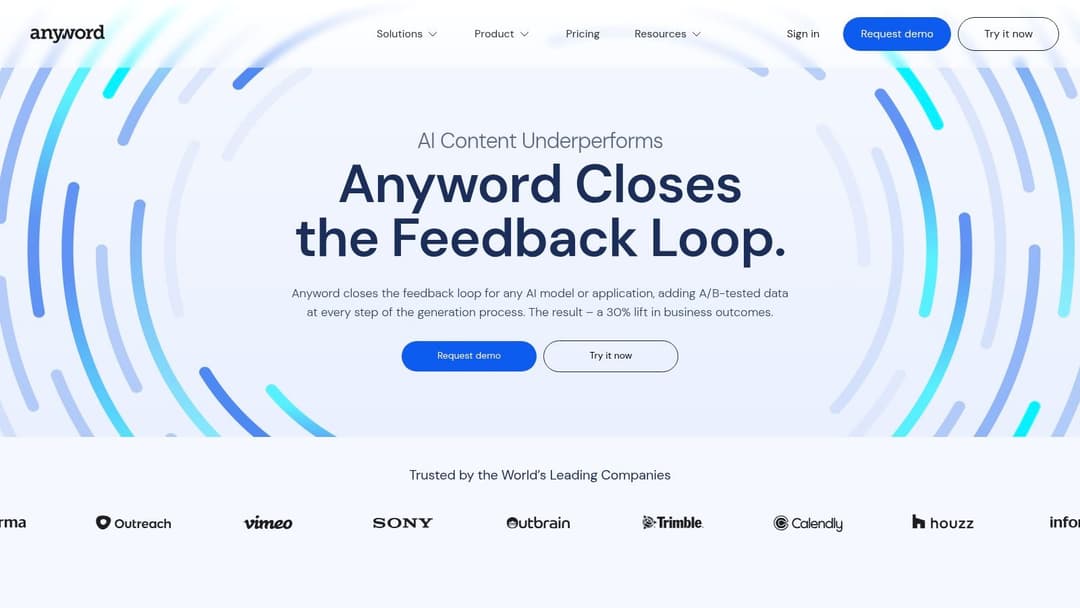
Anyword is a generative AI platform built for performance marketing teams that need to create and optimize copy at scale. It moves beyond simple text generation by adding a predictive performance layer, scoring ad copy, emails, and landing page headlines on their likelihood to convert. This makes it a practical tool for teams wanting to prioritize their creative testing and make data-informed decisions before spending a single dollar on ad campaigns.
Core AI Capabilities & Use Cases
The platform's main distinction is its Predictive Performance Score. This feature analyzes copy and assigns a score indicating its potential effectiveness for a specific audience and channel. It helps teams quickly filter out low-potential variants and focus A/B tests on copy with a higher probability of success.
Anyword also includes robust brand voice controls, allowing teams to upload style guides and examples to ensure all AI-generated content remains on-brand. This function, combined with team collaboration features and content safeguards, makes it a reliable choice for maintaining consistency across multiple writers and campaigns. Its browser extension allows for convenient copy generation directly within other marketing tools.
Best Use Case: A B2B SaaS growth team uses Anyword to generate 50 headline variations for a new Meta Ads campaign. They use the predictive scores to select the top 5 variants for their initial A/B test, reducing wasted ad spend on underperforming copy.
Pricing, Pros & Cons
- Pricing: Anyword offers transparent, self-serve pricing tiers, including a free trial and plans for individuals and teams. Paid tiers provide unlimited copy generation, with pricing scaling based on user seats and advanced features, making it accessible for businesses of various sizes.
- Pros: The predictive scoring system provides a clear, data-driven method for prioritizing copy variants before they go live. Its transparent pricing and free trial lower the barrier to entry for smaller teams.
- Cons: The performance predictions are directional and not a substitute for live A/B testing. The platform's focus is on copy, with very basic image and video generation capabilities compared to specialized creative AI tools.
Website: https://www.anyword.com
10. AdCreative.ai
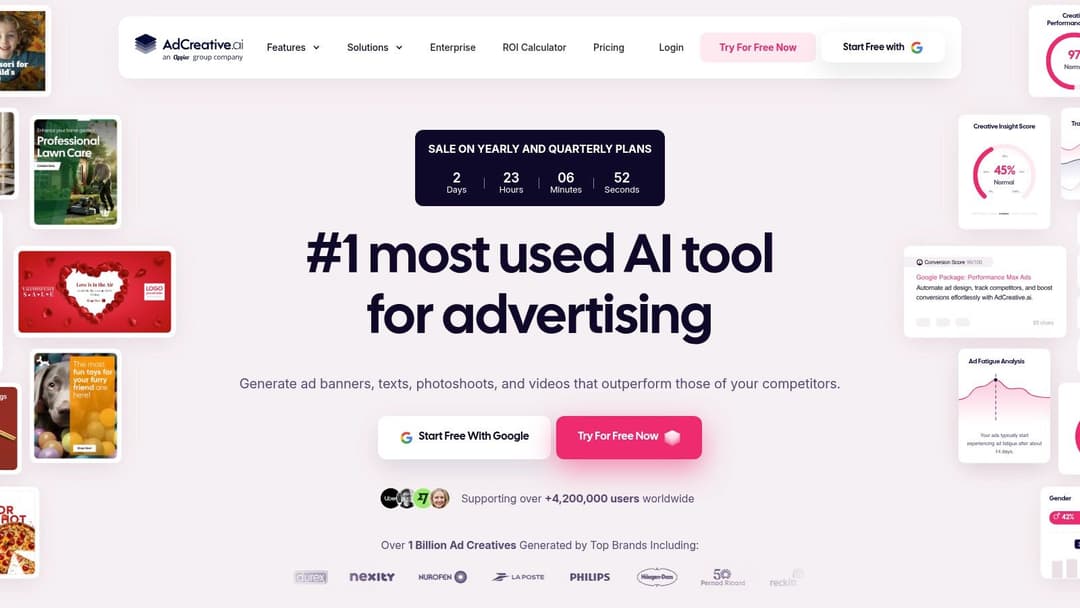
AdCreative.ai is a generative creative platform designed for speed and volume, enabling marketers to produce ad images and copy variants quickly. It is positioned for performance advertisers who need to accelerate testing on Meta, Google, and display networks by using templates and an AI-driven scoring system to predict creative effectiveness before launch. The platform focuses on rapid iteration, making it a practical tool for teams that prioritize high-volume creative output.
Core AI Capabilities & Use Cases
The core function is the rapid generation of ad assets. Users upload brand elements like logos and colors, and the AI produces hundreds of creative options tailored to different ad placements. This templated approach bypasses the need for extensive design work, allowing a single marketer to generate assets for multiple campaigns in minutes. Its performance scoring feature gives a predictive rank to each creative, helping prioritize which assets to test first.
While AdCreative.ai excels at generating compelling visuals, understanding how to effectively analyze Facebook ad creatives can further refine your strategy and competitive edge. The platform’s ability to produce variations at scale is most effective when paired with a strong analytical framework for interpreting test results.
Best Use Case: A growth-focused startup needs to test 20 different value propositions and visual angles for a new product on Meta Ads. Using AdCreative.ai, the marketing manager generates over 100 creative and copy combinations in under an hour, using the platform's scores to select the top 20% for an initial A/B test.
Pricing, Pros & Cons
- Pricing: AdCreative.ai operates on a credit-based subscription model. Credits are used to generate creatives, which can make the true cost variable for teams with high-volume needs. Plans are tiered based on the number of credits and user seats.
- Pros: It provides fast asset generation, ideal for volume testing and quick campaign launches. The entry cost is lower than many enterprise suites, making it accessible for smaller teams and agencies. The process is a great introduction to the benefits of dynamic creative optimization.
- Cons: The credit model can become unpredictable and costly at a larger scale. Multiple user reports cite frustrations with trial periods and billing practices, so it's critical to review the terms carefully before committing.
Website: https://www.adcreative.ai
11. Jasper
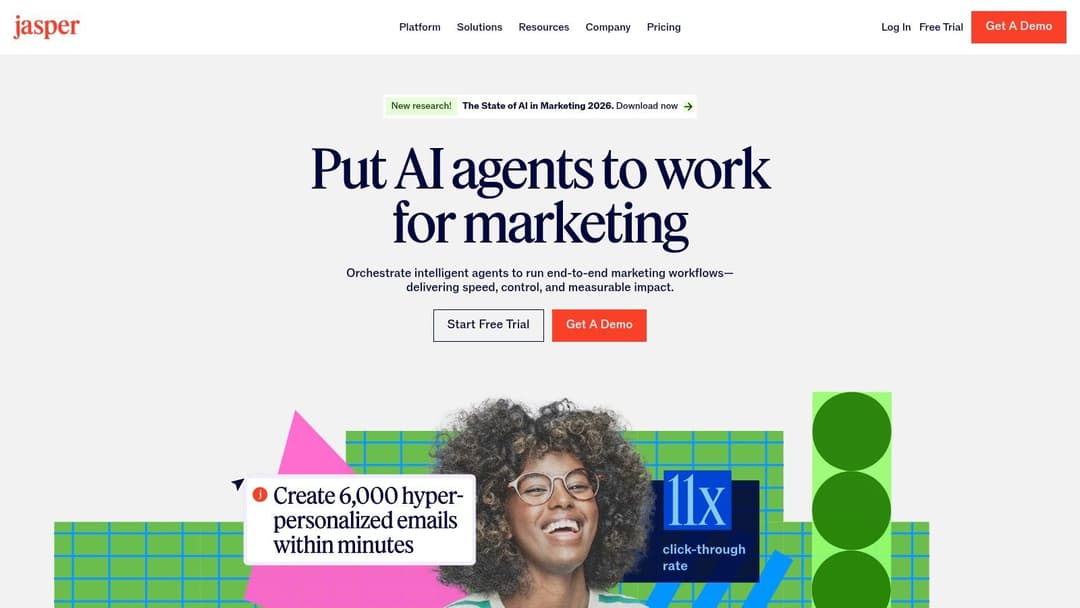
Jasper is a marketing-focused generative AI platform designed for teams that need to create high-quality, on-brand content at scale. It acts as a central content operating system for growth teams, providing tools to enforce brand voice, generate campaign assets, write briefs, and produce multi-format content with built-in collaboration and governance features. It moves beyond generic chatbot functions to offer a structured environment for marketing content production.
Core AI Capabilities & Use Cases
Jasper’s main strength is its ability to learn and apply a company's specific brand voice and style guides across all generated content. This ensures consistency whether the team is creating ad copy, emails, blog posts, or product marketing materials. The platform includes a library of templates for specific marketing tasks, accelerating the creation process for common assets.
Its collaboration features, including approval workflows and enterprise-level security on higher tiers, make it suitable for larger teams needing control and oversight. Unlike many raw LLMs, Jasper integrates directly into existing workflows through a browser extension and a document-style editor, making it a practical daily tool for marketers. As one of the more mature artificial intelligence marketing companies in the content space, it provides a very focused solution.
Best Use Case: A B2B SaaS marketing team uses Jasper to create a complete campaign, from initial ad copy variations for Meta and LinkedIn to a long-form blog post, a follow-up email sequence, and social media updates, all aligned with their established brand voice and approved through the platform’s workflow.
Pricing, Pros & Cons
- Pricing: Jasper offers several tiers, starting with self-serve plans for individuals and scaling up to enterprise-level pricing for large teams. The cost is higher than using a generic LLM API directly, but the value is in the workflow tools, brand controls, and collaboration features.
- Pros: The platform has mature marketing workflows and templates that go far beyond what a raw chatbot can offer. It provides clear tiering from self-serve to enterprise, making it accessible for various business sizes.
- Cons: Jasper is a content generation tool, not an ad-buying or optimization platform; you still need to use native platform bidding tools for campaign management. The price can be a factor if a team only needs basic text generation without the workflow controls.
For marketers evaluating content-specific AI, exploring some Copy.ai alternatives can provide context on different platforms in this category.
Website: https://www.jasper.ai
12. Mutiny
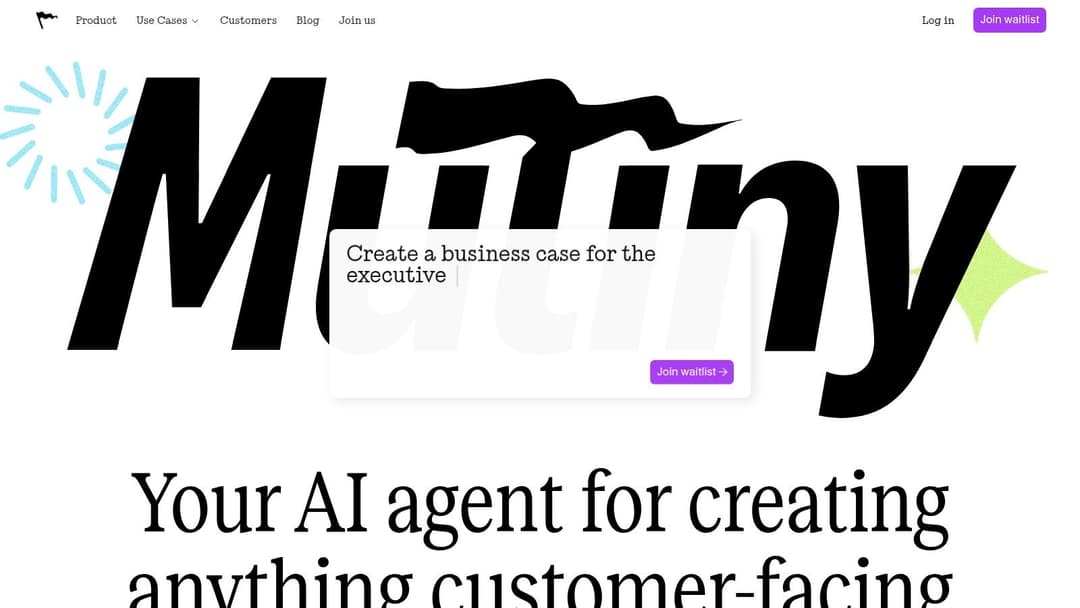
Mutiny is a website personalization and conversion rate optimization (CRO) platform that uses AI to improve the post-click experience. It’s designed for B2B and DTC teams looking to convert more of their hard-won paid traffic by tailoring on-site content to different visitor segments. The platform moves beyond generic landing pages, allowing marketers to dynamically alter headlines, copy, and calls-to-action based on the visitor’s firmographic data, traffic source, or on-site behavior.
Core AI Capabilities & Use Cases
Mutiny’s AI shines in its ability to identify high-value audience segments and recommend personalization “recipes.” It integrates with data sources like Salesforce and HubSpot to understand who is visiting your site. The system then suggests tested playbooks, such as changing a headline to match the industry of an account-based marketing (ABM) target or showing social proof relevant to a visitor's company size.
This no-code approach means marketing teams can launch A/B tests and personalization campaigns without engineering support. Its visual editor and clear reporting on conversion lift make it a practical tool for demonstrating ROI. Among artificial intelligence marketing companies, Mutiny is distinct for its focus on the post-click conversion journey.
Best Use Case: A B2B SaaS company running LinkedIn Ads can use Mutiny to automatically change the hero section of its homepage to reflect the industry of the visitor, showing relevant customer logos and case studies to increase demo requests from target accounts.
Pricing, Pros & Cons
- Pricing: Mutiny employs an enterprise-first model with custom contracts and no public pricing. The cost is based on factors like website traffic volume and the level of integration required, making it better suited for companies with a dedicated budget for conversion optimization.
- Pros: It is purpose-built to convert paid and ABM traffic, connecting ad spend directly to pipeline. The platform also offers a strong library of pre-built, tested personalization playbooks that accelerate time-to-value.
- Cons: The enterprise pricing and lack of transparency can be a hurdle for smaller businesses. To get a return on investment, a site needs sufficient traffic volume and clean data connections.
Website: https://www.mutinyhq.com
Top 12 AI Marketing Companies: Feature Comparison
| Product | Core focus & channels | Top features / UX | Best for | Value / Pricing & USP |
|---|---|---|---|---|
| AdStellar AI (Recommended) | Meta (Facebook & Instagram) ad automation | Bulk ad creation, AI Insights (ROAS/CPL/CPA), one-click launches, auto-scaling | Performance marketers, e‑commerce/DTC, agencies, B2B SaaS | 10× faster testing, data-driven scaling, demo/quote-based pricing |
| Smartly.io | High-volume creative & paid social across Meta, TikTok, Snap, Pinterest | Creative automation, dynamic templates, feed-based workflows, brand governance | Enterprises & agencies needing cross-channel scale | Proven at enterprise scale, enterprise pricing and implementation |
| Skai (Kenshoo) | Omnichannel (search, social, retail, apps) | Unified planning/budgeting, AI bidding, bulksheets, measurement | Large advertisers/agencies needing single system of record | Predictable flat annual pricing, strong forecasting & governance |
| Madgicx | Meta and Google-focused automation | AI “media buyer”, creative intelligence, audience/budget automation | Meta-first e‑commerce teams and agencies | Fast setup for Meta, rich creative analytics, subscription tiers |
| Trapica | Cross-channel autonomous optimization | Predictive audiences, autonomous budget allocation, creative insights | Teams wanting cross-channel “autopilot” with transparency | Cross-channel automation, enterprise pricing, requires clean data |
| Quantcast Platform | Programmatic open‑web with real-time audience modeling | Real-time audiences, planning + measurement, intelligent bidding | Performance/prospecting teams running open-web spend | Large-scale behavioral data, managed & self-serve options |
| Persado | AI for marketing language & compliance | Multi-agent language optimization, personalization, enterprise security | Regulated industries, enterprise CRM and messaging teams | Enterprise-grade compliance (ISO/SOC), quote-based contracts |
| Phrasee | AI language for email, push, SMS, social | Language personalization, tone/word insights, brand governance | High-volume CRM and retention teams | Brand-safe copy, enterprise pricing with integrations |
| Anyword | Generative copy with performance prediction | Predictive scores, brand controls, templates, collaboration | Performance writers for ads, emails, landing pages | Self-serve tiers, free trial, scoring helps prioritize variants |
| AdCreative.ai | Generative ad image & variant production | Template presets, credit-based generation, basic scoring | Teams needing rapid creative asset production | Fast, lower entry cost, credit model can vary cost at scale |
| Jasper | Generative content OS for marketing teams | Brand voice, templates (ads/blogs/email), collaboration & governance | Content teams and growth marketers centralizing output | Tiered plans from self-serve to enterprise, strong workflow tools |
| Mutiny | On-site personalization & CRO | AI segmentation, visual editor, no-code tests, impact reporting | B2B and DTC teams converting paid/ABM traffic | Purpose-built for conversion lift, enterprise contracts and traffic needs |
Final Thoughts
We've journeyed through a detailed roundup of the top artificial intelligence marketing companies, each offering a distinct approach to automating and optimizing your campaigns. From comprehensive platforms like Smartly.io and Skai that manage entire advertising ecosystems to specialized tools like Persado and AdCreative.ai that focus on creative and copy generation, the options are extensive. The core takeaway is that "AI in marketing" is no longer a futuristic concept; it's a practical, accessible set of tools that can give performance marketers a decisive advantage.
The companies featured demonstrate that AI's power lies in its ability to process data at a scale and speed no human team can match. This capability translates directly into tangible business outcomes: more efficient budget allocation, higher-performing ad creatives, and more precise audience targeting. For agencies juggling multiple clients or in-house teams managing massive ad spend, these tools are becoming essential for maintaining a competitive edge.
Making Your Selection: A Practical Framework
Choosing the right partner from this list of artificial intelligence marketing companies requires introspection about your team's specific pain points and goals. Your decision-making process should be guided by a clear understanding of what you need to fix, improve, or scale.
Here is a simplified framework to guide your choice:
- For All-in-One Campaign Management: If your primary challenge is managing complex, multi-channel campaigns at scale, look towards platforms like Smartly.io or Skai. These are built for teams that need a central hub for creation, automation, and reporting across channels like Meta, Google, and TikTok. They are best suited for larger teams and agencies with significant ad spend.
- For Meta Ads-Specific Optimization: If your focus is almost exclusively on maximizing performance on Meta platforms (Facebook and Instagram), tools like Madgicx and Trapica offer deep, specialized automation. Their AI is trained specifically on Meta's auction dynamics, making them powerful for DTC brands and e-commerce businesses that live and die by their ROAS on social.
- For Creative and Copy Generation: When creative fatigue is your biggest enemy, a specialized generative AI tool is your best bet. AdCreative.ai provides rapid, data-backed visual variations, while Jasper, Anyword, and Phrasee focus on producing high-converting ad copy. These tools integrate into your existing workflow to supercharge your creative testing velocity.
- For Audience Discovery and Data Enrichment: If you're struggling to find new, high-value audiences or want to move beyond platform-level targeting, consider the Quantcast Platform. Its strength lies in using its vast dataset to identify and reach untapped customer segments across the open internet, a valuable asset for top-of-funnel growth.
Final Considerations Before You Commit
Before signing a contract, remember that implementation is where theory meets reality. Even the most advanced AI is only as good as the strategy guiding it and the data feeding it. Success requires a commitment to a new way of working. Your team will need to shift from manual campaign tweaks to strategic oversight, focusing on interpreting AI-driven insights and setting the right high-level objectives.
Ask potential vendors about their onboarding process, the level of human support provided, and how they help clients build a culture of experimentation. The best artificial intelligence marketing companies act as partners, not just software providers. They understand that their success is tied to yours and will provide the resources needed to ensure a smooth transition and a clear path to achieving your performance goals. Ultimately, the goal isn't just to adopt AI; it's to build a more intelligent, resilient, and effective marketing operation.
Ready to see how a purpose-built AI can transform your Meta Ads performance? AdStellar AI was designed specifically for performance marketers who need to launch, test, and scale campaigns faster without sacrificing control. Explore how our AI-powered campaign creation and optimization engine can become your unfair advantage. Visit AdStellar AI to learn more.