Using ChatGPT for advertising is about more than just generating a few lines of copy. It’s a completely new way to ideate, test, and scale your campaigns, combining a powerful creative assistant with an entirely new advertising channel.
The New Era of AI-Driven Advertising
The world of digital marketing is always in motion, but the launch of OpenAI's first ad platform inside ChatGPT in January 2026 was a genuine seismic event. Suddenly, performance marketers had an entirely new channel on their hands—one that behaves unlike anything we’ve seen before. This isn't just about using AI as a tool; it's about making ChatGPT advertising a core part of your growth strategy.

This new channel carves out a unique space in the customer journey. Early data shows that ChatGPT referrals produce a revenue per session that lands neatly between what we see from social media and traditional paid search. This discovery positions it as an incredibly valuable mid-funnel opportunity, catching users who are more intentional than someone scrolling a feed but are still exploring their options.
Finding the Mid-Funnel Sweet Spot
So, where does this new channel fit into your existing funnel? Think of it as the missing link between initial awareness and final purchase. It's a touchpoint for engaging potential customers who are actively researching solutions but haven't committed to a decision yet.
To understand how traffic from ChatGPT differs from other channels, it helps to compare user intent.
ChatGPT Referrals vs Traditional Ad Channels
| Channel | Primary User Intent | Typical Funnel Stage | Best Use Case |
|---|---|---|---|
| Paid Social | Passive Discovery & Entertainment | Top-of-Funnel | Building brand awareness and reaching new audiences with low-intent content. |
| ChatGPT Advertising | Active Research & Comparison | Mid-Funnel | Engaging users who are asking questions, comparing options, and seeking solutions. |
| Paid Search | Transaction & Direct Action | Bottom-of-Funnel | Converting high-intent users who are ready to make a purchase or sign up. |
As the table shows, ChatGPT fills a crucial gap, allowing you to connect with users in a conversational, high-context environment just as they're evaluating their choices.
This guide will show you how to master this new domain. We’ll skip the high-level theory and get straight to practical application, covering how to generate and test creatives at scale. You'll see how platforms like AdStellar AI can bridge the gap between AI-driven ideation and executing real-world campaigns. For more on this, check out our guide on the broader applications of AI for ads.
The core concept is twofold: using ChatGPT to brainstorm and produce ad creatives, and then using its native advertising platform to reach an entirely new segment of mid-funnel users. It’s a powerful combination of creative engine and distribution channel.
By the end of this article, you’ll have a repeatable framework for using ChatGPT not just to assist your marketing, but to actively drive it forward. We’ll cover everything from engineering the perfect prompts to measuring campaign performance, giving you the tools you need to win.
How to Engineer Prompts for Winning Ad Creatives
Ever asked ChatGPT for an ad and gotten back something so painfully generic it could be for a car or a can of soup? If you’re just typing in “write an ad for my product,” you’re going to get bland, ineffective copy that gets lost in the noise.
To get results that actually convert, you have to stop giving simple instructions and start engineering your prompts. Think of ChatGPT less like a magic box and more like a junior copywriter—it's eager and capable, but it needs a detailed creative brief to do its best work.
The Foundation of a Powerful Prompt
The quality of your prompt is directly tied to the quality of the ad creative you get back. Without the right guardrails, AI models naturally drift toward the generic. It’s not about finding some secret template; it’s about giving the AI enough context to understand the why behind your ad.
A winning prompt needs to include these core components. Get these right, and you're halfway there.
- Role and Goal: Start by telling ChatGPT who it is. For example, "Act as an expert direct-response copywriter." Then, give it a clear objective: "...your goal is to generate ad copy that drives free trial sign-ups."
- Product Details: Be specific. Provide the product name, what it does, and its standout features. Dropping in the landing page URL is a great way to give it extra context.
- Target Audience: Who are you talking to? Go beyond basic demographics. Describe their job title, their biggest frustrations, their goals, and what keeps them up at night.
- Offer and CTA: What’s the deal? A 20% discount? A free trial? State the offer clearly. Then, provide the exact call-to-action you want them to click, like "Shop Now" or "Start Your Free Trial."
- Brand Voice and Tone: How should the ad sound? Are you witty and playful? Authoritative and professional? Empathetic? If you have examples of your brand's voice, include them.
The biggest mistake I see marketers make is putting low-effort prompts into ChatGPT and expecting brilliant results. A real AI advertising strategy is built on detailed, context-rich prompts that leave zero room for guesswork.
Crafting Prompts for Real-World Scenarios
Let’s make this practical. Imagine you're a B2B SaaS company trying to get marketers to sign up for a webinar about using AI.
A weak, low-effort prompt would be: "Write an ad for my webinar on AI."
An engineered prompt, on the other hand, gives ChatGPT everything it needs to succeed. It looks more like this:
Act as an expert B2B copywriter for Meta ads. Your goal is to drive registrations for a free webinar titled "AI-Powered Ad Creatives."
**Product:** A 60-minute webinar showing performance marketers how to use AI to generate and scale ad creatives.
**Audience:** Performance marketers at tech startups who manage budgets over $50k/month. They are struggling with creative burnout and are running out of new ad angles to test.
**Pain Point:** They spend hours manually creating dozens of ad variations and feel like their ideas are getting stale.
**Offer:** A free spot in our live webinar, which includes a Q&A session with experts.
**CTA:** "Reserve Your Spot"
**Tone:** Authoritative and helpful, with a touch of urgency.
Now, generate 5 distinct ad headlines (under 10 words) and 3 primary text variations (around 50 words each). Each one should agitate the pain point and present the webinar as the clear solution.
See the difference? This level of detail turns ChatGPT from a simple text generator into a focused brainstorming partner. You aren’t just asking for copy; you’re guiding the AI to solve a specific business problem. That's the real secret to creating compelling ad creatives. For a deeper look at what makes an ad truly work, check out our guide on the role of creatives in digital marketing.
Generating High-Impact Ad Variations at Scale
You’ve nailed down a solid prompt that gets you a great ad concept. That’s a fantastic start, but a single ad won't build a winning campaign. The real wins come from testing—and I mean testing dozens, if not hundreds, of creative variations. This is where you move from just brainstorming with ChatGPT to using it as a full-blown production engine for your advertising.
The secret here is what I call the component-based approach. Instead of asking ChatGPT for a complete, finished ad, you prompt it for the individual pieces: headlines, body copy, calls to action (CTAs), and opening hooks. This gives you a library of interchangeable parts that can be mixed and matched to create a staggering volume of unique ads from one core idea.
A Component-Based Workflow
Let's say you've found a winning angle for your product. You can dive in and ask ChatGPT to generate:
- 10 headlines that all hammer on a specific customer pain point.
- 5 body copy variations, each highlighting a different product benefit.
- 3 different CTAs to test whether urgency or value drives more clicks.
Just with these simple components, you can now assemble 10 x 5 x 3 = 150 different ad combinations. This isn't just about creating more ads; it’s about systematically testing every single part of your message to find out exactly what resonates with your audience.
This workflow visualizes how feeding structured inputs into the AI results in a diverse set of high-quality ad elements, all ready for testing.
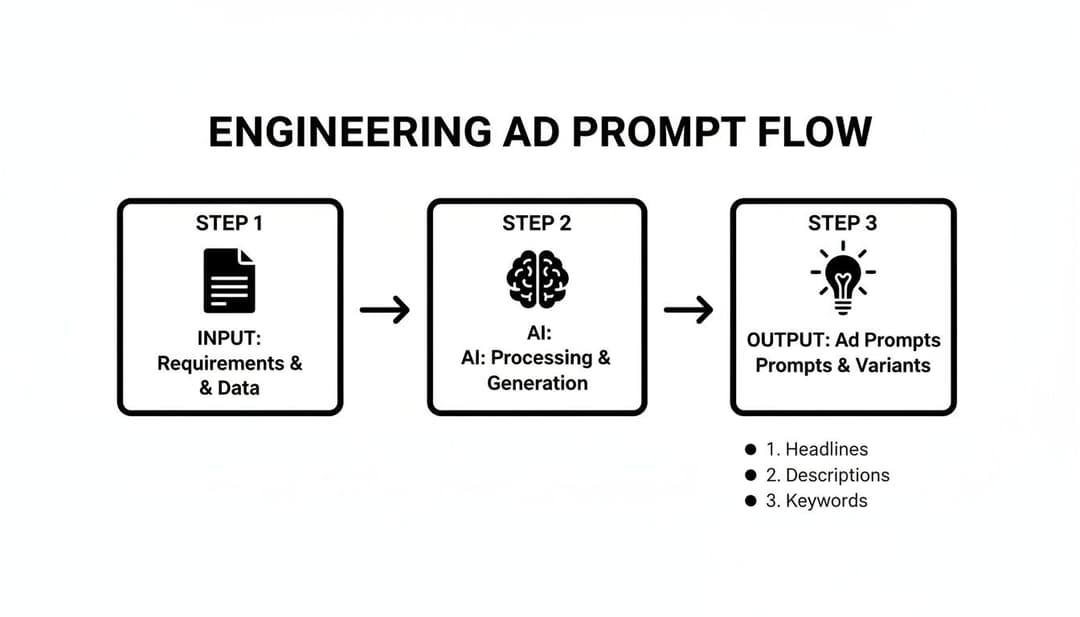
It’s all about having a system. When you have a clear process, the AI can transform your inputs into a wide array of creative outputs ready to go.
Automating Ad Assembly for Maximum Efficiency
Now, manually stitching together hundreds of ad components is a nightmare. It’s tedious, prone to error, and a massive time sink. This is where automation tools come into play. Platforms like AdStellar AI are built specifically for this. You can feed your AI-generated components directly into the system, and it assembles hundreds of ready-to-launch ad combinations for your Meta campaigns in minutes.
The real power of ChatGPT advertising is unlocked when you combine its creative generation with tools that automate assembly and deployment. This frees up your team from hours of manual copy-pasting to focus on what really matters: strategy and analysis.
This fusion of AI and automation is completely changing how marketing teams work. The economic impact is already massive—ChatGPT's role in the consumer journey is projected to have a $6.2 trillion total impact by March 2026. Take the Travel & Hospitality sector, where 18% of customers are already using ChatGPT in their buying process, contributing an estimated $1.48 trillion to the economy.
By adopting a component-based strategy, you're not just making ads; you're building a scalable system for creative production. You can quickly adapt your messaging for different audiences, iterate on winning concepts, and generate fresh content to fight ad fatigue. You can see more on how this works by exploring our guide on creative automation tools and their direct impact on campaign performance.
Building an Efficient QA and Campaign Launch Workflow

So, you've used ChatGPT to generate hundreds of ad variations. That’s a great start, but it’s only half the job. Without a rock-solid quality assurance (QA) workflow, you risk launching ads that are off-brand, packed with errors, or flat-out violate platform policies.
The sheer volume of content can feel like a tidal wave, but a structured review process makes it manageable. Your goal isn't to rewrite everything. It's to quickly vet the 80% of content that's good to go and toss what isn’t. While AI gets you most of the way there, it’s the final 20% of human refinement that separates a generic ad from a great one.
A Human-Led QA Checklist
Your review process needs to be fast and focused. A human reviewer should be able to scan each AI-generated asset and run it through a simple checklist. This is all about preventing bottlenecks and keeping the campaign moving.
Here’s a practical checklist we use on my team:
- Brand Voice: Does this copy actually sound like us? Check the tone, personality, and any specific lingo we use.
- Factual Accuracy: Are all claims, stats, and product details 100% correct? AI can "hallucinate" if it's not given specific data to work with.
- Clarity and Impact: Is the message crystal clear? Does the hook actually grab attention? Does it solve a real problem for the customer?
- Policy Compliance: Does the ad follow the platform’s rules (like Meta’s ad policies)? Look for any prohibited language or imagery.
I can't emphasize this enough: AI-generated content requires human oversight. Think of ChatGPT as a powerful assistant that churns out first drafts at scale. The final editorial call must come from an expert on your team.
Using AI to QA Itself
Here's an interesting twist: you can actually use ChatGPT as part of the QA process itself. Once you have a piece of copy, you can feed it back into the model with a specific prompt to check for potential red flags. This adds another layer of verification before a human even lays eyes on it.
For example, try using a prompt like this:
"Analyze the following ad copy for compliance with Meta's advertising policies. Flag any potentially problematic phrases related to personal attributes, sensationalism, or unsubstantiated claims. Also, rate the tone on a scale of 1-10 from 'formal' to 'casual' and suggest one change to make it more impactful."
This approach helps you systematically screen for common problems, which saves your team a ton of valuable time. You can learn more about creating repeatable systems by checking out our guide to a streamlined Facebook ad launch workflow.
From Vetted Assets to Live Campaigns
Once your creative assets are polished and approved, it’s time to launch. But manually building hundreds of campaigns in Meta Ads Manager is a painfully slow, error-prone process that completely kills your momentum. This is where a direct integration becomes a total game-changer.
Tools like AdStellar AI’s ‘AI Launch’ feature were built for this exact moment. You can take all your approved headlines, body copy, and creative variations and push them live to Meta Ads Manager in a single click. This instantly creates hundreds of ad combinations, directly connecting your ideation and QA process to execution.
That seamless transition is what makes ChatGPT advertising a truly scalable growth engine.
How to Measure and Optimize Your AI-Powered Campaigns
So you’ve launched your first wave of ChatGPT-powered ads. It’s easy to feel like the hard part is over, but this is where the real work—and the real magic—begins. Getting ads live is the starting line, not the finish. Now it's all about turning raw performance data into a smart feedback loop that makes every ad you run better than the last.
This is how you graduate from simply generating ads to building a strategic, data-driven ChatGPT advertising engine. Your goal isn't just to see which ad won, but to understand precisely why it won. Was it the headline’s emotional punch, the specific benefit in the copy, or the urgency you dialed up in the call-to-action? Every click and conversion holds a clue.
From Data to Actionable Insights
Don't just glance at your dashboard and declare a winner. You need to dig into the numbers to isolate the specific elements that are driving results. This is how you find the golden nuggets that will inform your next round of prompts.
This process creates a powerful, continuous learning cycle: live campaign data feeds directly into the prompts you write for your next batch of creatives. It’s how you systematically turn good ads into unbeatable ones.
For instance, say you're testing ten ad variations and you notice that the ads talking about "time-saving" features have a 50% lower Cost Per Acquisition (CPA) than those focused on "cost-saving." That’s not just a data point; it’s a strategic insight. Your next prompt for ChatGPT should be laser-focused on this angle: "Generate ten new headlines that frame our product's primary benefit as saving professionals at least 5 hours per week."
Automating Performance Analysis
When you're testing hundreds of ad variations, manually digging through spreadsheets to spot these trends is not just slow—it's nearly impossible. This is where a platform designed for this exact workflow becomes a game-changer. AdStellar AI, for example, uses its AI Insights feature to do the heavy lifting for you.
Instead of manual analysis, the platform automatically crunches the numbers and shows you what’s working across:
- Creative Assets: Instantly identify the specific images or videos that are capturing attention and driving clicks.
- Audience Segments: Discover which targeting groups are actually responding to your message and converting.
- Messaging Angles: Pinpoint the exact headlines, copy, and value propositions that resonate most with your customers.
This kind of automation lets you make decisions with confidence. You can quickly cut the underperformers and double down on the proven winners, ensuring your budget is always working as hard as it can. To really get a handle on what the numbers are telling you, a solid foundation in marketing analytics is invaluable.
Ultimately, effective ChatGPT advertising is about building a system. It's a system where AI generates the creative possibilities, real-world data provides the proof, and your insights guide the next wave of smarter, higher-performing campaigns. For a deeper look at setting up this kind of analysis, you might want to check out our post on marketing campaign analytics.
Common Questions on Using ChatGPT for Ads
As marketers start weaving ChatGPT into their daily routines, it's natural for practical questions to pop up. Moving from theory to the real world always brings new challenges. Let's tackle some of the most common questions about using ChatGPT for advertising to help you build a smarter, more efficient workflow.
Can ChatGPT Replace My Creative Team?
No, and it shouldn't. The best way to think of ChatGPT is as a creative co-pilot or a super-powered collaborator, not a replacement for human talent.
Its real magic is in its ability to generate ideas and first drafts at a scale no human team could ever match. It’s a tool for augmentation, not total automation. The smartest teams use it to churn through the repetitive, time-sucking tasks—like generating hundreds of ad variations. This frees up your creative strategists to focus on high-level direction, brand alignment, and the final polish that only an expert can provide.
Research consistently shows that AI models can get you about 80% of the way to a finished product. But that final 20% of human refinement is what turns generic content into truly impactful advertising.
How Do I Make Sure Ad Copy Stays On-Brand?
Keeping AI-generated copy on-brand is a two-part process. It all starts with giving the model extremely detailed context in your prompts.
Think of your prompts as a mini creative brief. You need to include:
- Brand voice guidelines (e.g., witty, authoritative, empathetic)
- Target audience personas and their specific pain points
- Examples of past ad campaigns that worked well
The more context you feed the model, the better and more aligned your output will be. But even the best prompt needs a human touch. The second step is a firm, human-led quality assurance process. Use the generated text as a strong first draft that a brand marketer can quickly tweak and refine. This combo of detailed prompting and human oversight gives you both speed and brand integrity.
What Are the Biggest Mistakes to Avoid?
The most common mistake by far is using lazy, low-effort prompts and expecting brilliant results. Vague requests like "write an ad for my product" will always get you generic, useless copy. The model needs clear, specific direction to do its job well.
Another frequent pitfall is blindly trusting the AI's output without a rigorous QA process. This is how you end up with factual errors, off-brand messaging, or even ad policy violations. Finally, a huge mistake is using the AI in a silo. The most successful strategies create a feedback loop where you use live campaign data to inform and refine your future prompts.
How Can I Find New Advertising Audiences?
ChatGPT is an excellent brainstorming partner for audience discovery. You can prompt it to act as a senior marketing strategist and have it pinpoint potential customer segments you haven't even thought of yet.
For example, you could give it a prompt like this:
"I sell sustainable running shoes for urban runners. My current audience is 25-35 years old. Generate 10 new, detailed customer personas outside of this core demographic, including their psychographics, media consumption habits, and potential pain points that our product could solve."
From there, you can dig deeper and ask it to suggest specific targeting parameters for platforms like Meta, such as new interests, behaviors, and lookalike audience ideas. This helps you break out of your current assumptions and uncover fresh, testable segments for your campaigns.
Ready to stop copy-pasting and start scaling? AdStellar AI helps you launch, test, and optimize Meta ad campaigns 10x faster. Learn how AdStellar AI can transform your workflow.