Your cost of a lead (CPL) is the bottom-line price you pay to get a single prospective customer interested in what you’re selling. It’s a make-or-break metric that cuts right to the chase, telling you if your lead generation campaigns are actually making money or just burning through your budget.
Understanding Your Cost of a Lead
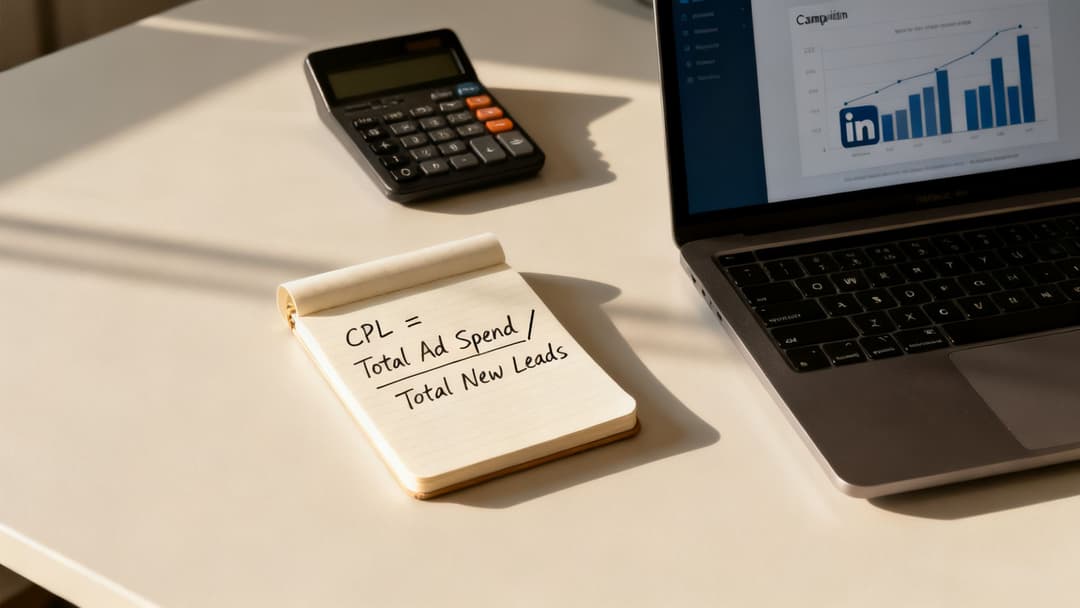
Before you can start chipping away at your CPL, you have to get a feel for what it really means. The easiest way to think about it is as the price tag on a potential customer’s curiosity. It’s the cash you spend just to get them to raise their hand and say, “Hey, I’d like to know more.”
Getting to this number is refreshingly simple. The formula is just your total marketing spend for a campaign divided by the number of new leads that campaign brought in.
CPL Formula: Total Ad Spend / Total New Leads = Cost of a Lead
This little equation gives you a clear baseline. It’s the starting point for all the smart optimizations that come next.
A Practical CPL Calculation Example
Let's walk through a real-world scenario. Imagine a SaaS company runs a campaign on LinkedIn to push their new ebook. The whole point is to get marketing managers to download it, turning them into fresh leads.
Here’s how their numbers shake out:
- Total LinkedIn Ad Spend: $5,000
- Total New Leads (Ebook Downloads): 250
Plugging those numbers into our formula, we get:
$5,000 (Ad Spend) / 250 (New Leads) = $20 Cost of a Lead
So, they paid exactly $20 for every single marketing manager who showed interest by grabbing their ebook. Now, a $20 CPL isn't automatically good or bad. Its real value depends entirely on what happens after that download. The next step is to stack this CPL up against other critical performance marketing metrics to see if it’s actually driving the business forward.
What to Include in Your Calculation
Consistency is king when you're calculating CPL. For a specific campaign, your "Total Ad Spend" should really only include the direct costs tied to that channel, like what you paid for the ad space.
You want to avoid muddying the waters by tossing in things like team salaries or software subscriptions. The only time you'd do that is if you're calculating a blended, company-wide CPL, which is a different beast altogether.
Take a look at the hyper-competitive world of Meta advertising. Aldar Properties, a luxury real estate developer, managed to slash their CPL in a big way. They started feeding their first-party customer data back into Meta's ad platform, allowing them to target lookalike audiences with scary precision.
The result? According to a case study on LeadsBridge, the campaign generated 3X more leads at a 68% lower CPL compared to what they were doing before. It’s a perfect example of how zeroing in on specific campaign variables can lead to huge wins.
The Key Levers That Control Your CPL
Your cost per lead isn't some fixed number pulled out of thin air. It’s a direct result of the strategic choices you make. Think of it like tuning an engine—certain adjustments make it run smoothly and efficiently, while others cause it to sputter and burn through fuel. Understanding these key levers is the first step to figuring out why your costs might be high and how to make smart adjustments.
Three main factors act as the control dials for your lead generation engine and, ultimately, your CPL.
Industry and Competition
First up is the competitive landscape you’re playing in. If you're selling software in a crowded B2B tech space, you’re not just bidding for ad space; you're bidding for attention against hundreds of other companies all chasing the same professionals. This fierce demand for a limited audience naturally jacks up ad prices, setting a higher baseline for your cost of a lead.
On the flip side, a local D2C fashion brand targeting a broad audience on a less saturated platform like TikTok might find their starting CPL is much lower. The level of competition really sets the stage—it's the foundational cost you have to overcome before any other optimizations can even begin to make a difference.
Audience Targeting Specificity
The next major lever is how narrowly you define your audience. This one can feel a bit counterintuitive. You’d think broader is cheaper, but getting more specific, while often increasing your CPL on paper, is a critical trade-off for higher-quality leads.
For example, a LinkedIn campaign targeting "C-suite executives in the financial sector with over 500 employees" is going to be way more expensive per lead than one targeting "small business owners" on Meta. Why? Because the smaller and more valuable the audience segment, the more you’ll pay to get in front of them.
The goal isn't just to find cheap leads; it's to find the most cost-effective path to your ideal customer. Precision targeting might raise your initial CPL, but it dramatically increases the odds that those leads will convert into paying customers, making the initial investment worthwhile. You can explore how to build these high-value groups in our guide on what is audience segmentation.
Ad Creative and Offer Quality
Finally, we have what is arguably the most powerful lever you can pull: the quality of your ad creative and the appeal of your offer. A truly compelling ad that speaks directly to a user's pain point can stop them dead in their scroll and inspire action. When that happens, your CPL plummets.
Poor creative, on the other hand, just gets ignored. Ad platforms actively reward engaging content with better placement and lower costs because it improves the user experience for everyone. Your creative is a combination of several elements you can—and should—be testing:
- The Visual: Does a clean product shot outperform a candid lifestyle photo?
- The Headline: Is a direct question more engaging than a bold, declarative statement?
- The Offer: Is a free trial a bigger draw than a downloadable whitepaper?
A weak offer paired with uninspired creative will force you to pay a premium for every single lead, no matter how perfectly dialed-in your targeting is. These three levers—competition, targeting, and creative—all work together to determine your final cost of a lead.
Benchmarking A Good Cost Per Lead By Industry
"What's a good cost per lead?" It's the million-dollar question every marketer asks, and the honest answer is... it depends. There’s no magic number that works for everyone. A "good" CPL is simply one that allows your business to grow profitably.
Think about it: a SaaS company selling enterprise software for thousands of dollars can stomach a much higher CPL than a small e-commerce shop selling t-shirts. Their customer lifetime values and profit margins are worlds apart. That's why industry benchmarks are best used as a compass, not a rigid map.
The real goal isn't to hit some universal CPL number. It's about figuring out what’s realistic and sustainable for your campaigns and using benchmarks to see how you stack up against the competition.
Average Cost Of A Lead By Industry And Channel
To get your bearings, it helps to look at the data. The table below breaks down some typical CPLs across different industries and the major ad platforms. Just remember, these numbers are always in flux—they can swing based on seasonality, how crowded the ad space is, and even broader economic trends.
Average Cost of a Lead by Industry and Channel
| Industry | Average CPL on Meta Ads | Average CPL on Google Ads | Average CPL on LinkedIn Ads |
|---|---|---|---|
| Technology | $25 - $45 | $55 - $70 | $75 - $120+ |
| E-commerce & Retail | $10 - $30 | $30 - $55 | $80 - $150 |
| Healthcare | $30 - $50 | $60 - $80 | $90 - $130 |
| Professional Services | $20 - $40 | $50 - $75 | $60 - $100 |
As you can see, the platform you pick makes a huge difference. For instance, Meta Ads often provides a more direct and cost-effective route for lead generation. It's not uncommon for a well-tuned Meta campaign to deliver a CPL that's 20-50% lower than what you'd see on Google Ads for the same audience.
So, what actually drives these costs up or down? It boils down to three main levers: the level of competition, the precision of your targeting, and the quality of your creative.
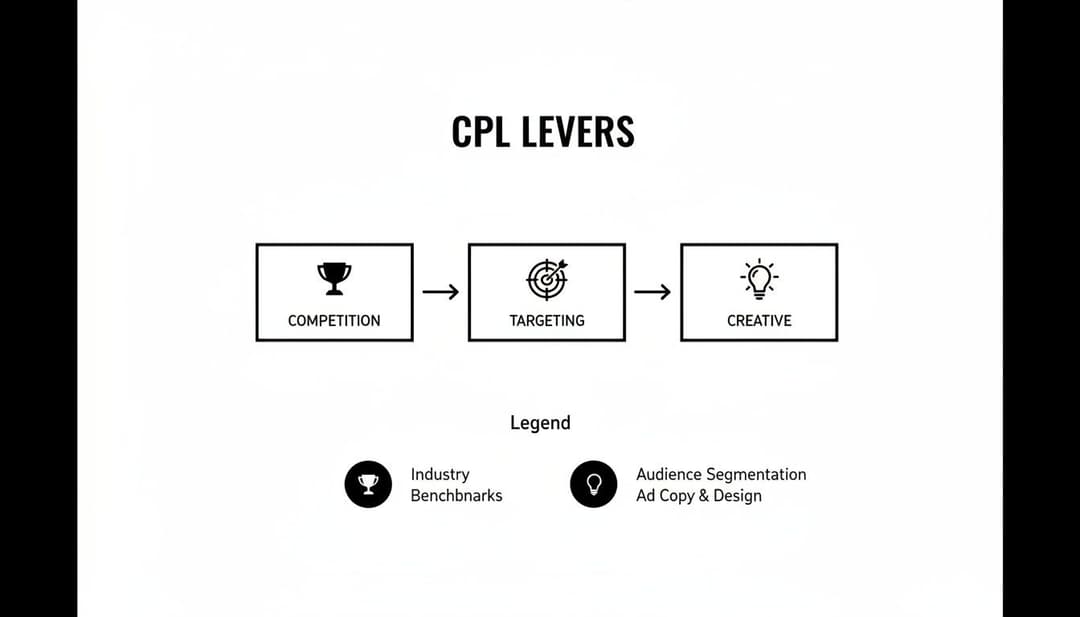
Each of these elements is a dial you can turn to fine-tune your campaign's performance. Mastering them is the key to managing your final cost of a lead and understanding the total costs of advertising online.
Proven Strategies to Lower Your Cost of a Lead
Alright, you've figured out what’s driving your cost of a lead. That's the first step. Now it’s time to roll up your sleeves and actually do something about it.
Lowering your CPL isn't about finding some magical "silver bullet." It’s about being methodical—systematically testing and refining every piece of your campaign. Think of yourself as a scientist in a lab, running a series of small experiments designed to make every ad dollar work harder for you. Each test, whether it’s on your audience, ad creative, or landing page, gives you priceless data that leads to serious cost savings and much better performance.
Refine Your Audience Targeting
One of the fastest ways to burn through your budget is to show your ads to the wrong people. It’s that simple. The more precisely you can dial in on your ideal customer, the lower your cost of a lead will naturally fall. This is all about quality over quantity.
Get surgical with your targeting. Don't just aim at broad interests and hope for the best. Build out detailed customer profiles and use the powerful tools inside platforms like Meta to find people who are a perfect match.
- Build Lookalike Audiences: Take a list of your absolute best customers—the ones who buy, stay, and rave about you—and upload it. The platform’s algorithm will then go out and find new people who share those same characteristics. You’re essentially cloning your best customers.
- Use Negative Keywords and Exclusions: Just as important as telling the ad platform who to target is telling it who not to target. If you sell premium, high-end software, you should be actively excluding keywords like "free," "cheap," or "discount" from your search campaigns to stop wasting clicks on bargain hunters.
Run Structured A/B Tests on Creative
Your ad creative—the image, the video, the headline—is your single biggest lever for capturing attention and slashing costs. I've seen a simple headline tweak or a different image cut CPL in half overnight. But you’ll never know what works unless you test.
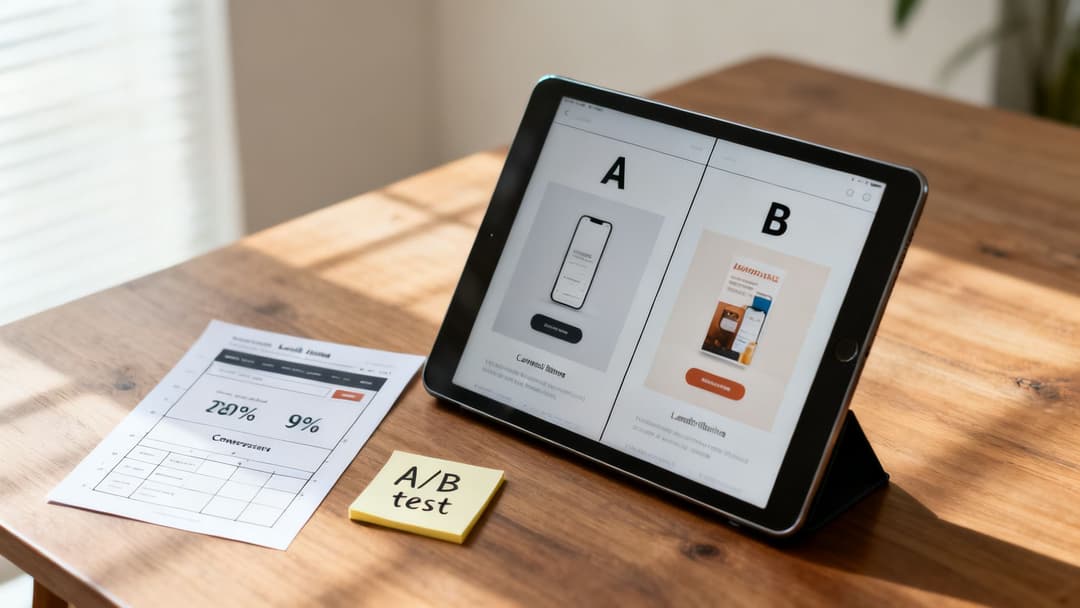
A/B testing (or split testing) is just running two versions of an ad against each other to see which one gets better results. The golden rule? Only change one thing at a time. If you change the headline and the image, you have no idea which change made the difference.
The real goal of A/B testing isn't just to find one "winner." It's to build a continuous learning loop. Every campaign teaches you more about what your audience actually wants, letting you steadily improve results and lower lead costs over the long haul.
For example, you could test a static image against a short video clip. Or pit a question-based headline against one that focuses on a key benefit. Consistent testing takes the guesswork out of the equation and replaces it with cold, hard data. Of course, to make sure these tests run accurately, it helps to understand the technical side of ad delivery, which can include the effective use of proxy servers in media buying for things like ad verification.
Optimize Your Landing Page for Conversions
Getting someone to click your ad is only half the battle. If they land on your page and get confused, bored, or frustrated, they'll leave. You just paid for a click that went nowhere, and that directly inflates your effective cost of a lead.
Your landing page needs to feel like a seamless continuation of your ad. The headline, the offer, the visuals—it should all feel perfectly connected to the ad that brought them there. For more on creating that smooth journey, check out our guide to building high-converting lead gen ads.
Here are the key areas to focus on for quick wins:
- Message Match: Does the headline on your landing page perfectly mirror the promise made in your ad? It has to.
- Simplify Your Form: Every single field you add to your form is another reason for someone to give up. Only ask for what you absolutely need to qualify the lead.
- Improve Page Speed: A page that takes forever to load is a conversion killer. In 2024, if your page doesn't load in under three seconds, you're losing people.
Beyond CPL: Why Lead Quality Is the Real Goal
It’s tempting to get laser-focused on lowering your cost of a lead. After all, efficiency is the name of the game in marketing. But chasing the lowest possible CPL is a classic trap, and it can actually hurt your business in the long run.
Think about it. An impressively low CPL is nothing more than a vanity metric if those "cheap" leads never turn into paying customers.
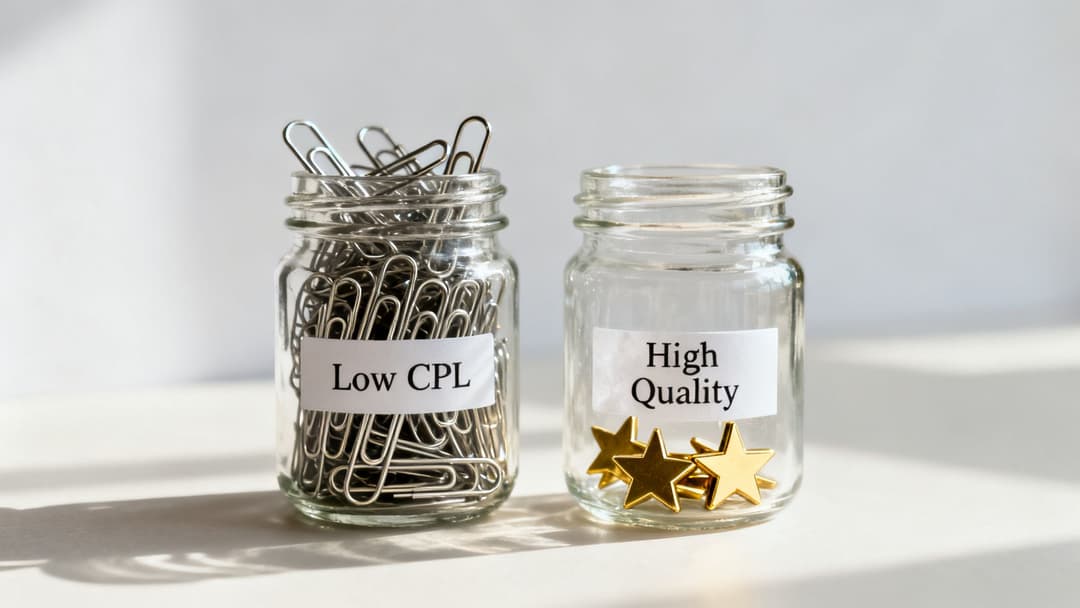
When you obsess over cost, you often end up filling your pipeline with low-quality prospects. These are the folks who will gladly download a free PDF but have zero intent—or budget—to ever buy from you. This just burns out your sales team, forcing them to waste precious time chasing dead ends.
The Fishing Analogy: Quality vs. Quantity
Let’s think about lead generation like fishing. You have two choices.
First, you could cast a giant, cheap net and drag it across the ocean floor. You’ll definitely catch a lot of something—seaweed, old tires, and tiny fish you have to throw back. That's the low-CPL, high-volume approach.
Or, you could use specific, high-quality bait to attract the exact type of fish you’re after. You might not catch as many, but you know that nearly every bite will be a prize winner. This is what focusing on lead quality looks like, even if it means the initial cost of a lead is a bit higher.
A cheap lead that never becomes a customer isn’t a bargain; it’s a cost with zero return. The real goal is to find the lowest possible CPL for a high-quality lead who has a genuine chance of converting.
Metrics That Measure What Matters
To get this right, you have to shift your focus from pure cost to real value. That means tracking a few metrics that go beyond CPL to reveal the true health of your marketing engine.
Here are the KPIs that show you the whole picture:
- Lead-to-Customer Rate: This one is simple but powerful. What percentage of your leads actually become paying customers? A high rate is a clear sign that you’re attracting the right people.
- Customer Lifetime Value (CLV): How much revenue does an average customer bring in over their entire relationship with you? High-CLV customers absolutely justify a higher upfront cost to acquire them.
When you balance your CPL against these quality-focused metrics, you start making decisions that drive profitable growth. It’s a critical mindset shift that separates campaigns that just look good on paper from those that actually build a sustainable business.
For a deeper dive into the financial side of things, check out our guide on customer acquisition cost calculation.
Got Questions About Cost Per Lead? We've Got Answers.
Diving into the numbers can bring up a lot of questions. Let's tackle some of the most common ones that come up when you're trying to get a handle on your cost of a lead.
How Often Should I Calculate My CPL?
For any campaign you're actively running, you should be checking your CPL at least weekly. This gives you enough data to spot trends and make smart adjustments without getting jumpy over daily swings, which can be all over the place.
For bigger-picture strategy, a more thorough review should happen monthly or quarterly. That's when you'll make decisions that guide your overall budget and long-term goals.
Can My Cost of a Lead Actually Be Too Low?
You bet it can. An extremely low CPL is often a red flag. It usually means your targeting is way too broad, or your offer is attracting a flood of low-quality leads that have zero intention of ever becoming customers.
The real goal isn't just to find the cheapest lead possible. It's to find the lowest possible CPL for a high-quality lead. Always, always track your lead quality right alongside your cost metrics.
My CPL Is Through the Roof. What's the First Thing I Should Fix?
Start by putting your targeting and your ad creative under a microscope. A sky-high cost of a lead is almost always caused by a disconnect between who you're showing your ads to and what you're saying in the ad itself.
First, double-check that you're actually reaching the right audience. Once you've confirmed that, it's time to experiment. Test different ad copy, headlines, images, and videos to see what finally clicks with them.
Does CPL Change Much Between B2B and B2C?
Yes, and it's a night-and-day difference. B2B CPL is almost always higher. Why? Because the sales cycles are longer, the deals are worth a lot more, and the target audiences are much smaller and more difficult to pin down (think specific job titles at specific companies).
On the flip side, B2C audiences are generally massive, which makes it easier and cheaper to generate leads, often leading to much lower CPLs.
Ready to stop guessing and start scaling? AdStellar AI automates ad creation, testing, and optimization, so you can find your lowest CPL for high-quality leads faster. Discover how AdStellar can transform your Meta campaigns today.