Let’s start at the top of the funnel. If you’ve ever run a brand awareness campaign, you’ve definitely come across the term Cost Per Impression, more commonly known as CPM.
Think of it as the price you pay to rent a tiny slice of someone's attention online. It's the cost for one thousand people to see—or get an "impression" of—your ad. This is the bedrock metric for figuring out how cost-effective your brand awareness efforts really are.
What Cost Per Impression Actually Means for Your Budget
Sure, CPM doesn’t track clicks or sales. It measures something that comes long before that: pure visibility. This number tells you exactly how much it costs to get your brand in front of potential customers, planting that first seed of recognition.
Getting a handle on your CPM is a non-negotiable for a few key reasons:
- Smarter Budgeting: It helps you predict how much reach you can get for your money. No more guessing games with your ad spend.
- Performance Benchmarking: It gives you a clear baseline to compare the cost-efficiency of different ads, audiences, or even entire platforms. Is TikTok cheaper than Meta for your audience? CPM will tell you.
- Measuring Awareness: For campaigns where getting eyeballs is the whole point, CPM is your most direct scoreboard for success.
Gauging Your Top-of-Funnel Health
Picture your marketing funnel as a big bucket. Impressions are the raindrops you need to fill it. If it costs a fortune just to make it rain (a high CPM), you’ll never fill that bucket enough to get a steady stream of leads and sales trickling out the bottom.
A healthy CPM means you're efficiently filling the top of your funnel with potential customers, giving your other metrics a fighting chance.
It's also a dynamic number, constantly shifting with market competition and how much your audience is engaging. Just look at Meta’s ad costs over the years—they’ve steadily climbed. As of 2025, a single impression on Facebook can cost anywhere from $0.50 to $1.00, a wide range that hinges entirely on your targeting, creative, and placement choices.
By keeping a close eye on your CPM, you have an early warning system. A sudden spike might mean your audience is getting tired of your ads or a new competitor just drove up the auction price. It’s a signal to refresh your creative or rethink your targeting before you burn through your budget.
Ultimately, understanding your cost per impression helps you make sharp, data-backed decisions. It’s not just about what you’re spending, but how effectively you’re spending it to grab attention. Mastering this is the first real step to managing your total social media marketing cost and getting the best possible return on your investment.
The Simple Math Behind Calculating Your CPM
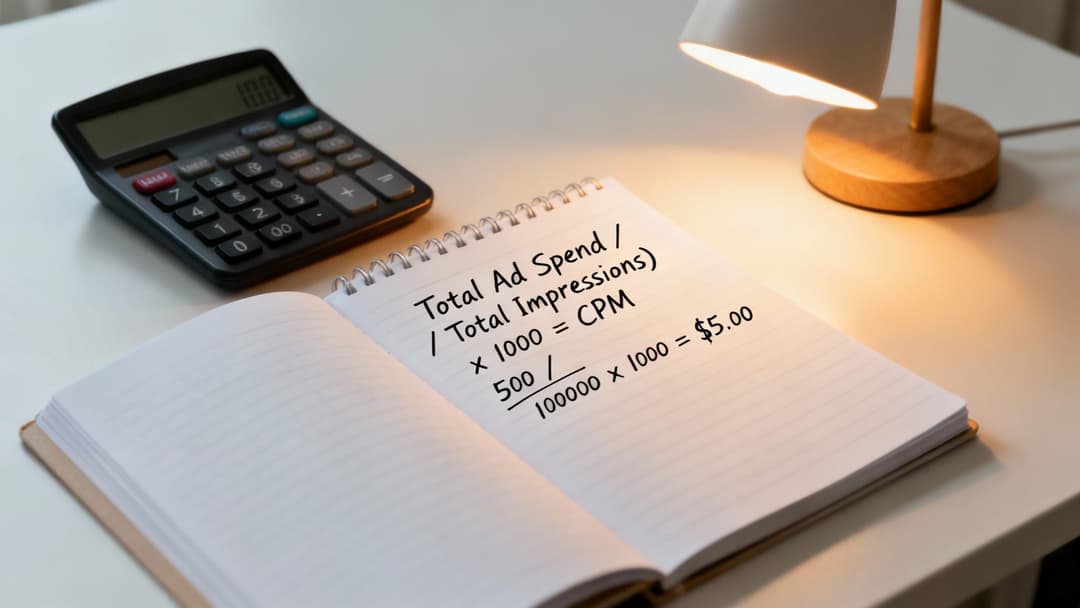
Calculating your Cost Per Mille (CPM) is refreshingly simple. You don't need a math degree or a complex spreadsheet—just one straightforward formula that tells you exactly how efficient your ad spend is.
It all boils down to this:
CPM = (Total Ad Spend / Total Impressions) × 1000
This formula reveals what you’re paying for every one thousand times your ad gets shown. We multiply by 1,000 just to make the number easier to digest. It’s a lot simpler to talk about paying a few dollars per thousand views than it is to deal with fractions of a cent for a single cost per impression.
Putting the Formula into Practice
Let's walk through a quick, real-world example. Imagine you just ran a brand awareness campaign on Meta. You spent $500, and your ads manager shows you hit 100,000 impressions.
Here’s how you’d calculate your CPM:
- Divide your total ad spend by the total impressions: $500 / 100,000 = $0.005
- Multiply that number by 1,000: $0.005 × 1000 = $5.00
Boom. Your CPM for this campaign is $5.00. This means you paid a clean five bucks for every thousand eyeballs that saw your ad. Grasping what impressions are on social media is crucial for this number to really mean something.
Flipping the Formula for Campaign Forecasting
But this isn’t just about looking back at past performance. You can flip the formula around to become a powerful forecasting tool for future campaigns. This turns a simple metric into a strategic way to plan your budget and set expectations.
Let’s say you’ve been given a new budget of $2,000, and you know from past campaigns that your average CPM is around $5.00.
- Formula: Expected Impressions = (Budget / Target CPM) × 1000
- Calculation: ($2,000 / $5.00) × 1000 = 400,000 impressions
Now you can confidently tell your team that a $2,000 investment should generate somewhere in the neighborhood of 400,000 impressions. It’s a simple piece of math that sets clear goals from the very start.
Why a Good CPM Is Always Relative
Chasing some universal, one-size-fits-all "good" CPM is like asking, "How long is a piece of string?" The number itself is totally meaningless without context.
A CPM that would have an e-commerce brand popping champagne could spell disaster for a B2B SaaS company selling six-figure software deals. Your cost per impression isn't a fixed price tag on an item; it’s a dynamic, ever-shifting number influenced by a dozen different variables at any given moment.
Trying to hit an arbitrary CPM benchmark without understanding what's driving it is just a recipe for frustration. The real goal is to figure out what pushes your specific costs up or down. A "good" CPM is simply one that’s efficient for your campaign and gets you closer to your actual business goals.
The Big Four Factors Driving Your CPM
At its core, your CPM is determined in the ad auction, where you're constantly bidding against other advertisers for the same eyeballs. Four key elements are always shifting the price you pay.
Audience Targeting: The more valuable and in-demand your target audience, the steeper the competition. It’s simple supply and demand. Targeting high-income individuals in New York City is going to cost you a lot more than targeting a broad, nationwide audience.
Ad Placement: Not all digital real estate is created equal. An ad placed in the highly visible, super-engaging Instagram feed will almost always command a higher CPM than one tucked away in the Audience Network.
Creative Quality and Relevance: Ad platforms want to show their users content they actually like. If your ad has a high click-through rate (CTR) and gets positive interactions, you're telling the algorithm it’s a winner. In return, the platform often rewards you with a lower cost per impression.
Seasonality and Competition: Advertising is a marketplace, and prices swing wildly with supply and demand. Costs absolutely skyrocket during peak shopping seasons like Q4 for Black Friday, as thousands of brands all pile in to compete for the same holiday shoppers.
A rock-bottom cost per impression means nothing if it’s coming from an audience that will never, ever buy from you. A slightly higher CPM that reaches a hyper-targeted, high-intent audience is almost always a much smarter investment for driving real business results.
Understanding what levers you can pull to influence your CPM is the first step toward optimizing your campaigns. Let's break down the most common variables.
Factors That Influence Your Cost Per Impression
This table breaks down the key variables that can raise or lower your CPM, helping marketers diagnose the cause of their campaign costs.
| Factor | Impact on CPM | Example |
|---|---|---|
| Audience Specificity | Highly specific, high-value audiences increase CPM. | Targeting "CEOs in the tech industry" will cost more than "people interested in business." |
| Geographic Location | Targeting affluent or competitive regions increases CPM. | Ad impressions in San Francisco are more expensive than in Omaha. |
| Ad Placement | Premium placements like feeds or stories have higher CPMs. | An Instagram Story ad will have a higher CPM than a right-column ad on Facebook. |
| Ad Quality Score | Higher relevance and engagement scores can lower CPM. | An ad with a great CTR gets a "discount" from the platform's algorithm. |
| Bidding Strategy | Manual bids or bidding for high-value actions can raise CPM. | Optimizing for "conversions" often results in a higher CPM than optimizing for "reach." |
| Industry Competition | More advertisers in your niche drive up auction prices. | The e-commerce fashion industry is far more competitive than B2B industrial manufacturing. |
| Time of Year/Day | Peak seasons (like Q4) or times of day increase CPM. | Running ads on Black Friday weekend will be significantly more expensive than on a random Tuesday in February. |
By looking at this table, you can start to see how these elements work together. A high CPM isn't necessarily a bad sign if you're intentionally targeting a high-value audience in a competitive market—as long as it's profitable.
Industry and Platform Benchmarks Matter
Beyond those core factors, your industry plays a massive role. Costs vary wildly across the digital advertising landscape. According to recent data, the average cost per impression can swing from $0.10 to $2.00, all depending on the vertical, platform, and audience quality. To get a deeper look at these variations, you can find more information in this ad cost per impression analysis at Umbrex.com.
For instance, a luxury real estate firm can and should expect to pay a much higher CPM than a mobile gaming app. Why? The potential lifetime value of a single real estate client is astronomical, so advertisers are willing to bid much more aggressively for each impression. Knowing your industry's baseline is the first step to setting realistic expectations for your own campaigns.
Actionable Strategies to Lower Your CPM on Meta
Knowing what goes into your cost per impression is one thing. Actually taking control of it is another. On platforms like Meta, your CPM isn't just a number to track—it’s a lever you can pull to make your budget work harder. Bringing that number down means you get more eyeballs for the same ad spend, stretching every single dollar.
So, how do you do it? The key is to systematically test and fine-tune the three core pillars of any campaign: your audience, your ad placements, and your creative.
This isn't about finding one silver bullet. As the diagram below shows, these three elements are completely intertwined.
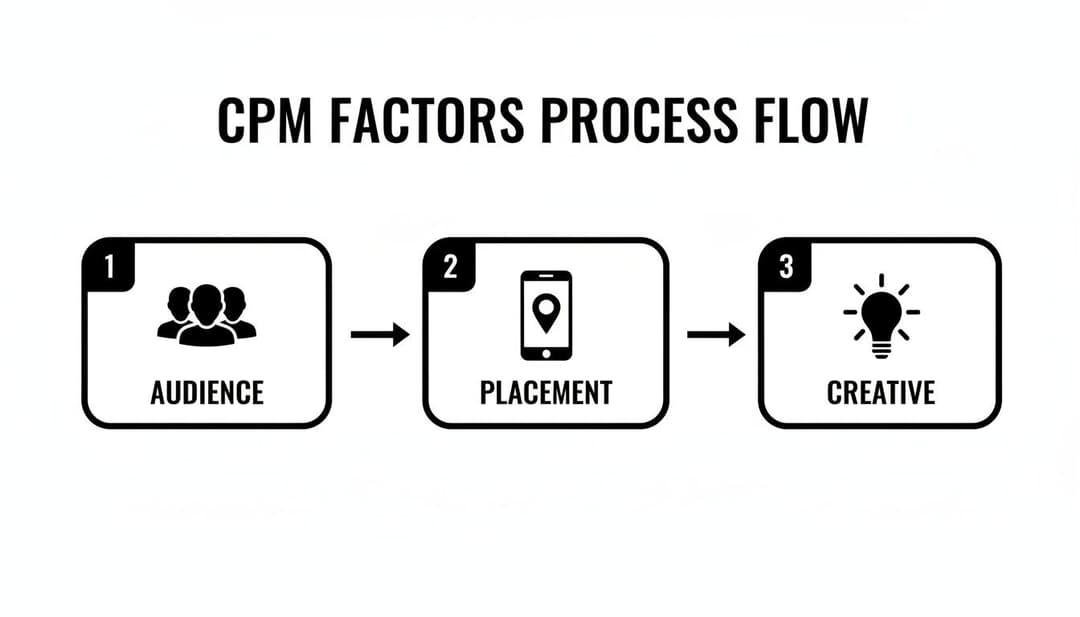
You can't just fix your creative and ignore your audience, or vice versa. A winning strategy—and a lower CPM—demands a balanced approach across all three.
Refine Your Audience Targeting
Hands down, the fastest way to slash your CPM is to stop showing ads to people who don't care. Meta's algorithm actively rewards advertisers who deliver relevant experiences, and that all starts with who you’re talking to.
It’s time to move beyond broad, generic interest targeting. Instead, focus on building high-intent audiences that are far more likely to engage with what you're putting in front of them.
Lookalike Audiences: Stop guessing and start modeling. Create Lookalike audiences from your absolute best customers—think recent purchasers or your high-LTV clients. An audience built from a 1% Lookalike of your top spenders will almost always crush a broad interest group in performance.
Strategic Exclusions: This one is simple but so often overlooked. Don't forget to exclude your existing customers from top-of-funnel campaigns. There's no reason to pay to show brand awareness ads to people who have already bought from you. This one small tweak cleans up your targeting instantly and plugs a major hole in your budget.
Nail Your Ad Creative
Your ad creative is the single biggest lever you have for grabbing attention and driving down costs. An ad that genuinely stops the scroll and earns clicks sends a powerful signal to Meta's algorithm: people like this. When that happens, you're often rewarded with a lower cost per impression.
High-relevance, engaging creative isn't just a 'nice-to-have'—it's a direct path to reducing your media costs. The more people who positively interact with your ad, the more efficiently the platform can deliver it, driving down your CPM.
You have to experiment with different formats and messages to figure out what resonates. For anyone deep in the Meta ecosystem, brushing up on best practice Facebook Ads strategies can give you a serious competitive edge.
Creative Testing Ideas:
- Static vs. Video: Put a compelling static image head-to-head with a short, punchy video (think under 15 seconds). Video often does a better job of capturing attention, which can lead to higher engagement and lower CPMs.
- UGC vs. Polished: Test authentic User-Generated Content (UGC) against a slick, studio-shot ad. UGC often feels more trustworthy and relatable, which can send your relevance scores through the roof.
- Benefit-Led vs. Problem-Focused Copy: Does your audience react better to a headline that spotlights a key benefit ("Achieve Flawless Skin") or one that pokes at a pain point ("Tired of Acne Breakouts?")?
Setting up these tests manually is a grind. It's tedious and eats up hours you don't have. This is exactly where a tool like AdStellar AI comes in. AdStellar can spin up hundreds of creative and copy variations in minutes, letting you launch comprehensive A/B tests with a single click. The platform’s AI then crunches the numbers to pinpoint the winning combinations of images, headlines, and audiences, helping you scale what works without all the manual busywork.
Optimize Your Bidding Strategy
Finally, your bidding strategy is your instruction manual for Meta on how to spend your money. While the default "Lowest Cost" (now called "Highest Volume") option works well much of the time, it might not always be the most efficient path to your goals.
It's worth testing different bid caps or cost controls. Setting a manual bid cap can act as a ceiling, preventing your CPM from exploding in super competitive auctions and giving you more predictable spending. The trade-off? If you set it too low, you might kneecap your ad delivery. To go deeper on this, check out our complete guide to Facebook ad optimization.
By methodically testing these three areas—audience, creative, and bidding—you can stop watching your CPM and start controlling it. You'll transform it from a passive metric into an active tool for making your entire campaign more efficient.
Balancing CPM with CTR and CPA for Real Results
Chasing the lowest possible cost per impression can feel like a win, but it’s often a trap. Getting a rock-bottom CPM means nothing if those impressions don't actually lead to clicks, leads, or sales. The real goal isn't just cheap exposure; it's finding that sweet spot where what you pay for eyeballs (CPM) lines up with how many people actually engage (CTR) and what it costs to land a real customer (CPA).
Think of these three metrics as being locked in a delicate dance. If you focus too hard on just one, you’ll throw the whole system out of balance, leaving you with wasted ad spend and results that fall flat. True campaign success comes from understanding how they all work together.
Imagine you score an incredibly low $2.00 CPM by targeting a massive, super-broad audience. On the surface, it looks great—your ads are getting seen for cheap! But because the audience is mostly uninterested, your Click-Through Rate (CTR) is a dismal 0.2%. The handful of clicks you do get are from low-intent users who never convert, which sends your Cost Per Acquisition through the roof.
In this scenario, you're just efficiently buying impressions that do absolutely nothing for your bottom line.
Shifting Focus From Cheap Impressions to Valuable Clicks
Now, let's flip that script. You decide to target a much more specific, high-intent audience. They’re a more competitive group to reach, so your CPM climbs to $10.00. It feels more expensive up front, but this hyper-relevant audience genuinely connects with your ad.
What happens next? Your CTR jumps to a healthy 2.0%. More importantly, these engaged users are far more likely to actually buy something. Even though you paid more for the initial impressions, the surge in engagement and conversions brings your final CPA way down, making the whole campaign profitable.
A higher CPM isn't a sign of failure if it's buying you access to a premium audience that converts. Paying more to reach the right people is always a better investment than paying less to reach everyone.
This is the fundamental trade-off every performance marketer has to manage day in and day out. Optimizing for just one metric is shortsighted; you have to look at the entire funnel to see what's really happening. For a deeper dive into making your ads more compelling, our guide on how to improve click-through rate has some great, actionable insights.
Ultimately, a slightly higher CPM that drives a stellar CTR and a profitable CPA is the winning formula. And if you want to get a better handle on that final, crucial metric, this guide on What Is Cost Per Acquisition (CPA) from Frozen Crow is an excellent resource. By balancing these key metrics, you ensure your campaigns aren't just efficient—they're truly effective at driving growth.
Choosing the right Key Performance Indicator (KPI) is like picking the right compass for a journey. Pick the wrong one, and you'll end up optimizing for the wrong destination. While metrics like Cost Per Action (CPA) or Return On Ad Spend (ROAS) usually get all the attention, there are specific, critical moments when cost per impression should be your one true north.
Focusing on CPM means your primary goal isn't an immediate click or a sale. It’s about buying attention at scale and maximizing your visibility as efficiently as possible.
Prioritizing Reach Over Direct Response
Not every campaign is built to get a lead or a sale right now. Sometimes, the goal is simply to plant a seed that you’ll harvest later. This is where CPM really shines.
Here are the prime scenarios where CPM should be your go-to metric:
- New Product or Brand Launches: When you’re introducing something new, your first job is just to get on people's radar. You need to blanket your target market with your message, building familiarity and recall long before you ever ask for their credit card.
- Top-of-Funnel Brand Awareness: The goal here is simple: get as many relevant eyeballs on your brand as you possibly can. You're filling the top of your marketing funnel so your conversion-focused campaigns have a larger, warmer audience to work with down the line.
- Dominating a Specific Demographic: If your strategy is to become the go-to brand for a particular niche—say, female golfers aged 25-40—your first objective is to make sure that group sees your ads everywhere. A low cost per impression is crucial for achieving this market saturation without breaking the bank.
In these situations, you're playing the long game. The impressions you buy today build brand recognition that can pay off for months, or even years. Some of this impact can be measured through delayed attribution, and you can learn more about how impressions influence future sales by understanding what a view-through conversion is.
When your objective is to build a brand, not just a shopping cart, CPM is your most direct measure of success. It tells you how efficiently you're purchasing the one thing you can't get back: your audience's attention.
When Other Metrics Must Take the Lead
On the flip side, making CPM your main focus during a conversion-focused campaign is a recipe for wasted ad spend. When your business goal is tied directly to a specific action, your KPIs have to reflect that reality.
You should shift your focus away from CPM in these cases:
- E-commerce Sales Campaigns: For an online store, the only thing that really matters is driving profitable sales. Here, ROAS is king. A high CPM is perfectly fine if it’s bringing in a 4x or 5x return on your ad spend.
- Lead Generation Efforts: If you’re a B2B company looking for demo requests or a service business collecting contact info, your success is measured by Cost Per Lead (CPL) or Cost Per Acquisition (CPA).
- Bottom-of-Funnel Retargeting: When you're targeting users who have already shown interest—people who have visited your site or added to a cart—your goal is to close the deal. The cost of the impression is secondary to the cost of getting that final conversion.
Aligning your primary metric with your campaign’s actual goal is everything. Use CPM to win minds, and CPA to win wallets.
Common Questions About Cost Per Impression
Diving into paid advertising metrics can feel like you're learning a new language, but getting a handle on your cost per impression is a must. Let's clear up some of the most common questions performance marketers have about this crucial metric.
Is a Low CPM Always a Good Thing?
Not always. In fact, a rock-bottom cost per impression can sometimes be a red flag. It might mean your ads are being served to a low-quality or completely irrelevant audience—cheap to reach, sure, but with zero chance of ever converting.
The trick is to balance a low CPM with your other key metrics, like Click-Through Rate (CTR) and Cost Per Action (CPA). This makes sure you're reaching an audience that doesn't just see your ad, but actually drives real business results.
How Does Ad Creative Affect My CPM?
Your ad creative has a massive impact on your costs. Think of it this way: platforms like Meta want their users to have a good experience, so their algorithms are built to reward engaging and relevant ads with lower delivery costs. A killer image, a compelling video, or snappy copy that clicks with your audience will naturally earn higher engagement.
An ad with a strong relevance score is seen as a positive user experience by the platform. In return, the algorithm often rewards you with a lower CPM, effectively giving you a "discount" for creating good content.
This positive feedback loop directly leads to a lower cost per impression, which means you get to stretch your ad budget that much further.
Why Does My CPM Increase Over Time?
It's totally normal to see your CPM creep up over a campaign's lifetime, and there are a few usual suspects. The most common culprit is "ad fatigue." This is what happens when your target audience has seen your ad so many times they just start tuning it out, causing engagement to nosedive.
Other big factors include:
- Increased Competition: More advertisers are jumping into the auction and targeting the same audience you are, driving up prices for everyone.
- Seasonality: Costs almost always rise during big shopping seasons like the Q4 holidays when competition is absolutely fierce.
- Algorithm Changes: Ad platforms are constantly tweaking their systems, and these updates can sometimes cause your costs to shift.
The best defense is a good offense. Regularly refreshing your ad creative and keeping a close eye on audience saturation are your best bets for keeping CPMs in check for the long haul.
Ready to stop guessing and start scaling your Meta ads? AdStellar AI helps you launch, test, and optimize hundreds of ad variations in minutes, not days. See how you can unlock more revenue with less work at https://www.adstellar.ai.