Your team launches a new product. Search is already saturated, paid social is getting expensive, and leadership wants reach now, not after a six-month brand build. So you open Google Display Network, look at a DSP demo, review a retargeting setup doc, and realize display isn’t one channel. It’s targeting logic, creative production, frequency control, placements, attribution, and a reporting problem all at once.
That’s where most growth teams get stuck. Not because display is a bad channel, but because it’s operationally heavy. The web offers huge scale, yet the path from “we should run display” to “this is producing efficient revenue” is full of points where budget leaks.
Display advertising agencies exist because that complexity is real. The broader agency market is large for a reason. The global advertising agencies industry is projected to reach $444.7 billion in revenue by 2025, and programmatic display ad buying accounts for 85% of all digital display purchases, which tells you how much of this work now depends on specialized systems and buying expertise, not simple direct placement deals (IBISWorld global advertising agencies outlook).
The mistake I see most often is treating an agency like a pair of hands. A good display partner is closer to a systems operator. They help decide where display belongs in your funnel, which audiences are worth paying for, how creative should rotate, and which buying platforms fit your budget and goals. If you're still sorting through the platform side, this breakdown of top demand-side platforms is a useful starting point.
The Display Advertising Maze
A lot of teams enter display with the wrong expectation. They think they need a few banners, an audience list, and a media budget. Then the work starts. Someone has to define prospecting versus retargeting. Someone has to decide whether managed placements matter. Someone has to build audience exclusions so paid social and display don’t cannibalize each other.
Then creative becomes the bottleneck.
You need static sizes, responsive assets, copy variants, product angles, offer angles, and a refresh cadence before fatigue drags performance down. You also need a clear point of view on whether display is being used for reach, assisted conversion, direct response, or all three. Without that, every report turns into an argument.

Where teams lose control
The maze usually shows up in four places:
- Platform sprawl: One team member wants Google Display Network, another wants a standalone DSP, and nobody agrees on how much overlap is acceptable.
- Creative drag: Design can’t keep up with testing requests, so campaigns run too long on weak assets.
- Audience confusion: First-party lists, lookalikes, contextual ideas, and retargeting windows get mixed together without a clean structure.
- Measurement friction: Clicks look cheap, branded search rises, but nobody can prove what display contributed.
Display rarely fails because the channel has no potential. It fails because the operating model is unclear.
That’s why experienced display advertising agencies are still valuable. They bring process to a channel that punishes improvisation.
What Display Advertising Agencies Actually Do
A serious display agency doesn’t just traffic banners and send a monthly screenshot. It handles a chain of decisions that starts before launch and keeps going long after creative goes live.
Strategy comes first
The first job is deciding what display is supposed to do in your funnel. That sounds obvious, but many accounts skip it. Prospecting display, retargeting display, native placements, and video inventory shouldn’t all be judged the same way.
A strong agency maps display to the customer journey. For an e-commerce brand, that might mean broad reach for category awareness, mid-funnel product education, and retargeting for cart recovery. For B2B SaaS, it might mean account-based audience segments, content promotion, and post-demo reinforcement.
If your channel mix includes retail media, this kind of cross-channel planning matters even more. Teams that want a clean view of marketplace spend can borrow ideas from this piece on strategic guidance on Amazon advertising, because the same budget allocation logic applies when display supports a broader acquisition program.
Creative work is a testing system
Display creative has to do more than look polished. It has to create hypotheses.
The average banner ad CTR is 0.05%, which is why weak creative gets exposed fast. Agencies create value by improving relevance and sequencing, especially with retargeting, which is 10 times more effective than standard display ads according to the cited industry roundup (digital advertising statistics on display performance).
That changes how good agencies think about banners. They don’t ask for one “final set.” They build a testing plan around:
- Message angle: Offer-led, proof-led, feature-led, or urgency-led
- Visual treatment: Product close-up, lifestyle, UGC-style, category graphic
- Audience fit: Cold traffic creative should not look like cart abandoner creative
- Format choice: Responsive, native-style, standard units, animation where supported
Practical rule: If an agency can’t explain its creative testing logic, it’s probably just producing assets, not managing performance.
For teams that want to understand the execution layer better, this guide on what a media buyer does gives useful context on how strategy turns into daily optimization.
Media buying is not just bid management
Modern display buying is part technical setup, part inventory judgment. Agencies handle audience construction, exclusions, bid strategy, pacing, placement review, frequency control, and budget shifts across campaigns that often serve different roles.
Channel experience matters. A capable buyer knows when cheap inventory is hurting quality, when view-through-heavy reporting is misleading, and when a retargeting pool is too small to support aggressive spend. They also know that “scale” can mean lower signal quality if audience logic gets diluted.
Reporting should change decisions
The best reporting decks are not long. They’re clear.
A useful agency report should answer questions like:
- What changed this period
- Why it changed
- What the team will do next
- What the client needs to approve or fix
If reporting is mostly impressions, clicks, and broad commentary, you’re not getting enough. Agencies should tie creative, audience, and placement decisions back to business outcomes, even when attribution is imperfect.
Decoding Agency Service and Pricing Models
Pricing conversations get messy when brands and agencies use the same words to describe different things. “Management fee” might include creative strategy at one shop and exclude it at another. “Programmatic support” might mean a senior trader at one agency and a junior coordinator checking pacing twice a week at another.
That’s why pricing has to be decoded in context. Display agencies buy across DSPs, and programmatic accounts for about 90% of display ad spend globally, so fee structures usually sit on top of technology costs, media costs, and execution labor. In those systems, machine learning and data integration can produce 3 to 4 times higher CTR for retargeting campaigns, which is why experienced execution can justify higher fees when the setup is complex (programmatic display statistics and DSP benchmarks).
The three models you’ll see most often
Some agencies charge a percentage of media spend. Some prefer a fixed retainer. Others tie part of compensation to outcomes. None is automatically right or wrong.
| Model | How It Works | Best For | Pros | Cons |
|---|---|---|---|---|
| Percentage of ad spend | The agency charges a percentage of monthly media spend | Brands with growing budgets and broad campaign scope | Scales with account size, simple to calculate, often easy to start | Can create tension if spend rises faster than results |
| Fixed monthly retainer | The agency charges a set monthly fee for an agreed scope | Teams that want budget predictability | Easier forecasting, clearer service scope, less incentive to overspend | Scope can become rigid if campaign complexity changes |
| Performance-based | Compensation depends partly on agreed business outcomes | Brands with strong tracking discipline and aligned definitions | Better incentive alignment in theory, useful for accountability | Hard to structure well when attribution is noisy |
What each model gets wrong
Percentage-of-spend models can work well when your account does require more labor as budget expands. They break down when scale comes mostly from platform automation and the agency’s work doesn’t increase at the same pace.
Retainers look cleaner on a finance sheet, but they can hide under-resourcing. If your team suddenly needs new market launches, creative testing support, and more frequent reporting, a cheap retainer may turn into a service bottleneck.
Performance-based agreements sound attractive, but they only work when both sides agree on what counts. If the agency is graded on last-click conversions while your brand uses display for assisted revenue and retargeting support, arguments start fast.
The best contract isn’t the one with the cleverest fee formula. It’s the one that makes incentives and scope obvious before launch.
Questions worth asking before you sign
Use these in pricing calls:
- What is included in the fee: Strategy, trafficking, reporting, creative testing, landing page input, pixel setup
- What is billed separately: Design work, third-party data, DSP seat fees, analytics support
- Who touches the account: Senior lead, trader, creative strategist, analyst
- How often the scope is reviewed: Monthly, quarterly, or only when there’s a problem
- What happens when spend changes: More support, same support, or a contract reset
A pricing model should fit your operating reality, not just your current budget.
How to Evaluate and Choose the Right Agency
The agency shortlist usually looks good on paper. Nice logos. Clean decks. Familiar phrases about performance, transparency, and full-funnel growth. The critical work is figuring out who can operate inside your constraints.
That means asking better questions.
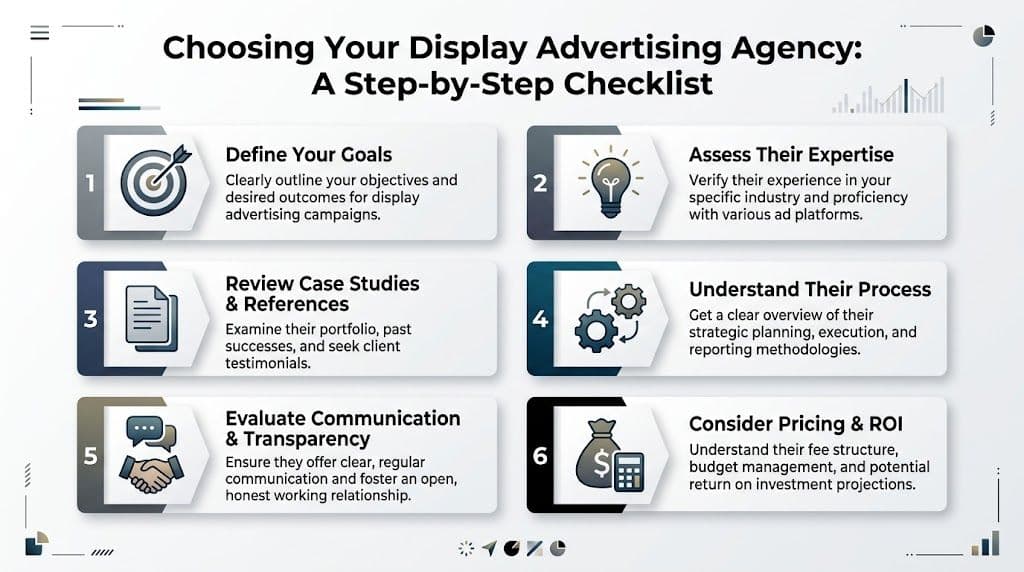
Start with fit, not reputation
A large agency with recognizable clients can still be a poor fit for a startup that needs fast creative cycles and direct access to the person making buying decisions. A small specialist can outperform a bigger network if your product category is niche and your reporting needs are hands-on.
One helpful benchmark is to review how other firms frame the selection process. This guide on choosing a Display Advertising agency is useful because it reflects the practical questions buyers should ask before treating an agency pitch as proof.
Look for alignment in these areas:
- Business model fit: E-commerce, DTC, B2B lead gen, subscription, marketplace
- Funnel fit: Prospecting heavy, retargeting heavy, or mixed full-funnel work
- Channel overlap: Search, paid social, retail media, and whether display needs to coordinate with them
- Operating style: Fast iteration versus heavier process and approvals
Evaluate their technical depth
A display agency should be able to talk clearly about platform decisions without drifting into jargon. You want plain answers on inventory quality, audience strategy, exclusions, attribution limitations, creative rotation, and how they use first-party data.
Good signs include:
- Clear platform logic: They can explain why they prefer one buying route over another
- Structured audience planning: They separate prospecting, site visitors, engaged users, and customer exclusions cleanly
- Creative feedback loops: They don’t treat design as a one-off deliverable
- Transparent reporting: They can show how campaign learnings change future spend
Bad signs are easier to spot than people think. If every answer leads back to “our proprietary approach,” press harder. If they can’t walk through an example of a weak campaign and how they fixed it, they may not have much depth.
Ask agencies to show a report where performance got worse for a period and explain what they changed. That answer is often more useful than a polished win story.
Review the team, not just the agency logo
One of the most common mistakes in procurement is buying the senior pitch and receiving a junior account team. You don’t need to reject junior talent, but you do need visibility into roles.
Ask:
- Who owns strategy
- Who does day-to-day buying
- Who reviews creative performance
- Who builds the report
- Who joins weekly calls
If the account lead can’t answer that without checking internally, the staffing model is probably still vague.
Use a structured RFP
An RFP doesn’t need to be long. It needs to reduce ambiguity.
Sample RFP outline
Company overview and product lines
Primary business goal for display
Target audiences and markets
Current channel mix
Existing tech stack and data sources
Creative resources available internally
Reporting requirements and KPI definitions
Requested scope from the agency
Expected communication cadence
Budget range and contract preference
The shortlist should survive a live working session
Before final selection, give finalists a realistic scenario. Ask how they’d launch a prospecting campaign, structure retargeting, handle creative refresh, and report on early performance when attribution is incomplete.
That format reveals more than a polished capabilities deck. It shows whether they can think with your team, not just present to it.
Agency Partner vs In-House Team A Complete Breakdown
The agency versus in-house question usually gets framed too simplistically. In practice, you’re comparing operating models, not just headcount.
An in-house team gives you direct control. An agency gives you immediate specialization. Neither is automatically more efficient.

Where agencies tend to win
Agencies are usually stronger when your team needs expertise quickly. They already know the common setup mistakes, they’ve seen more creative patterns across accounts, and they can often troubleshoot platform issues faster because they work inside them every day.
They also help when your internal team is thin. If your designer is overloaded, your paid social lead is moonlighting as a display buyer, and analytics support is limited, an agency can stabilize the operation.
Agency advantages often include:
- Specialized knowledge: Media buyers, strategists, and analysts with channel-specific experience
- Faster ramp-up: No hiring cycle, no training period, fewer early mistakes
- Broader pattern recognition: They’ve seen what breaks across multiple accounts
- External pressure: They can push for discipline when internal teams get distracted
Where in-house tends to win
In-house teams usually perform better when creative, product, and growth are tightly connected and speed matters more than process. If your marketing calendar changes weekly, internal operators often react faster than an outside partner waiting for approvals.
You also get better institutional context. Your team understands margin pressures, inventory constraints, brand sensitivities, and product nuances without needing a briefing every time.
Common in-house strengths include:
- Daily control: Faster adjustments and closer oversight
- Context depth: Better understanding of product shifts and customer feedback
- Tighter feedback loops: Paid media can coordinate directly with creative and lifecycle teams
- Long-term capability building: Skills stay inside the business
The real trade-off is operating friction
A lot of brands choose in-house because they want control, then discover they don’t have enough specialist depth. Others hire an agency for expertise, then get frustrated by slower approvals and distance from internal priorities.
If your team keeps saying “we need more control,” check whether the real issue is speed, reporting clarity, or role confusion.
The best choice depends on what’s currently constraining growth. If the problem is channel expertise, an agency may be the right answer. If the problem is execution speed and internal coordination, in-house may be the better move.
For many teams, neither extreme is ideal.
The Modern Partnership Integrating Agencies with AI Platforms
The most useful model now isn’t agency or in-house. It’s a split of responsibilities.
The agency handles strategic judgment. The internal team handles fast execution and data access. An AI platform sits between them, reducing production drag and tightening the learning loop.

There’s a clear reason this model is gaining traction. One cited industry write-up notes a major content gap in how agencies use AI for bulk display ad creation. It also states that AI platforms enable 10x faster launches, and that Meta’s 2025 updates showed AI-optimized campaigns yielding 25% higher ROAS (analysis of AI automation gaps in agency workflows).
That doesn’t mean agencies become irrelevant. It means the division of labor changes.
What the hybrid model looks like
In a modern setup, the agency should own the strategic layer:
- Audience architecture
- Channel role definition
- Testing roadmap
- Budget allocation logic
- Interpretation of performance patterns
The internal team should own the assets and velocity layer:
- Creative inputs
- Offer updates
- Product feed changes
- Approval workflows
- Rapid iteration based on business context
An AI platform handles the repetitive work that slows both sides down. Teams using tools such as AI ad agency platforms can generate large sets of creative, copy, and audience combinations far faster than a manual workflow allows. One example is AdStellar AI, which connects to Meta Ads Manager through OAuth, ingests historical performance data, and helps teams launch and rank combinations against metrics like ROAS, CPL, or CPA.
Where agencies still matter
Automation can produce variations quickly. It still doesn’t replace judgment.
An agency should decide whether the account needs tighter exclusions, a different retargeting window, fewer overlapping audience definitions, or a cleaner separation between prospecting and recovery campaigns. It should also pressure-test whether the winning creatives are scalable or just exploiting a narrow audience pocket.
That distinction matters. Speed creates more tests. It doesn’t automatically create better strategy.
Here’s a useful example of the workflow in practice.
- Agency sets the plan: Define audiences, campaign roles, budget ranges, and testing priorities.
- Internal team produces and launches fast: Use AI tooling to generate and publish creative combinations at scale.
- Agency reads signal, not noise: Identify what is repeatable, what is audience-specific, and what should be cut.
- Team feeds learnings back into the system: Creative and audience updates happen quickly without waiting on a full agency production cycle.
A short walkthrough helps make that shift more concrete.
Why this model is stronger
This hybrid setup solves three recurring problems.
First, it reduces the creative bottleneck. Second, it keeps strategic oversight in place so testing doesn’t become random. Third, it gives internal teams more control without forcing them to build an entire specialist function from scratch.
The strongest display operation usually isn’t the one with the most headcount. It’s the one where strategy, execution speed, and measurement are tightly connected.
That’s the operating model more growth teams should be aiming for.
Measuring Success Tracking KPIs and Attribution
A display program can look busy and still be weak. Impressions rise. Click volume looks fine. Reports fill up with placement names and CTR charts. None of that proves the work is moving the business.
That’s why agency accountability should start with business KPIs, not media activity.
A cited industry analysis states that 62% of agencies report inaccurate attribution due to signal loss in 2026, and that teams can waste up to 40% of budget on underperformers when they can’t connect spend to downstream outcomes like CPL or CPA (discussion of agency attribution problems and wasted spend).
What to measure instead
If your agency is reporting only on clicks, ask for a tighter framework. The numbers that matter depend on your model, but the hierarchy should be clear:
- Primary KPI: ROAS, CPA, or CPL, depending on your business
- Secondary KPI: Conversion rate, qualified lead rate, or new customer rate
- Diagnostic metrics: CTR, viewability, frequency, landing page behavior, placement quality
This order matters. Diagnostic metrics explain performance. They are not the same thing as performance.
For teams working through this transition, a practical resource on how to measure advertising effectiveness can help structure reporting around contribution, not just activity.
How to handle attribution honestly
Attribution in display is messy now. You won’t fix that by pretending every conversion came from the last click. You fix it by agreeing upfront on how decisions will be made when signals are incomplete.
That usually means combining a few methods:
- Platform reporting: Useful for directional reads, but never enough on its own
- First-party data review: CRM and purchase data to validate lead or customer quality
- Time-based analysis: Looking at periods before and after launch or creative shifts
- Incrementality-minded thinking: Asking what likely would not have happened without the campaign
If an agency promises perfect attribution in display, treat that as a warning sign, not a comfort.
The ultimate standard is decision quality. Your reporting should help the team cut waste, find stronger audience and creative combinations, and protect budget from channels or tactics that only look efficient on paper.
Onboarding Your Agency for Maximum Impact
The first ninety days decide whether the partnership becomes productive or political. Most display agency relationships don’t struggle because the strategy is impossible. They struggle because access is delayed, ownership is fuzzy, and nobody agrees on what “good” looks like early on.
What to do in the first month
Start with a kickoff that includes the people who shape outcomes. That means paid media, creative, analytics, and whoever owns the commercial target. Share customer personas, product priorities, seasonality concerns, brand guardrails, and the campaigns that have worked or failed before.
Then give the agency what it needs to operate:
- Platform access: Ad accounts, analytics tools, tag managers, reporting dashboards
- Business context: Margin constraints, geographic priorities, inventory issues, lead quality rules
- Creative materials: Brand guidelines, approved claims, asset libraries, landing pages
- Measurement definitions: What counts as a qualified lead, purchase, assisted conversion, or efficient spend
Set the operating rhythm early
You need a meeting cadence, but what matters even more is a decision cadence. Weekly check-ins should cover blockers, active tests, creative needs, and spend shifts. Monthly reviews should focus on what changed and what gets adjusted next.
For teams that want cleaner communication from day one, this guide on agency client reporting is worth reviewing because reporting quality usually reflects operating quality.
Protect the relationship from common failure modes
Watch for these early:
- Too many approvers: Creative and media decisions stall
- Unclear KPI ownership: The agency reports one goal while leadership judges another
- Late data access: Optimization starts with partial information
- No escalation path: Small issues sit unresolved and become trust problems
A good onboarding process makes the agency faster. A bad one makes even a strong agency look average.
If you want the hybrid model without the usual production bottleneck, AdStellar AI helps growth teams and agencies generate large volumes of ad creatives, audience combinations, and campaign variations faster, while using performance data to surface what’s driving ROAS, CPL, or CPA.