Before you even think about crafting that killer ad creative, let's talk about what really separates the profitable dropshippers from everyone else: the setup. Getting your technical foundation right isn't just a box-ticking exercise; it's the bedrock of every successful campaign you'll ever run.
We're talking about creating a reliable data pipeline between your store and Meta's ad platform. Jumping straight into ad creation without this is like trying to navigate a new city without a map—you'll burn a lot of fuel and probably end up lost.
Building a Foundation for Profitable Campaigns
In today's ad environment, accurate data is everything. It's the lifeblood that feeds Meta's algorithm, telling it who to show your ads to next. Getting this initial phase right ensures every click, add-to-cart, and purchase is captured, giving you the best possible shot at profitability from day one.
This isn't just about basic setup anymore. It’s about building a robust system that can withstand the challenges of modern digital advertising.
The Core Technical Pillars
Your entire setup really boils down to three critical components: the Meta Pixel, the Conversions API (CAPI), and a clean product catalog. Think of the Pixel and CAPI as your campaign's eyes and ears, gathering vital intel on how users interact with your site.
- Meta Pixel: This is the classic snippet of code that tracks user actions—page views, product views, purchases, you name it. A proper installation is non-negotiable for building custom audiences and optimizing for conversions.
- Conversions API (CAPI): CAPI is the Pixel's much-needed partner. It sends conversion data directly from your server to Meta's, creating a more reliable data stream. This server-to-server connection helps you get around signal loss from ad blockers and iOS 14+ updates.
- Product Catalog: This is just a file with all your product info (images, prices, descriptions). Hooking it up to Meta unlocks seriously powerful ad formats like Dynamic Product Ads (DPAs), which automatically show people the exact products they were just looking at on your site.
This chart breaks down the essential flow: get the Pixel installed, connect your catalog, and then build out your funnel.
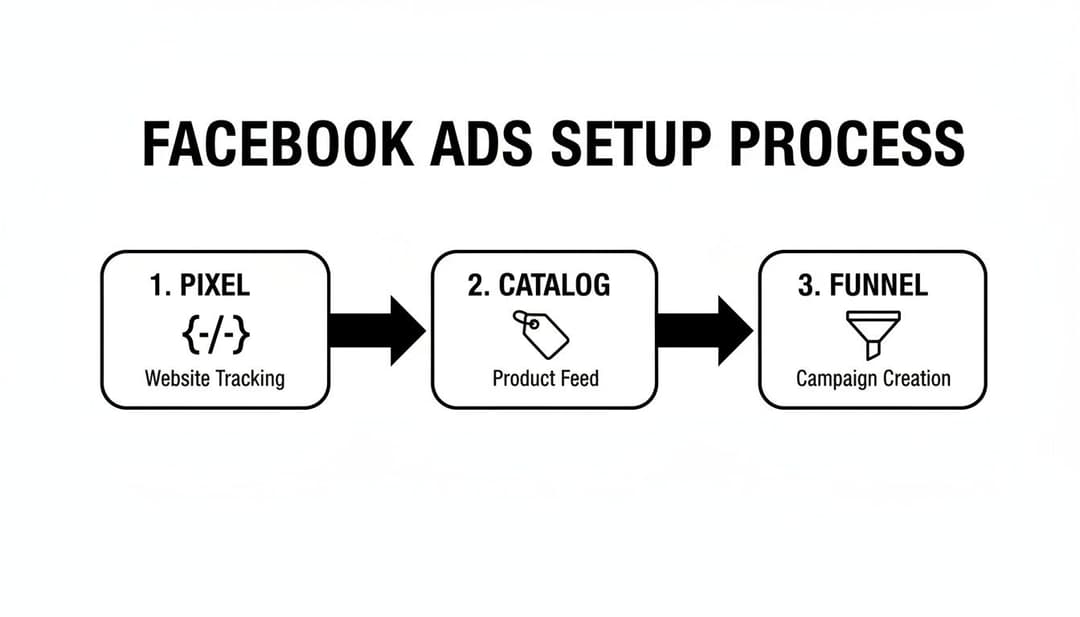
Each of these steps builds on the last. If you need a hand with the first part, our guide on how to set up the Facebook Pixel walks you through it.
Mapping Your Full-Funnel Strategy
Once the technical pieces are in place, it's time to think strategically. A full-funnel approach is about guiding potential customers from "who are you?" to "take my money!" It’s not just about running a single conversion campaign; it's about engineering a complete customer journey.
The dropshipping market is absolutely massive—it was valued at $445.5 billion in 2025 and is projected to hit $1,253 billion by 2030. With an 18.3% profit boost over traditional retail, the opportunity is huge if you get your marketing right. This kind of growth makes having a structured funnel more critical than ever.
One of the biggest mistakes I see is marketers focusing only on bottom-of-funnel conversion ads. They're essential, of course, but they work so much better when you're also running top-of-funnel campaigns to build awareness and middle-of-funnel campaigns to nurture interest.
Your strategy should have distinct campaigns for each stage:
- Top of Funnel (ToFu): This is all about awareness. You're reaching a broad, cold audience that has probably never heard of you. Use engaging video view or traffic campaigns to introduce your product and get on their radar.
- Middle of Funnel (MoFu): Now you're targeting people who have engaged with your brand—they've watched a video, visited your site, etc. The goal here is consideration. Use objectives like "Add to Cart" to nudge them closer to a purchase.
- Bottom of Funnel (BoFu): Time to close the deal. Here, you retarget high-intent users, like cart abandoners. Dynamic Product Ads are absolute gold at this stage, reminding them of the exact products they almost bought.
By building campaigns for each stage, you create a cohesive system that doesn't just find one-off customers but consistently generates and converts new leads, setting you up for real, sustainable growth.
Creating Ad Content That Actually Converts
Once your technical setup is solid, it's time to focus on the single biggest lever you can pull in dropshipping with Facebook ads: your creative. In a feed crammed with similar products and generic ads, compelling content is your secret weapon. It’s what stops the scroll, builds instant trust, and convinces someone to actually click "Shop Now."
This isn't about having a Hollywood-sized production budget. Not even close. It’s about understanding the psychology of the platform and making ads that feel native and authentic. Your goal is to blend in with your audience's personal feed content while standing out with an offer that’s impossible to ignore.
Proven Creative Frameworks That Drive Sales
Forget those flashy, over-produced commercials. The ads that consistently win on Meta are the ones that feel real and relatable. These formats build instant credibility and cut right through the noise of traditional advertising.
Here are three frameworks I’ve seen work wonders for dropshipping products:
- User-Generated Content (UGC): This is the gold standard, period. UGC-style ads, even if you pay a creator to make them, look like genuine reviews from real customers. They build social proof and trust faster and more effectively than any polished brand video ever could.
- Problem-Solution Videos: A direct-response classic for a reason—it just works. The first 3 seconds show a common, frustrating problem your ideal customer deals with. Then, your product swoops in as the simple, elegant solution, followed by a quick demo of its benefits.
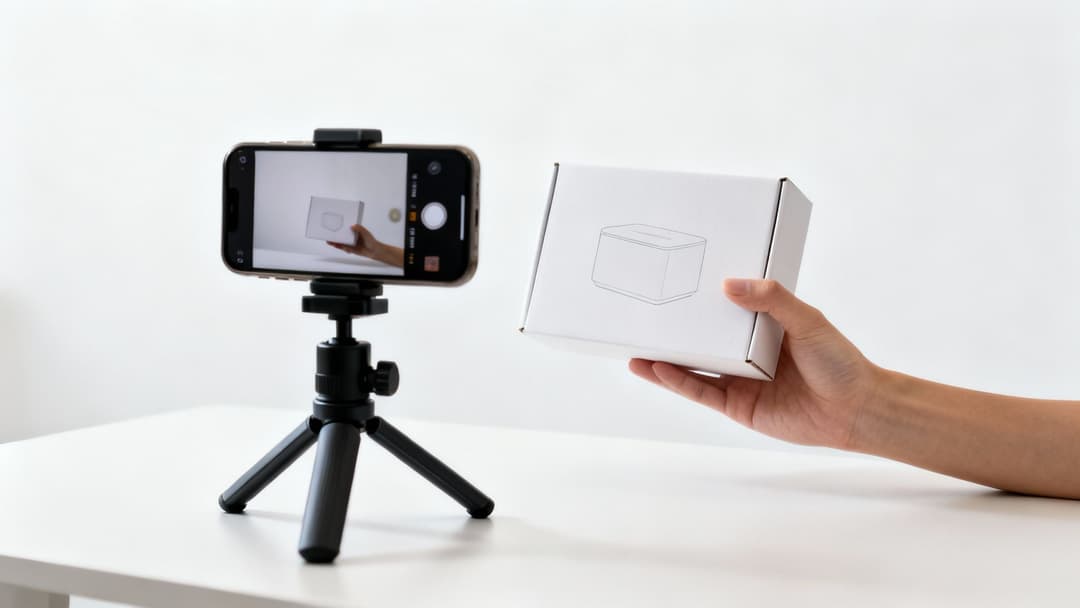
- Unboxing and First Impressions: These videos tap into that universal excitement of getting a new package. They showcase the product in a raw, authentic way, highlighting its quality and features as someone experiences it for the very first time.
Writing Copy That Persuades
Your ad's visual hooks their attention, but your copy is what closes the deal. Strong ad copy speaks directly to the customer's pain points and desires, smoothly guiding them from curiosity to conversion. One of the most effective structures for this is the AIDA framework.
AIDA Framework Breakdown
- Attention: Hook them immediately. Start with a bold question, a surprising statistic, or a relatable pain point right in the first line.
- Interest: Build on that hook by explaining the benefits, not just the features. How will this make their life better, easier, or more fun?
- Desire: Create an emotional connection. Use social proof (like, "Join 10,000+ happy customers!") and paint a vivid picture of the awesome outcome they'll experience.
- Action: Tell them exactly what to do next with a clear, urgent call-to-action (CTA). Phrases like "Get 50% Off Today Only" or "Tap Shop Now to Claim Yours" create urgency and get the click.
Of course, to really maximize your ROI, you'll need to master some high-impact conversion optimization techniques. For a deeper dive into persuasive writing, check out our guide to writing great ad copy that converts: https://www.adstellar.ai/blog/great-ad-copy
The Power of AI in Creative Testing
The biggest grind in dropshipping with Facebook ads is finding that winning combo of creative, copy, and audience. Manually creating and testing dozens—or hundreds—of variations is painfully slow and expensive. This is where AI tools completely change the game.
Platforms like AdStellar AI can generate hundreds of ad variations in minutes. Just upload a few product images and videos, provide some core messaging points, and the AI will spit out a massive volume of combinations of headlines, primary text, and visuals. This lets you test way more ideas at a fraction of the time and cost.
By automating this bulk creation and testing, you can pinpoint your top-performing ads with incredible speed. The AI crunches real-time data to tell you which images, hooks, and CTAs are driving the highest ROAS. This means you can double down on your winners and scale your campaigns with confidence, not guesswork.
Mastering Audience Targeting and Ad Spend
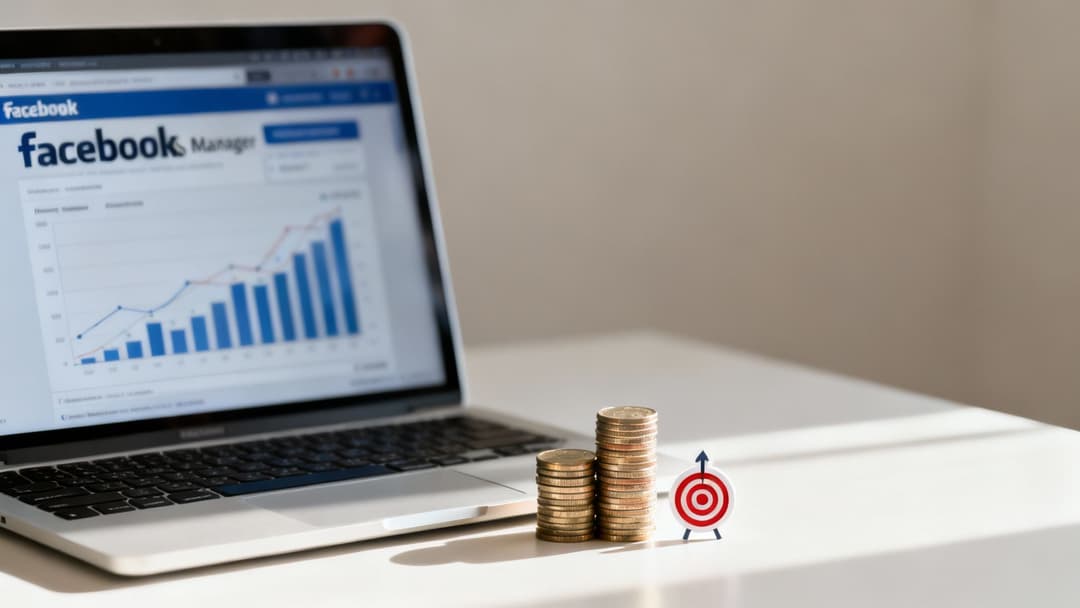
Let’s be honest: a brilliant ad creative is completely useless if it’s shown to the wrong people. This is the exact point where most dropshippers either strike gold or burn through their entire budget with nothing to show for it.
Getting a handle on audience targeting and how you spend your money is the core skill separating a six-figure store from one that never gets off the ground.
The game isn't just about finding people who might be interested. It’s about finding pockets of high-intent buyers and methodically pouring fuel on the fire once you've proven they convert. This takes a layered approach, moving from broad exploration to laser-focused precision.
Starting Broad to Gather Crucial Data
When you're launching a new product, you don't really know who your best customer is. You might have a solid hunch, but the data always tells the true story. That’s why the first phase of any new dropshipping campaign on Facebook should start with broad, interest-based targeting.
Forget trying to pinpoint some hyper-niche audience from day one. Instead, group several related interests into a single ad set. For example, if you're selling a slick portable coffee maker, you could build out a few "interest stacks" to test against each other:
- Hiking & Outdoors: People who need their caffeine fix on the go.
- Espresso & Barista: Coffee snobs who appreciate a quality brew, anywhere.
- Remote Work & Digital Nomads: Professionals who work from anywhere and everywhere.
The goal here isn't immediate profitability. The real objective is to feed your Meta Pixel with data—specifically, link clicks, add-to-carts, and those first precious purchases. This early data is the raw material for your most powerful audiences down the line. To really dig into this process, check out our guide on how to identify a target audience for your business.
Unlocking Power With Lookalike Audiences
Once your pixel has a decent amount of data (I usually aim for at least 100-500 purchase events), it's time to build Lookalike Audiences. This, my friends, is where the magic happens. A lookalike is you telling Meta, "Go find me more people who look and act just like my existing customers."
These audiences almost always outperform interest-based targeting because they’re built from your actual, real-world conversion data.
A 1% Lookalike Audience based on your "Purchase" event is often the most potent audience you can build. It represents the top 1% of users in your target country who most closely resemble your paying customers. It's the first place I look when it's time to scale.
As more data flows in, you can build lookalikes from other high-intent events, like "Add to Cart" or "Initiate Checkout," to further expand your reach to qualified buyers.
ABO vs. CBO: A Practical Budgeting Guide
How you spend your budget is just as important as who you target. On Meta, you have two main options: Ad Set Budget Optimization (ABO) and Campaign Budget Optimization (CBO).
- ABO (Ad Set Budget Optimization): This is where you set a specific budget for each individual ad set. It gives you total control over how much you spend testing a particular audience.
- CBO (Campaign Budget Optimization): With CBO, you set a single budget at the campaign level. Meta's algorithm then automatically distributes that budget to the best-performing ad sets in real time.
For your initial testing phase, ABO is your best friend. I recommend setting a daily budget of $20-$30 per ad set. This ensures each of your audiences gets a fair shot to perform without Meta pulling the plug too early.
Once you've identified two or three winning ad sets from your ABO testing, it's time to scale. Move those winners into a brand new CBO campaign. This lets Meta efficiently allocate your larger budget to the audiences delivering the best ROAS at that moment.
Facebook is still a powerhouse for e-commerce, influencing over 60% of US shoppers. With the platform's average click-through rate at 2.5% and a cost per click around $0.60, a smart budget strategy is non-negotiable. Don't forget, simply maintaining an active social presence can generate about 32% more revenue for dropshipping brands.
How To Test, Optimize, and Scale Your Winners
Getting those first few sales is an incredible feeling, but it’s just the starting line. The real money in dropshipping is made by turning that initial spark into a predictable, scalable profit machine. This is where disciplined testing and smart scaling separate the one-hit wonders from the seven-figure stores.
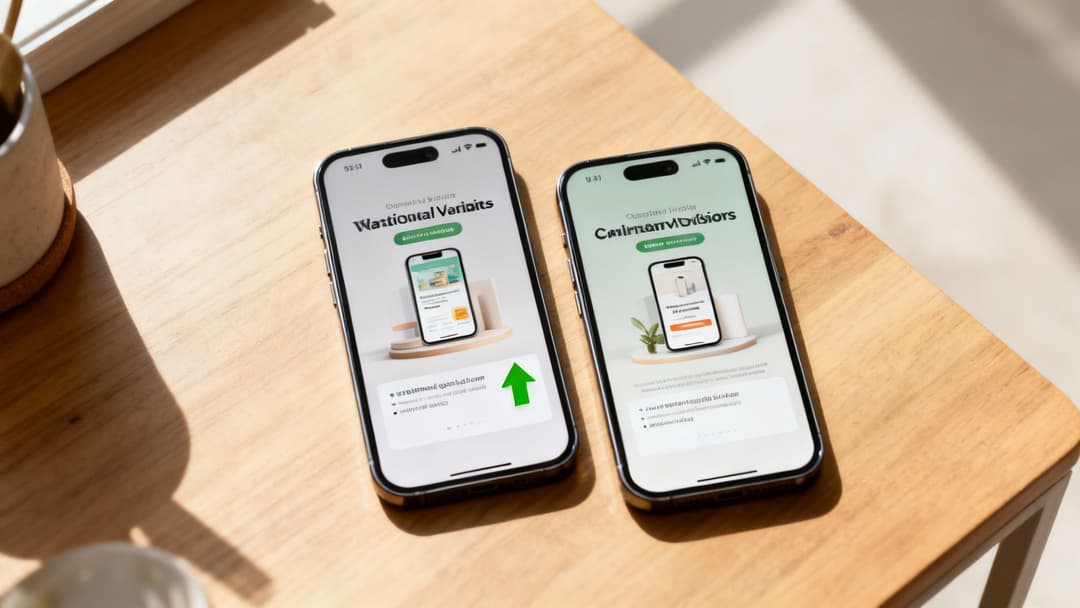
It all boils down to a methodical approach. You have to fight the urge to change ten things at once just because a campaign is struggling. To get clean, actionable data, you absolutely must test one variable at a time. Is it the creative? The audience? The headline? Isolating your tests is the only way you'll know for sure what's actually moving the needle.
Interpreting Your Dashboard for Profit
Your Meta Ads Manager is an ocean of metrics, and it’s easy to drown in data like CPMs or reach. That’s a rookie mistake. For a dropshipping business, only a handful of numbers truly dictate whether you're making or losing money.
These two KPIs should be your north stars:
- Cost Per Acquisition (CPA): This is your all-in cost to get one customer. You need to know your break-even point down to the dollar. If your profit on a product is $25 and your CPA is $30, you're losing money on every single sale—no matter how impressive your sales volume looks.
- Return on Ad Spend (ROAS): This shows you the total revenue you get back for every dollar you put in. A 2.0 ROAS means you made $2 for every $1 spent. For most dropshipping products, aiming for a 3.0+ ROAS is where you start seeing real, sustainable profit.
Sure, metrics like Click-Through Rate (CTR) and Cost Per Click (CPC) can be useful for diagnosing problems—a garbage CTR usually points to weak creative—but they don't pay the bills. Always, always optimize for CPA and ROAS above everything else.
Proven Methods for Scaling Your Winners
Okay, so you've found an ad set that's consistently crushing your target CPA and ROAS. Now it's time to scale. This is where you pour fuel on the fire, but you have to do it strategically or you’ll torch your budget and kill your campaign’s momentum.
There are two main ways to scale up.
Vertical Scaling: Increasing the Budget
This is the most straightforward method: you just gradually increase the daily budget of your winning ad set. The key word here is gradually.
A classic rule of thumb is the 20% rule. Only increase an ad set's budget by a maximum of 20% every 24-48 hours. A sudden, massive budget jump can send Meta's algorithm into shock, forcing it back into the learning phase and often wrecking your performance.
Horizontal Scaling: Expanding Your Reach
This is all about taking what works—your winning creative and copy—and showing it to new groups of people. You’re basically cloning your success across different audience segments.
Here are a few ways to do it:
- Launch New Lookalike Audiences: If a 1% Purchase Lookalike is performing well, it's time to test a 1-3% or 3-5% lookalike to find more buyers.
- Test New Interest Groups: Take your best ad and aim it at new, related interests you haven't touched yet.
- Duplicate the Ad Set: Seriously, sometimes just duplicating a winning ad set with zero changes can tap into a fresh pocket of converting users within the exact same audience. It sounds weird, but it works.
Once you have a few winning campaigns under your belt, you can explore more proven growth tactics for scaling Facebook ads to really blow up your revenue. We also have a comprehensive guide on how to scale Facebook ad campaigns that dives even deeper.
The Role of AI in Scaling
Let’s be honest: manually babysitting campaigns, tweaking budgets, and launching new tests is a 24/7 grind. This is exactly where AI-powered tools like AdStellar AI can be a game-changer, automating the entire optimization and scaling workflow.
These platforms can automatically spot your best-performing ads based on your ROAS and CPA targets. From there, they can intelligently shift your budget to those winners in real time and even spin up new campaigns using your top creative and audience combinations.
This kind of constant monitoring is critical. We've seen case studies where single ad sets spend $10,000 to bring in $27,000 in revenue. But the data also shows ad fatigue is a silent profit killer. Viewers who see the same ad six or more times have a 16% drop in purchase intent. This means you have to keep feeding the machine fresh creative. Automating this process ensures you're always scaling what’s working today without burning out your audiences tomorrow.
Keeping Your Ad Account Safe From Meta’s Hammer
Nothing tanks a profitable dropshipping campaign faster than seeing that dreaded red notification: "Your ad account has been disabled." It's a gut-wrenching moment. Many dropshippers fail not because their products are bad or their ads don't convert, but because they accidentally trip one of Meta's countless policy wires, leading to ad rejections, restrictions, or a full-blown ban.
If you want to stay in this game for the long haul, you have to treat Meta’s ad policies as a core pillar of your business, not just some annoying fine print. Think of it as learning the rules of the road before you start sending traffic.
The Most Common Policy Violations
Ad account shutdowns rarely happen out of the blue. They're almost always triggered by specific, often repeated, mistakes that Meta's automated review systems are built to catch. Staying safe means knowing exactly what those red flags are and avoiding them like the plague.
Here are some of the fastest ways dropshippers get their ads rejected or accounts flagged:
- Unrealistic Claims: This is a big one. Ads promising the world, like "lose 30 pounds in a week" or "get rid of wrinkles overnight," are an express lane to getting shut down. Your claims have to be believable and something you can actually back up.
- Copyright Infringement: Never, ever use popular music, clips from movies, or photos of celebrities in your ads without getting explicit permission first. This is a direct violation that can get your account banned instantly.
- Misleading Brand Associations: You can't make it look like you're affiliated with Meta, Facebook, or Instagram. That means no using their logos or making your ad creative look like a part of their official user interface.
- A Sketchy Landing Page: Meta’s review doesn't stop with your ad. Their bots crawl your website, checking for clear shipping policies, easy-to-find contact info, and a professional, trustworthy experience. A low-quality, slapped-together site is a major red flag.
Your ad account is the most valuable asset you have in this business. Protect it. That means reading the actual ad policies yourself, not just going off what you heard in a Facebook group. A couple of hours of reading now can save you from months of headaches later.
How to Proactively Stay Out of Trouble
Instead of waiting for a problem to happen, build your entire operation on a foundation of compliance. This is about creating good habits that put policy and customer trust first. Your on-site policies—shipping times, returns, refunds—need to be crystal clear and easy for anyone to find.
For your ad creatives, stick to royalty-free music and stock footage. Even better, make your own content. Be completely transparent in your ad copy and on your product pages. If shipping is going to take three weeks, just say that upfront. Don't bury it in the fine print. Building a brand people trust is your absolute best defense against account issues.
Troubleshooting When Performance Suddenly Dips
Even with a perfectly healthy account, performance will have its ups and downs. The key is to diagnose the issue correctly instead of panicking and turning everything off. Often, the culprit is simple ad fatigue—your audience has just seen your ad too many times, and it's gone stale. The fix? Get fresh creative in there on a regular basis.
Another common problem is a sudden spike in CPMs (your cost to reach 1,000 people). This can be caused by more competition in the auction or because you've saturated your audience. To fight this, start testing new interest groups or broaden your lookalike audiences to find fresh pockets of customers.
If you run into a situation where your ads just aren't spending money at all, our guide on what to do when your Facebook ad is not delivering has a step-by-step checklist to help you figure it out. When you learn to systematically find and fix these issues, you build a much more resilient advertising machine.
Still Have Questions? Let's Clear Things Up.
Diving into dropshipping with Facebook ads can feel like learning a new language. You're bound to have questions, especially when you're just starting out. Here are the straight answers to some of the most common things we hear from marketers and store owners trying to get their campaigns off the ground.
How Much Money Do I Actually Need to Start?
Look, there’s no magic number, but going in with a realistic testing budget is non-negotiable. You’ll want to have somewhere between $500 and $1,500 set aside purely for this initial phase. This isn't your profit-making budget; it's your data-buying budget.
This gives you enough breathing room to properly test a few different products, angles, and audiences. If you try to do it with less, you’ll likely burn out before a campaign even has a chance to find its footing.
A solid approach is to set a daily budget of $20-$50 for each ad set you're testing. The goal here is simple: gather enough data to make smart decisions. Are people clicking? Are they adding to cart? Rushing this part with a tiny budget is the fastest way to kill a potentially great product because you’ll make calls based on a handful of clicks, which is just gambling.
What’s a “Good” ROAS for Dropshipping?
This is the million-dollar question, and the honest answer is: it depends entirely on your product margins. But if you want a general benchmark to aim for, most dropshippers consider a 3.0 ROAS to be the sweet spot. Put simply, that means for every $1 you spend, you’re making $3 back in revenue.
If you’re selling something with fat margins, you might be perfectly profitable at a 2.5 ROAS. On the flip side, if you're dealing with razor-thin margins, you might need a 4.0 ROAS or even higher to make it all worthwhile.
It's also completely normal for your ROAS to be low—or even negative—when you first start testing. Don't panic. The initial goal isn't profit; it's to find the winning combination of creative and audience that you can later scale into your target ROAS zone.
Why Aren’t My Facebook Ads Getting Any Sales?
This is easily one of the most frustrating feelings in e-commerce. You're spending money, but nothing's happening. When this happens, it's almost always a problem in one of a few key areas of your funnel. It’s time to play detective.
Start by asking yourself these questions:
- Does anyone actually want this product? Before you start blaming Facebook, be honest. Is there real demand for what you’re selling at your price point?
- Is my ad creative boring? Your Click-Through Rate (CTR) will tell you the truth. A low CTR is a dead giveaway that your creative or copy just isn't stopping the scroll.
- Is my website the problem? If you’re getting plenty of clicks but no one is adding to cart, the issue is almost certainly on your landing page. Check your site speed, make sure your layout is clean (especially on mobile!), and test your checkout process.
- Is my targeting off? Are you showing ads for fishing gear to people who are interested in makeup? Double-check that your audience targeting makes sense.
Systematically work your way down the customer journey, from the ad all the way to the checkout button. When you find the spot where everyone is dropping off, you've found the bottleneck. Fix that, and you'll start seeing sales.
How Can AI Tools Like AdStellar AI Actually Help Me?
Think of AI tools as a massive force multiplier. Their biggest advantage comes down to two things: speed and scale. Manually creating dozens of ad variations—testing different images, headlines, copy, and audiences—is a slow, painful grind.
An AI platform can spit out hundreds of those combinations in the time it takes you to make a cup of coffee. This radically shortens the path to finding a winning ad that actually makes you money.
Beyond that, tools like AdStellar AI analyze performance data around the clock, telling you exactly which creative elements are driving results. Then, its automated scaling features can intelligently push your budget toward the ads that are working best, so you can capitalize on a winner without having to stare at your Ads Manager all day.
Ready to stop guessing and start scaling? AdStellar AI can help you launch, test, and scale your Meta ad campaigns up to 10x faster. Automate your ad creation, uncover data-backed insights, and let AI find and scale your winners for you.
Discover how AdStellar can transform your dropshipping business at https://www.adstellar.ai.