E-commerce advertising is the engine that connects your online store with millions of potential buyers. It's how you place your digital storefront on the world's busiest streets, using paid strategies to invite the right people inside.
This guide breaks down how modern brands win, from choosing the right channels to measuring what truly matters for growth.
Your Foundation for Advertising Success
Think of e-commerce advertising not as a technical maze, but as a direct line to your future customers. Without it, even the best online store is like a brilliant shop hidden on a quiet backstreet—full of amazing products but completely invisible.
Strategic advertising doesn't just put your brand in front of shoppers who are already looking for what you sell; it also introduces you to new audiences who don't even know they need you yet.
The core idea is simple: you invest money to place targeted ads where your potential customers spend their time. That could be their social media feeds, search engine results, or other websites they browse. The goal is to drive qualified traffic to your site and, ultimately, turn that traffic into sales. This is far more than just "boosting" a post; it's a calculated system for growth.
Building Your Strategic Pillars
A successful advertising program is built on four key pillars that have to work together. If you neglect one, the entire structure gets wobbly. These pillars are your roadmap to turning ad spend into predictable revenue.
- Choosing the Right Channels: Not all platforms are created equal. Your strategy needs to match your ads to the places where your target audience is most engaged, whether that's Google, Meta, or TikTok.
- Understanding Your Audience: Who are you actually talking to? Deeply knowing your customer's needs, pain points, and online habits is the only way to create messages that genuinely connect.
- Crafting Compelling Creative: Your ads have one job: stop the scroll. This pillar covers everything from eye-catching visuals and persuasive copy to a clear call-to-action that tells people exactly what to do next.
- Measuring What Matters: Data is your compass. You have to track the right metrics to understand what’s working, what isn’t, and how to optimize your campaigns for better results. For this to work, it's critical to understand how tracking tools function; our guide on what the Facebook Pixel is is a great place to start.
An effective strategy combines these pillars to create a repeatable system for customer acquisition. It moves beyond random tactics and focuses on building a scalable engine for growth, ensuring every dollar spent is an investment in your brand's future.
Getting this right has never been more critical. Global digital ad spending is projected to blow past $700 billion by 2025, making up over 65% of all advertising budgets. This massive shift shows just how brands are fueling their growth in a booming $6.4 trillion global e-commerce market.
To build a strong base, it's vital to understand what works on specific platforms. For instance, a solid guide to mastering ROI and growth through effective Amazon Advertising Management can provide platform-specific insights. This guide will walk you through each of these foundational elements, giving you actionable workflows to build a powerful strategy from the ground up.
Choosing the Right Advertising Channels
Picking the right ad channels for your e-commerce brand is a lot like choosing the perfect spot for a brick-and-mortar store. You wouldn't open a high-end boutique in the middle of an industrial park, right? The same logic applies online—you have to show up where your ideal customers are already spending their time. Your channel mix is the absolute foundation of your entire ad strategy, dictating who you'll reach and how you'll reach them.
A winning approach isn’t about spraying your budget across every platform under the sun. It's about making smart, strategic choices that align with your goals. Are you trying to build brand awareness? Capture shoppers who are ready to buy right now? Or bring back people who’ve visited your site before? Each channel plays a unique role in that customer journey.
The graphic below lays out the core pillars of a solid ad strategy, and it all starts with that critical first step: choosing your channels.
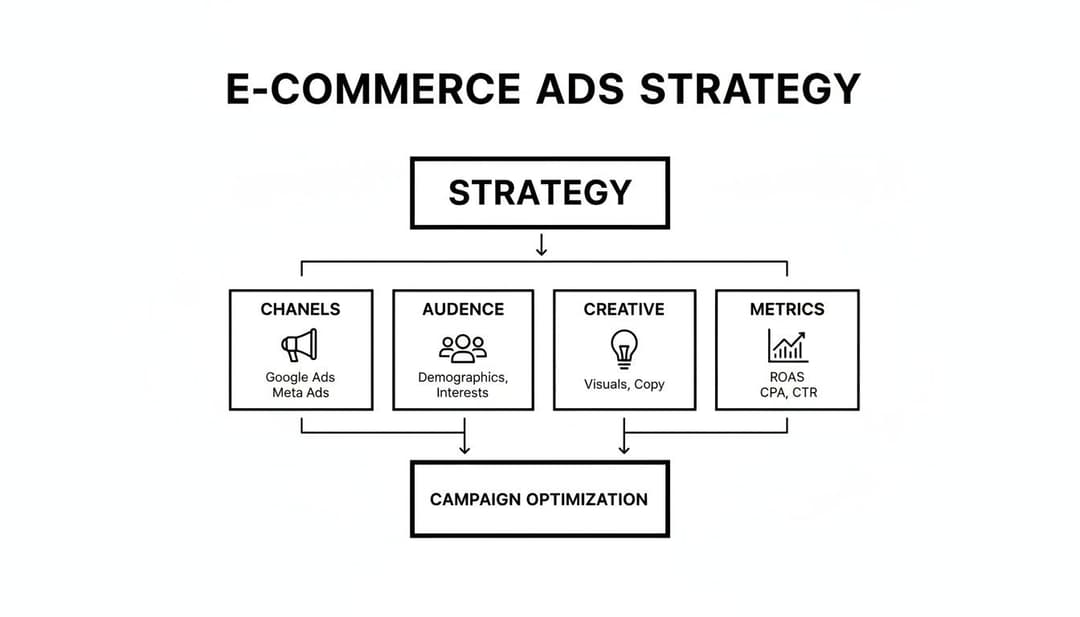
As you can see, once your main strategy is defined, your channel selection is the first tactical move. It directly influences your audience targeting, creative direction, and how you’ll measure success down the line.
Capturing Demand with Google Ads
When it comes to capturing existing demand, Google Ads is the undisputed king. Think about it: when people know what they want and are actively looking for it, their first stop is almost always Google. This makes it an absolutely essential channel for funneling high-intent traffic straight to your product pages.
It's like setting up a pop-up shop right at the finish line of a marathon. These shoppers have already decided they need a product like yours; your job is just to convince them that your product is the one to buy. For e-commerce brands, two ad types are particularly powerful here:
- Google Search Ads: These are the classic text-based ads you see at the top of the search results. They’re perfect for targeting super-specific, long-tail keywords that signal someone is ready to pull out their wallet, like "buy organic cotton baby onesie."
- Google Shopping Ads: You know those visually-driven product listings with images and prices that pop up? That's them. They command a staggering 76% of search ad spend from e-commerce brands for a reason—they grab attention and drive clicks from people who are primed to purchase.
Generating Demand on Meta Platforms
While Google is fantastic for capturing demand, platforms like Meta (that’s Facebook and Instagram) are masters at creating it. This is where you get to introduce your brand to people who aren’t actively searching for your products but are very likely to be interested based on their demographics, hobbies, and online behavior.
Meta's real power comes from its incredibly deep audience-targeting options and its visual-first ad formats. It gives you a canvas to tell your brand's story with stunning images and videos, stopping users mid-scroll and sparking that initial flicker of interest.
Use Meta to build a community and create desire. It's less about the hard sell and more about showcasing your brand's lifestyle and value, making it the perfect top-of-funnel channel for customer acquisition and brand awareness.
Expanding Your Reach with Other Key Channels
Beyond the two giants, a truly well-rounded advertising strategy often includes a mix of other channels. Diversifying your ad spend is just smart business—it helps you tap into different audience segments and protects you from having all your eggs in one basket. If you're looking to explore more options, you can find a detailed breakdown of the top ad networks for advertisers in our dedicated guide.
Consider adding these heavy hitters to your channel mix:
- Programmatic Advertising: This is essentially the automated buying of ad space across millions of websites. It’s an absolute powerhouse for sophisticated retargeting campaigns, letting you show specific ads to users who visited your site but left without buying. You can effectively "follow" them around the web to gently nudge them back.
- TikTok: With its explosive growth, especially among younger crowds, TikTok offers an incredible opportunity for viral marketing. The short-form video format is perfect for authentic, user-generated-style content that entertains first and sells second.
- Pinterest: This platform is a visual discovery engine where people go to find inspiration and plan purchases. If your brand is in a visual niche like home décor, fashion, or food, you can thrive here by creating beautiful "Pins" that link directly to your products.
Ultimately, your channel strategy should be a dynamic portfolio. Start with one or two platforms that are a natural fit for your goals. Master them, learn from the data, and then methodically expand as your budget and confidence grow.
Mastering Audience and Creative Strategy
Picking the right channels for your e-commerce ads is just the start. The real magic happens when you figure out who you're talking to and what you're saying to them. Even a perfectly placed ad will flop if it delivers the wrong message to the wrong person. This is where your audience and creative strategies become the twin engines of your campaign.
Think of your audience strategy as drawing a hyper-detailed map to find your ideal customers. Instead of shouting your message into a crowded room, you're whispering it directly to the people most likely to lean in and listen. And if your audience is the 'who', your creative is your 'hello'—it's that split-second visual handshake that decides if they keep scrolling or stop to learn more.

Building Your Ideal Audience Segments
The best place to start is with the people who already know and love your brand. This isn't just low-hanging fruit; it's the rich data source that modern ad platforms use to build incredibly powerful targeting tools. You’re not just guessing anymore.
The goal is to move beyond broad demographics like "women ages 25-40" and get into precise, behavior-based segments that actually drive sales. Here are the three core audience types you need to be building right now:
- Customer Lists: This is your foundation. Upload a list of past buyers to create a Custom Audience. You can then re-engage them with new products, exclusive offers, or loyalty rewards. They're your warmest leads.
- Website Visitors: By installing tracking pixels, you can build audiences of people who have visited your site, looked at specific products, or even ditched their shopping carts. This is the fuel for incredibly effective retargeting campaigns.
- Lookalike Audiences: This is where things get really interesting. Platforms like Meta can analyze the traits of your best customers and find millions of new users who share similar characteristics and buying behaviors. It’s like cloning your best customers.
Your audience strategy isn't a "set it and forget it" task. It's a living thing that should evolve as you collect more data. A small, highly engaged audience of proven buyers will almost always outperform a massive, generic one. Start with your core customers and expand from there.
Crafting Creative That Converts
Okay, you've identified who you're talking to. Now you need to craft a message that actually connects with them. Your ad creative—the mix of visuals, copy, and call-to-action—has just a few seconds to stop the scroll and earn that click. In a feed overflowing with content, generic visuals and boring copy are completely invisible.
Effective creative follows a simple formula: grab attention, clearly state your value, and tell people exactly what to do next. Success isn't about chasing one "perfect" ad; it’s about building a system for testing and learning what truly resonates. To see how top brands nail this, check out our deep dive into some of the most creative ad campaigns and the strategies behind them.
This process is absolutely critical because the ROI of your ad spend hinges on personalization. Tailored ads can deliver up to 80% higher conversion rates than generic ones. That’s a massive edge, especially in a market where mobile advertising now accounts for over 70% of total ad budgets.
The High-Tempo Testing Framework
The most successful advertisers don't rely on guesswork—they test. High-tempo testing is a method for rapidly launching multiple ad variations to quickly find the winning combinations of creative and copy. This turns ad creation from a slow, painful bottleneck into a data-driven growth engine.
Here’s a simple breakdown of how it works:
- Develop a Hypothesis: Start with a clear idea. For instance, "A video showing our product in a real-life setting will outperform a static image on a white background."
- Create Variations: Build out multiple components to test your hypothesis. This could mean testing three different headlines, two ad images, and two calls-to-action against each other.
- Launch and Learn: Run all the variations at the same time to a specific audience. Ad platforms will automatically start shifting the budget toward the top performers.
- Analyze and Iterate: Once you have enough data, look at the results. Cut the losers, double down on the winners, and use what you learned to inform your next round of tests.
By constantly running these small experiments, you create a powerful feedback loop. This iterative approach allows you to systematically improve performance, ensuring your creative strategy is always optimized based on real customer behavior, not just your assumptions.
Measuring Performance with Analytics
Running ads without tracking performance is like driving a race car blindfolded. You might be moving fast, but you have no idea if you’re heading for the finish line or a brick wall. To really get your advertising off the ground, you need to measure what works, what doesn't, and why. This is where analytics and attribution come in, turning confusing data into a clear roadmap for growth.
It all starts with getting a handle on attribution models. Think of attribution as giving credit where it's due. When a customer makes a purchase, they've likely interacted with your brand multiple times. Was it the Facebook ad they saw last week, the Google search they did yesterday, or the email they clicked this morning? Attribution helps you figure that out.

Understanding Common Attribution Models
The attribution model you choose shapes how you value each channel in your marketing mix. There's no single "perfect" model; the right one depends on your business and how complex your customer's path to purchase is.
Here are the most common models, broken down:
- Last-Touch Attribution: This one is simple. It gives 100% of the credit to the very last ad a customer clicked before buying. It’s easy to track, but it completely ignores the channels that first introduced the customer to your brand.
- First-Touch Attribution: The exact opposite. This model gives 100% of the credit to the first ad a customer ever interacted with. It’s fantastic for seeing which campaigns are doing the heavy lifting to generate initial awareness.
- Linear Attribution: This model is the diplomat. It spreads the credit evenly across every single touchpoint in the customer's journey. If someone saw a Facebook ad, then a Google ad, then clicked an email, each channel would get an equal slice of the credit.
Getting familiar with these models is your first step toward accurately reading the data in tools like Google Analytics and making much smarter decisions about where to put your money.
Focusing on Metrics That Drive Growth
It’s incredibly easy to get distracted by vanity metrics—things like likes, shares, and impressions. They feel good to look at, but they don't directly translate into sales. Successful e-commerce advertising means tuning out the noise and focusing on the numbers that actually reflect the health of your business.
The goal isn't just to get clicks; it's to acquire profitable customers. This requires a shift from chasing engagement to optimizing for tangible business outcomes like revenue and customer value.
Here are the three most important metrics every e-commerce advertiser should live and breathe:
- Return on Ad Spend (ROAS): This is the ultimate measure of whether your ad campaigns are actually making you money. It calculates how much revenue you generate for every single dollar you spend on ads. A 4:1 ROAS, for instance, means you’re making $4 for every $1 spent. You can learn more about this crucial figure in our complete guide to what Return on Ad Spend is.
- Customer Acquisition Cost (CAC): This metric tells you exactly how much it costs, on average, to get a new customer through your advertising. A low CAC is absolutely essential for keeping your profit margins healthy.
- Customer Lifetime Value (LTV): LTV is a prediction of the total revenue a single customer will bring in over their entire relationship with your brand. A high LTV is a game-changer because it allows you to spend more to acquire a customer (a higher CAC), knowing they'll be profitable for you in the long run.
When you set up your tracking correctly and laser-focus on these core metrics, you stop guessing. You build a data-backed system that gives you a crystal-clear picture of your campaign performance, allowing you to confidently scale what’s working and cut what isn’t.
How to Budget and Scale Your Campaigns
So, your e-commerce ads are finally running, and you've got some data trickling in. You can see what's working. This is where the real fun begins: scaling.
Scaling isn't about blindly dumping more money into your ad accounts. It’s a calculated process of doubling down on your proven winners to drive profitable growth. Think of it like a successful restaurant owner who wants to expand. They don't just randomly build a second location; they replicate the exact recipe, location strategy, and service that made the first one a runaway hit.
The same idea applies here. You start small, prove your strategy by finding winning ads and audiences, and then you methodically scale what's working. This disciplined approach is how you pump up your ad spend without watching your returns evaporate.
Foundational Budgeting Strategies
Before you can hit the accelerator, you need a solid budget strategy in place. How you manage your funds on platforms like Meta can make or break your performance. You have a couple of key choices to make.
First up is the choice between a daily budget and a lifetime budget. A daily budget tells the platform to spend up to a set amount each day, which is perfect for steady, ongoing campaigns. A lifetime budget, on the other hand, gives the platform a total amount to spend over the campaign's entire run, giving it the flexibility to spend more on days when opportunities are ripe.
Another fantastic tool in your arsenal is Campaign Budget Optimization (CBO). With CBO, you set a single budget at the campaign level and let Meta's algorithm automatically divide it among your ad sets. It smartly funnels more cash toward your best-performing audiences and creatives in real-time, maximizing your results without you having to constantly tinker. For a deeper dive, our guide on marketing budget allocation lays out more advanced models.
Choosing Your Scaling Method
Once you've got a campaign humming along with a strong Return on Ad Spend (ROAS), it's time to add more fuel to the fire. Scaling generally breaks down into two main approaches: vertical and horizontal.
Here's a quick look at how they stack up against each other.
Campaign Scaling Strategies Comparison
| Scaling Method | How It Works | Best For | Key Risk |
|---|---|---|---|
| Vertical Scaling | Gradually increasing the budget of a high-performing, existing ad set or campaign. | Proven, stable campaigns where you want to maximize returns from a winning formula. | Increasing the budget too quickly can knock the algorithm out of its learning phase and tank performance. |
| Horizontal Scaling | Duplicating a winning ad set and targeting a new, similar audience (e.g., new lookalikes, interests). | Expanding your reach to find new customer pockets after an audience has been saturated. | The new audience may not respond as well, leading to wasted spend if not monitored closely. |
Let's break these down a bit further.
Vertical Scaling: This is the most direct method. You're simply increasing the budget of a campaign that's already crushing it. The trick is to do it slowly—a sudden, massive budget bump can spook the algorithm and reset its learning phase. A good rule of thumb is to increase the budget by no more than 20% every 2-3 days.
Horizontal Scaling: Instead of feeding more money to one ad set, you branch out to find new people. This means taking your winning ad creative and showing it to new lookalike audiences, different interest groups, or untapped demographic segments. It’s about finding new pools of customers who are just as likely to buy as your original audience.
The savviest advertisers rarely stick to just one method. They often combine both, vertically scaling their most reliable campaigns while simultaneously testing new audiences horizontally to grow their total market share.
This is where social media advertising becomes the undeniable rocket fuel for growth. With an average global growth rate of 18.1% annually through 2026, the opportunity is massive. According to the U.S. International Trade Administration, this trend perfectly mirrors e-commerce's expansion to $7.5 trillion in sales by 2025, where 2.77 billion shoppers are turning to platforms like Meta and TikTok to discover new products.
This enormous audience is a goldmine for both vertical and horizontal scaling. By carefully managing your budget and methodically expanding your campaigns, you can turn those small initial wins into a powerful, predictable revenue machine for your business. Just remember to let the data be your guide.
Solving Common Advertising Problems
Sooner or later, every advertiser hits a wall. Even the most buttoned-up campaigns can suddenly take a nosedive. Costs spike, returns plummet, or a platform slaps you with an ad disapproval out of the blue. It’s easy to panic and start hitting the pause button on everything.
Don't. The best thing you can do is stay calm and put on your detective hat.
Most advertising issues aren't random acts of chaos. They're symptoms, and the root cause usually lies in one of three places: your audience, your creative, or your offer. Learning to diagnose these symptoms is what separates the pros from the amateurs. It turns a potential disaster into a lesson that makes your entire strategy sharper.
Diagnosing a High Cost Per Acquisition
One of the most common—and frankly, terrifying—problems is a runaway Cost Per Acquisition (CPA). All of a sudden, you're paying way more to get a customer than you were last week, and your profit margins are getting torched.
Before you kill the campaign, you need to investigate. A high CPA almost always points to a mismatch somewhere in your funnel. It's time to work backward from the conversion and find where the friction is.
Here’s a quick diagnostic checklist:
- Audience Fatigue: Are you hammering the same small audience with the same ads? Check your ad frequency. If that number is climbing, people are probably sick of seeing your ads. Their eyes glaze over, click-through rates fall, and your costs go up.
- Creative Underperformance: Is your ad just not cutting through the noise? If your creative fails to stop the scroll, you won't get the clicks. The platform has to show your ad to way more people just to get a single action, which drives your costs through the roof.
- Landing Page Issues: The ad might be working perfectly, but what happens after the click? A landing page that loads at a snail's pace, a clunky checkout process, or surprise shipping costs are all conversion killers that will inflate your CPA.
Troubleshooting a Low Return on Ad Spend
Another headache that keeps advertisers up at night is a low Return On Ad Spend (ROAS). The money is going out, sales are coming in, but the math just isn't working. The revenue you're bringing in doesn't justify what you're spending.
A low ROAS often signals that you're paying too much for the traffic you're getting, or the traffic you're getting isn't converting at a high enough value. It's an efficiency problem at its core.
To fix this, you need to look at everything from top to bottom. Are you targeting broad, low-intent audiences who are just browsing with no real intention to buy? Is your offer actually compelling?
Sometimes the problem isn't the ad at all—it's the deal. A simple tweak, like adding a free shipping threshold or bundling products, can be the key to unlocking a much healthier ROAS.
Navigating Ad Disapprovals
And then there's the pure frustration of an ad disapproval. You’ve poured hours into crafting the perfect campaign, and a platform rejects it for a policy violation you can’t even decipher. Your momentum grinds to a halt.
The trick here is patience. Take a breath and read the platform’s feedback carefully. Most of these disapprovals are automated flags triggered by a keyword or something in your image.
Go through the ad policy they link to and compare it line-by-line with your ad copy and creative. More often than not, a tiny change—rephrasing a claim in your headline or swapping out a photo—is all it takes to get your ad approved and back in the game.
Of course. Here is the rewritten section, crafted to sound like it was written by an experienced human expert.
Frequently Asked Questions
Even the sharpest strategy runs into real-world questions. Let's tackle some of the most common ones that pop up when you're in the trenches of paid advertising for e-commerce.
How Much Should I Spend on E-Commerce Advertising When Starting Out?
There’s no single magic number here. A smart way to start is with a budget you're comfortable using strictly for learning—think somewhere in the ballpark of $500 to $1,000 per month.
Right now, your goal isn't profit. It's about buying data. Use that initial budget to run small, controlled tests on different channels (like Meta vs. Google), dip your toes into a few audiences, and see how a handful of ad creatives perform. In these early days, you're looking at leading indicators like Click-Through Rate (CTR) and Cost Per Click (CPC). Once you hit a combination that starts driving traffic and sales at a cost you can live with, you've earned the right to start methodically increasing your spend.
What Is a Good ROAS for an E-Commerce Business?
A "good" Return on Ad Spend (ROAS) is completely dependent on your profit margins. People love to throw around 4:1 ($4 back for every $1 spent) as a healthy industry benchmark, but that's just a guideline, not a rule.
A business selling high-margin products might be incredibly profitable at a 3:1 ROAS. On the flip side, a brand with razor-thin margins might need a 5:1 ROAS or even higher just to break even.
Your first step should always be to calculate your break-even ROAS. Anything above that number is pure profit. Don't forget to factor in Customer Lifetime Value (LTV), either. A lower ROAS on that first purchase is perfectly fine if you know that customer will come back and buy again.
This is the ultimate measure of your e-commerce advertising efficiency. Knowing your number is non-negotiable for running a profitable operation.
How Quickly Can I See Results from My Ad Campaigns?
This really depends on where you're spending your money. With high-intent channels like Google Search Ads, you're catching people who are already looking for what you sell. Because you're capturing existing demand, you can see results like clicks and even sales within a matter of days.
It’s a different story for channels like Meta or TikTok, where you're generating demand. You have to be more patient here. Expect a "learning phase" of one to two weeks where the platform’s algorithm is just figuring things out. Focus on traffic and engagement metrics during this time. To see sustainable, profitable results from these platforms, you should realistically plan for one to three months of consistent testing and optimization.
Ready to stop the manual grind and scale your Meta ads faster? AdStellar AI automates bulk ad creation, testing, and optimization, so you can focus on strategy, not setup. Generate hundreds of creative and audience combinations in minutes and let our AI identify the winning formulas for you.