You’re usually not chasing a badge for vanity. You’re trying to stop problems that show up first in the ad account.
A page gets impersonated during a promo. Support is slow. A legitimate campaign in a sensitive category gets flagged. Spend can’t scale cleanly because the account keeps tripping review systems. That’s when “facebook account verified” stops being a branding task and becomes an operations task.
For marketers managing paid social seriously, verification sits closer to compliance and account resilience than most articles admit. Meta presents it as an authenticity layer. In practice, it also affects how stable your page looks to the platform, how quickly issues get escalated, and how confidently a team can keep spend moving.
Why Getting Verified on Facebook Matters More Than Ever
Facebook built verification to fight impersonation, not to hand out status. The system started in 2012 for high-profile users as the platform raced from 900 million to 1 billion monthly active users between April and September of that year, and that authenticity layer still matters on a much larger network today. By Q4 2023, Facebook removed 1.1 billion fake accounts in a single quarter, and the platform had over 3 billion monthly active users as of April 2024 according to Statista’s Facebook industry overview.
That scale changes the meaning of verification. On a network this large, fake pages, cloned profiles, and low-trust entities aren’t edge cases. They’re part of the normal operating environment. If you run paid media, your page isn’t just a social asset. It’s part of your delivery infrastructure.
What marketers actually feel first
The first symptom usually isn’t “we want the checkmark.” It’s one of these:
- Impersonation risk: Fake pages siphon trust during launches, seasonal offers, or brand collaborations.
- Review friction: Ads that should pass get kicked back for manual review or vague policy reasons.
- Support bottlenecks: When something goes wrong, unverified entities often have less influence.
- Scale hesitation: Teams hold back budget because the account feels fragile.
That’s why I treat verification as part of account hygiene, alongside policy compliance, page setup, and clean Business Manager structure.
Verification matters most when something breaks. That’s when teams realize the badge was never cosmetic.
Why this matters for paid media teams
A verified page sends a trust signal to users, but it also sends one to Meta’s systems. That doesn’t mean verified accounts become immune to policy enforcement. They don’t. It does mean the business has done more to prove ownership, identity, and continuity.
For brands already tightening their Facebook strategy for marketing, verification is one of the cleaner ways to reduce avoidable platform friction. It won’t fix weak offers, poor creative, or sloppy compliance. But it can remove one layer of uncertainty from the stack.
That trade-off matters more now because many aren’t struggling with access to ad inventory. They’re struggling with trust, stability, and clean scaling.
Pre-Submission Checklist Eligibility and Documentation
Most verification rejections start before the application is submitted. The page is incomplete, the business details don’t line up, the branding changed recently, or the account looks inactive. Meta may not explain the exact reason clearly, but the pattern is easy to spot once you’ve seen enough denials.

The four filters your page has to pass
Meta’s review logic comes back to four practical tests:
Authenticity: The page has to represent a real person, brand, or business that can be substantiated with real-world documentation.
Uniqueness: It should be the primary presence for that entity, not one of several duplicate pages covering the same role or market without a clear reason.
- Notability: The brand or person needs a credible public footprint. That usually means an owned website, recognizable coverage, or a clear reason the account would be searched for.
- Completeness: The page has to look alive, maintained, and consistent.
What page completeness actually means
Marketers often underestimate this part because it sounds basic. It isn’t. Review systems read instability as risk.
Use this pre-flight check before you apply:
- Profile identity is locked: Profile photo, cover image, page name, username, and category all match your current brand presentation.
- About section is finished: Business description, website, contact details, and location are filled in and consistent with your external properties.
- Recent activity exists: A page with no posts, no engagement trail, or obvious abandonment is much harder to validate.
- Branding is consistent everywhere: Your Facebook page should match your site, Instagram, and ad creative naming.
- No recent profile edits: If you just changed the page name, swapped the username, or moved categories, wait until the account has settled.
A lot of teams rush this because they’re in campaign mode. That’s a mistake. A stable page converts better operationally than a freshly edited one, even before verification enters the picture.
Documents to prepare before you open a ticket
The documents depend on whether you’re verifying a person or a business page.
For an individual, expect to need:
- Government-issued ID
- A name that matches the account identity
- A profile setup that reflects the same public identity
For a business or brand page, prepare a simple file set:
- Business formation documents
- Tax or registration records
- Utility bill or similar proof of operational address
- Website ownership and business contact consistency
- Press or third-party references if available
If your paid media team is still formalizing setup, fix that first. A messy entity structure creates downstream issues in more places than verification. This is the same reason it helps to tighten your Facebook ad account setup process before you push harder on spend.
One rule that saves time
Don’t apply while the page is still being rebuilt.
If you’re mid-rebrand, moving domains, changing categories, or reviving a dead page, finish that work first and let the page operate normally for a while. Verification works best when Meta sees continuity, not motion.
Choosing Your Path Meta Verified vs Traditional Application
There are now two very different ways to get a facebook account verified. One is operationally simple and paid. The other is free in theory, but harder in practice and much more dependent on business credibility, support access, and internal Meta signals.
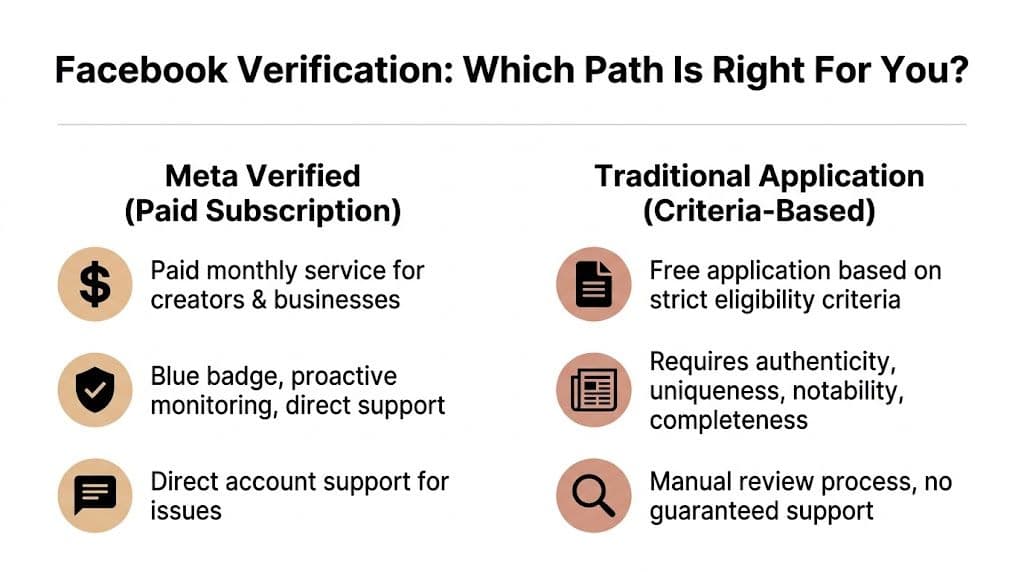
The wrong path creates avoidable delays. The right path depends on what kind of entity you manage, how fast you need the badge, and whether verification is being treated as a support and security layer or a public notability exercise.
Meta Verified in plain terms
The paid route is built around identity confirmation. According to this Meta Verified guide, approval is near 100% after a successful ID check, with 24 to 48 hour processing, and the subscription is priced at about $14.99 to $21.99 per month per platform in the US and EU, varying by region.
That’s why many businesses choose it. It’s less about proving press credibility and more about proving ownership. It also bundles practical benefits like impersonation protection and direct support access.
Where teams get tripped up is assuming payment overrides profile quality. It doesn’t. The same source notes that recent profile changes can block applications, failing in 40% of cases, and low-activity pages can still be denied.
Traditional verification in plain terms
The free route is still the better fit for certain public figures, established brands, and organizations with a clear public footprint. But it’s stricter, slower, and less predictable. You’re not buying faster processing. You’re trying to persuade Meta that the page deserves trust based on notability, consistency, and legitimacy.
This route often makes sense when a business already has:
- a real press footprint
- a strong website
- clear brand search demand
- account manager access
- enough ad history to be taken seriously internally
Before pushing that route, clean up policy risk first. If the page or ad account has unresolved compliance issues, fix those before anything else. A good place to tighten fundamentals is Meta’s Facebook ads policy workflow.
A side by side comparison
| Feature | Meta Verified (Subscription) | Traditional Verification (Free) |
|---|---|---|
| Cost | Paid monthly subscription | No direct application fee |
| Core requirement | Government ID and profile match | Authenticity, uniqueness, notability, completeness |
| Approval odds | Near 100% after successful ID check | More selective and less predictable |
| Typical speed | 24 to 48 hours | Can take much longer |
| Support access | Includes direct support features | No guaranteed support path |
| Best for | Businesses and creators who need speed and support | Public figures, brands, and entities with strong notability |
| Common blockers | Recent profile changes, low activity | Weak notability, incomplete page, unstable branding |
| Main trade-off | Ongoing subscription cost | More documentation and more uncertainty |
A quick walkthrough helps if you want to see the platform-side framing before deciding which route fits your setup:
Which one I’d choose in practice
If the account belongs to a business that needs faster support, stronger impersonation controls, and a cleaner operational path, the paid route is usually the practical answer.
If the account belongs to a public-facing brand with real notability and strong internal Meta relationships, traditional verification can still be worth pursuing. But that path rewards preparation, not optimism.
Pick the route that matches the business reality you can prove today, not the one you wish Meta recognized.
The Agency Playbook for Traditional Verification Success
Traditional verification is where most bad advice lives. Marketers are told to focus on followers, posting frequency, or vague “brand authority” signals. In practice, none of those matter as much as ad-spend credibility, account stability, and access to the right support channel.

One agency methodology reported a 14 out of 17 success rate, or 82%, over six years, and the key pattern was blunt: high ad spend carried more weight than follower count. Accounts with strong spend often succeeded regardless of audience size, while low-spend accounts could fail even with more than 1 million followers, according to The Social Lab’s verification guide.
What actually moves the application
The biggest advantage is often a dedicated Meta account manager. Without one, many businesses end up using generic channels that go nowhere. With one, the application has a path through business support instead of disappearing into a form queue.
That doesn’t mean account managers can force an approval. It means they can route a serious application correctly, which is a very different thing.
The process I’d use on a client account
Secure the support path first
If the business has enough spend to qualify for a dedicated Meta contact, use that route. Don’t start by filling random forms and hoping for the best.Lead with business value, not social vanity
In traditional verification, monthly ad spend matters. Meta is more likely to prioritize advertisers who already contribute meaningful revenue.Audit page hygiene before anything is submitted
The page should have a profile photo, cover image, clean About section, correct category, and stable brand details. No recent edits to name, username, location, or page type.Build a notability pack
Use the business website, legitimate news mentions, and evidence of active public presence. Thin blog mentions and low-trust directory citations won’t carry much weight.Submit through ad support, not general support
Business support teams tend to understand the advertiser context better and can frame the request properly.
The unwritten rules
Traditional verification punishes instability. If the page was dormant, recently renamed, or bouncing between categories, the application gets harder. If the ad account has unresolved policy issues, the business looks less trustworthy at exactly the wrong moment.
Practical rule: For traditional verification, spend history and page stability usually beat audience size.
There’s also an AI moderation layer to deal with. The same agency methodology notes that incomplete profiles or guideline issues can trigger rejections in 48 to 72 hours, while some cases stretch to 45 days. It also reports that 20% to 30% of viable applications may be rejected initially by AI error, which is why clean resubmission matters when the page qualifies.
What notability should look like
Notability should be external and verifiable. Think established website, recognizable business footprint, credible media mentions, and a page that people would reasonably search for.
If you’re an agency working across multiple client accounts, this is also where process discipline matters. Teams that already run structured escalation and compliance workflows through a specialized Facebook ads agency model usually handle verification better than teams treating it like a one-off social task.
Troubleshooting Denials and Crafting Your Appeal
A denial doesn’t always mean the page is unqualified. Sometimes it means the application was weak. Sometimes the profile was unstable. Sometimes the wrong route was used.
The fix starts with diagnosing the type of rejection instead of firing off an emotional reply.
Match the symptom to the fix
Here’s how I’d break down the common denial patterns:
Couldn’t confirm authenticity
Your documents, website, page details, and business identity probably don’t line up cleanly. Review naming, legal entity references, and public-facing contact details.Insufficient notability
The page may be real, but Meta doesn’t see enough external validation. Build more credible public references before trying again.Inauthentic or incomplete presence
Dormant posting, missing profile elements, or recent changes make the account look unstable. Clean the page up and let it operate normally before reapplying.Paid route blocked despite subscription
This often comes down to profile instability or low page activity. As noted earlier from the Meta Verified source, recent profile changes can fail in 40% of cases, and low activity can still stop approval.
Appeal or reapply
Appeal when the denial is clearly wrong and you have new information to support your case. Reapply when the account itself needs work first.
If the page is also dealing with broader restrictions, this practical guide on how to appeal a blocked Facebook account is useful because it separates emotional reactions from the documentation Meta usually expects in account recovery and review requests.
A simple appeal template
Use something professional and factual:
Hello Meta Support, We’re requesting a review of the verification decision for our Facebook page. Since the initial submission, we’ve confirmed that our page details, business documentation, and public references accurately reflect the entity represented on the account.
We’ve attached updated supporting materials, including identity or business documents and relevant public references. We’d appreciate a fresh review based on the corrected and expanded information.
Thank you.
Keep the tone neutral. Don’t argue. Don’t accuse support of incompetence. Give them a cleaner file.
When the problem is bigger than verification
Some denials are really policy-health issues wearing a different label. If the page has ad restrictions, recurring review failures, or Business Manager trust problems, solve those first. Teams dealing with active limitations should work through the causes of being restricted on Facebook before burning another verification attempt.
A clean reapplication beats a rushed appeal almost every time.
How Verification Impacts Ad Performance and Account Health
This is the part most verification guides miss. The badge isn’t just public proof. It can affect how efficiently you operate inside Meta’s ad ecosystem.
In competitive or more sensitive verticals, verified accounts can experience 20% to 30% fewer ad disapprovals and may access higher daily spend limits, according to Brandwatch’s write-up on Facebook verification. That’s the difference between a page being merely official and a business being easier to scale.
Why this matters in the media buying seat
If you manage performance campaigns, you already know that ad account friction compounds fast.
One rejected ad isn’t just an inconvenience. It delays testing. It interrupts budget pacing. It creates extra manual review work. If the page operates in a category Meta’s systems treat cautiously, every unnecessary flag costs time and momentum.
Verification helps because it adds trust to the entity behind the ads. It doesn’t exempt the account from policy checks, but it can reduce the chance that Meta’s automated systems treat the page like an unknown quantity.
Verified status won’t rescue bad compliance. It can reduce avoidable compliance friction on otherwise legitimate accounts.
The practical downstream effects
The biggest gains usually show up in these areas:
- Cleaner approvals: Fewer false-positive disapprovals means creative testing moves faster.
- Account stability: A page with stronger trust signals tends to feel less fragile during aggressive campaign periods.
- Higher scaling confidence: When spend limits loosen, buyers can increase budget without constantly battling platform hesitation.
- Brand protection during active spend: If impersonators appear while ads are live, the verified brand has a clearer legitimacy signal.
This becomes even more important when you’re pairing verification with creative and placement discipline. Teams refining their campaign structure should also study which best Facebook ads formats fit the buying stage and compliance profile of each offer, because format choice and trust signals often work together in review outcomes.
Verification is a risk-control layer
I wouldn’t frame verification as a magic lever for lower CPA by itself. That’s too simplistic. Creative, offer quality, audience strategy, landing page continuity, and feedback data still matter more.
But I would absolutely frame it as a risk-control layer for performance marketing. It helps protect campaign continuity, lowers avoidable review friction, and gives growth teams a sturdier base for scaling. For advertisers spending real money on Meta, that’s not a side benefit. It’s part of account operations.
If your team wants to scale Meta campaigns faster without adding more manual setup, AdStellar AI helps launch, test, and optimize campaigns with AI-driven creative, audience, and performance workflows built for serious media buyers.