Running Facebook Ads for customer acquisition often traps teams in a repetitive loop. Costs drift up, reporting gets noisy, one campaign looks promising for three days, then performance falls apart. The account gets rebuilt again. New creatives go live. Someone suggests fresh lookalikes. Nothing feels stable.
That usually isn't a creative problem alone, and it isn't a targeting problem alone. It's a system problem. The campaign objective, audience exclusions, offer economics, ad structure, and measurement model all have to point at the same business outcome. If they don't, Meta optimizes for activity while the business still struggles to acquire profitable customers.
Facebook can still work. Across industries, Facebook ads deliver a median CPA of $18.68, a median ROAS of 1.79 for B2C companies, and an average conversion rate of 9.21% according to this Facebook ads benchmark analysis. The platform isn't the issue. Misalignment is.
Introduction The Modern Acquisition Challenge
The old playbook was simple. Launch a few interest sets, build a lookalike, rotate creatives, and push budget into what looks cheapest. That approach still produces clicks. It just doesn't reliably produce net-new customers at the quality most brands need.
What changed is the margin for error. Teams now have less room to waste spend on existing buyers, low-intent traffic, or offers that can't absorb acquisition cost. If your account structure is loose, Meta will often find the easiest conversion path, not the most valuable customer path.
A better way to think about Facebook Ads for customer acquisition is to treat the funnel like a routing system. Each campaign setting tells Meta where to drive. The objective is the destination. The conversion event is the map pin. The exclusions tell the algorithm which roads are closed. If any of those signals are vague, the system starts taking shortcuts.
For a broader perspective on account design, creative testing, and measurement discipline, this breakdown of effective Meta advertising strategies is a useful companion read. Teams also benefit from grounding paid social inside a wider acquisition model, especially if you're aligning channels with sales goals, which is where this guide on performance marketing fundamentals helps.
Facebook rewards clarity. Vague goals create cheap but low-value outcomes.
The accounts that hold up under pressure usually share the same traits. They optimize for real business events, exclude existing customers aggressively, keep structures consolidated, and build offers that can survive paid traffic. That's the operating model that makes acquisition more predictable.
Mapping Campaign Goals to the Acquisition Funnel
A common account scenario looks like this. The business asks for net-new customers. The campaign is set to Traffic, the ad set has loose audience logic, and the reporting celebrates cheap clicks while first-order profit stays flat. Meta did its job. It found the easiest action available, not the one the business needed.
Objective selection is the first control point in acquisition. It determines what the system is allowed to optimize for, which users it will favor, and how quickly learning stabilizes. If the goal is a first purchase, optimize for purchase. If the goal is qualified lead volume, optimize for leads only when the CRM, sales process, and follow-up speed are strong enough to turn those leads into revenue.
Match the objective to the stage
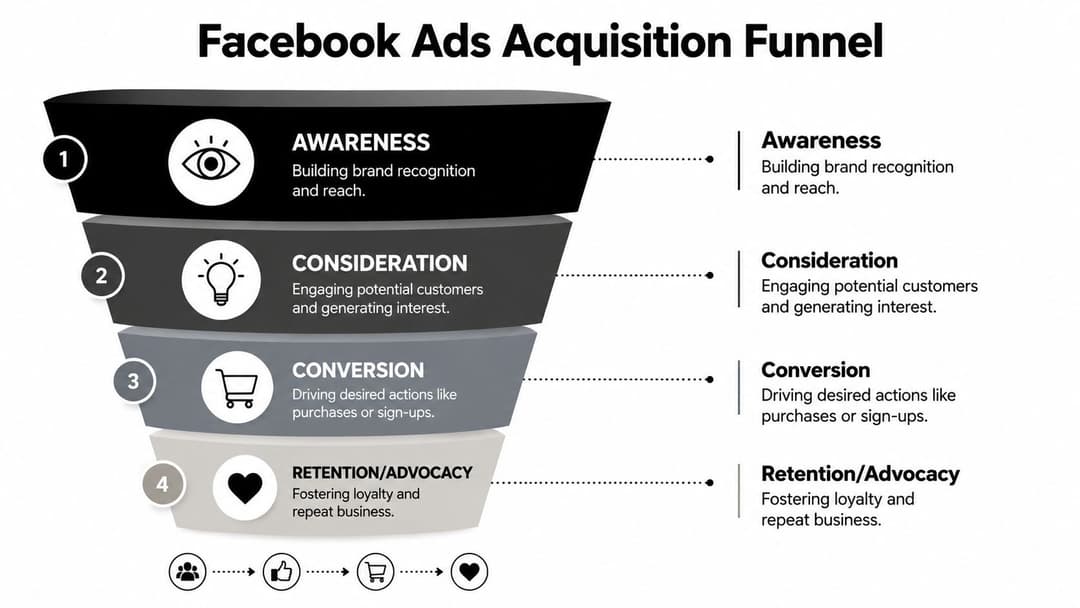
Use the funnel to decide what signal Meta should chase.
| Funnel stage | Best-fit Meta objective | What you're really asking Meta to do |
|---|---|---|
| Awareness | Awareness or Video Views | Find people likely to notice and remember you |
| Consideration | Traffic or Leads | Generate site visits or lead submissions |
| Conversion | Sales | Find users most likely to complete the target action |
| Retention | Sales or custom retention flows | Re-engage buyers and support repeat purchase behavior |
The trade-off is simple. Upper-funnel objectives usually buy cheaper reach and more volume, but they also give Meta weaker clues about purchase intent. Sales campaigns cost more per result in many accounts, yet they train the system on the behavior that matters if acquisition is the priority.
That distinction matters even more now because many brands cannot rely on low AOV products to carry paid social profit on the first order. A campaign can hit an acceptable CPA and still miss the business goal if average cart value is too low. Teams that map objectives to the funnel correctly usually pair that with offer design, bundles, and upsells that raise first-order economics. If your team still reviews paid social through front-end efficiency alone, this explainer on customer lifetime value in marketing is a useful planning reference.
Set acquisition goals around incrementality, not just conversion volume
A purchase is not automatically a new customer. That is where weak goal mapping breaks down.
If the account structure allows existing buyers, recent site visitors, and engaged users to sit inside the same conversion path, Meta will often spend into the warmest pool because it converts faster. Reported performance looks good. Actual customer acquisition is weaker than the dashboard suggests.
This is why exclusion-led acquisition strategy beats the old habit of defaulting to lookalikes in many accounts. The goal is not just to find people who resemble past buyers. The goal is to give Meta a conversion objective while removing customer segments that create false efficiency. That setup produces a cleaner read on incremental new-customer growth.
If you're reviewing account structures across multiple clients, this guide to agency social media campaigns offers useful examples of how campaign intent changes by business model.
Practical rule: For new customer growth, choose the objective that matches the end action and remove the audiences that let Meta pad results with existing demand.
A strong funnel map also keeps retention activity separate from acquisition reporting. Existing-customer revenue still matters. It just should not sit inside the same campaign logic if the business is trying to measure prospecting accurately.
Building High-Intent Acquisition Audiences
Audience strategy got cleaner once many advertisers stopped trying to outsmart Meta with endless segmentation. Broad targeting can work well, but only if you pair it with strong exclusions and a clear conversion signal. Without that, broad just means messy.
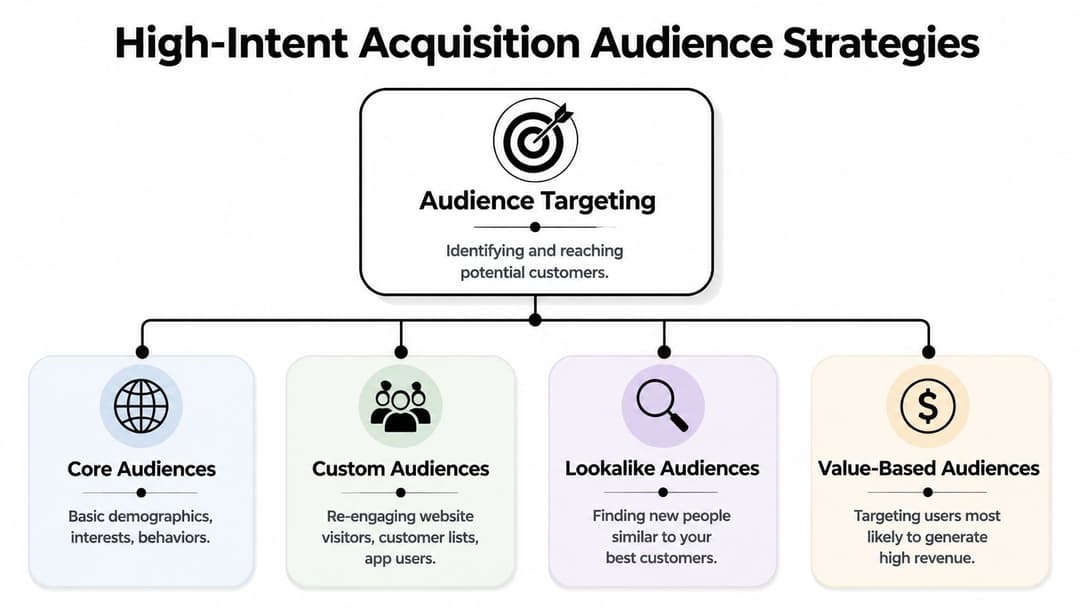
The first distinction that matters is intent source. Cold audiences don't know you. Warm audiences have interacted with your site, content, or ads. Hot audiences include cart abandoners, recent engagers, and known prospects. For true acquisition, the job is to convert cold users while preventing Meta from over-serving warm and existing customer pools when the campaign's stated purpose is net-new growth.
Build exclusions first
The cleanest acquisition audience structure starts with what you remove, not what you include.
- Upload the full customer file. Use as much historical purchaser data as the business can responsibly provide.
- Create exclusion audiences for recent buyers and known customers.
- Use New Customers Only mode when available within your Meta setup.
- Set the budget allocation for existing customers near zero so the system prioritizes prospecting.
- Keep prospecting broad unless there's a clear strategic reason to narrow.
Experts recommend the New Customers Only acquisition mode by uploading an extensive custom audience of existing customers and setting a near-zero budget allocation for them. That can raise initial CPA by 15% to 25%, but it's documented to lift LTV by 30% to 40% because Meta is pushed to find higher-quality new prospects, as described in this breakdown of the setup.
That trade-off scares teams that manage only to first purchase metrics. It shouldn't. If you want incremental customers, the campaign has to stop taking the easy path.
Broad plus exclusions usually beats fragile complexity
Micro-segmented ad sets look impressive in a dashboard. In practice, they often create audience overlap, slow learning, and noisy decision-making. A broad prospecting campaign with hard exclusions usually gives Meta more room to find converters while still protecting the acquisition goal.
Lookalikes still have a place, especially when seeded from strong customer quality signals. But they shouldn't be the default assumption. If you do use them, treat them as a test layer, not as the foundation of the entire prospecting account.
A useful way to think about audience priority is:
- First layer. Broad prospecting with existing customer exclusions.
- Second layer. High-quality signal audiences such as past site engagers or qualified leads, if the business has enough data.
- Third layer. Lookalikes from high-value customer cohorts, tested against broad, not assumed to outperform it.
If your team still leans heavily on similarity modeling, this reference on Meta lookalike audiences is worth reviewing alongside an exclusion-first structure.
The most expensive mistake in prospecting is counting familiar demand as new demand.
Targeting doesn't rescue a weak offer
Audience quality matters, but it can't fix economics. In markets where CAC has risen sharply, brands with stronger bundles, clearer value, and higher AOV offers tend to hold up better than brands trying to buy customers into low-ticket first purchases. If the product economics are thin, your targeting has to work too hard.
That's why high-intent audience strategy and offer strategy belong together. Meta can locate likely buyers. It can't manufacture margin.
Crafting Ad Creative and Copy That Converts
Your targeting can be right and your exclusions can be clean, but the ad still loses if a new prospect cannot understand the offer in two seconds. That is the daily reality in Meta acquisition. Cold traffic does not care about your campaign structure. It reacts to relevance, clarity, and whether the offer feels worth a click.

For net-new customer acquisition, creative has two jobs. It has to qualify the right buyer and filter out the wrong one. That matters more now because broad and exclusion-based prospecting gives Meta room to find demand, but the ad still has to signal who the product is for, what problem it solves, and why the economics work. If your first-purchase AOV is weak, creative has to carry too much weight. If your offer raises AOV through bundles, kits, or stronger entry offers, the ad has a better chance of producing profitable CAC.
Match the message to audience temperature
Cold prospecting creative should not read like retargeting. A new user needs context before persuasion.
The framework I use is simple:
- Lead with the problem or desired outcome. Start with the pain, use case, or result the buyer recognizes immediately.
- Show the product in use. Demonstration beats description for cold traffic.
- Explain the value clearly. Price matters, but value per order matters more. Bundles, quantity breaks, and starter sets often convert better because they improve AOV and make acquisition spend easier to justify.
- Handle one major objection early. Trust, fit, complexity, time-to-value, or cost.
- Ask for one action. Shop now, start trial, get quote, or apply. Pick one.
That sequence works because cold users are making three fast decisions. Is this for me. Do I believe it. Is the offer worth exploring.
Format matters, but message matters first
UGC-style videos, founder-led explainers, comparison ads, and direct-response carousels still work because they are easy to process. They look native to the feed and get to the point fast. Vertical edits usually give you more usable placements and a better viewing experience on mobile, but format alone does not rescue weak positioning.
The stronger approach is to build one angle across multiple formats. Run the same core message as a short video, a static image, and a carousel. If the message is strong, you will usually see it travel across formats. If only one format works, the creative idea may be less durable than it looks.
Speak to the viewer's current problem first. Brand story comes after relevance.
Write for exclusion-first prospecting
Broad acquisition with customer exclusions changes how copy should work. You are not relying on a tight interest stack or a lookalike to do all the qualifying. The ad itself has to create that fit.
That means more specificity, not less.
Weak copy says the product is for everyone. Strong copy names the user, the use case, and the payoff. “For busy parents who need dinner in 15 minutes” will usually outperform “Healthy meals made easy” because it helps both the buyer and the platform identify the right response pattern. The same principle applies in SaaS, lead gen, and high-consideration offers. Specificity improves click quality.
If you want a sharper process for developing hooks, angles, and primary text variants, this guide on ad copy best practices is worth reviewing.
Creative testing should answer business questions
A good creative test is not “Which ad gets the highest CTR?” It is “Which message gets us more first-time buyers at an acceptable CAC, while supporting enough AOV to stay profitable?”
That changes what you test. Test offer framing before cosmetic edits. Test bundle versus single product. Test problem-aware messaging versus aspiration-led messaging. Test creator-style proof versus polished brand explanation. Those are meaningful variables. Button color and minor headline tweaks rarely change acquisition performance in a meaningful way.
A practical testing grid looks like this:
| Variable to test | Why it matters for acquisition |
|---|---|
| Offer structure | Higher-AOV bundles or kits can make CAC workable |
| Hook angle | Different pains and desired outcomes attract different buyer quality |
| Proof type | Reviews, founder credibility, and demonstrations reduce skepticism in different ways |
| Format | Video, static, and carousel each create different levels of clarity and engagement |
A useful walkthrough is below, especially if your team is tightening video structure for direct response.
Budgeting Bidding and Launching for Success
A common launch scenario looks like this. The team builds six prospecting ad sets, gives each a small budget, adds a cost cap on day one, and expects Meta to find new customers efficiently. A week later, spend is uneven, results are noisy, and nobody can tell whether the problem is the audience, the creative, the bid strategy, or the offer.
That failure usually starts with structure, not spend.
Meta's delivery system needs enough conversion volume to learn. If an account cannot generate steady purchase volume, splitting prospecting into narrow segments makes optimization weaker and reporting harder to trust. That matters even more when the goal is true new customer acquisition, because exclusion-based targeting already removes part of the addressable audience. Fragmentation on top of exclusions often chokes delivery.
Structure before spend
Start with the fewest moving parts that can answer a real business question. For most accounts, that means one prospecting campaign, broad targeting or a small number of high-intent audience setups, and strong exclusions for existing customers, recent purchasers, email subscribers, and other known demand pools.
A clean launch setup usually looks like this:
- Use one optimization event that matches the acquisition goal, usually Purchase once tracking is reliable.
- Consolidate prospecting ad sets so each set has enough volume to learn.
- Apply exclusions aggressively to protect budget for net-new customer acquisition.
- Test one major variable at a time, usually offer or creative angle before audience refinements.
- Set budget from expected conversion volume, margin, and payback tolerance, not from how many ideas the team wants to include.
More ad sets do not make a campaign more effective. They usually create thinner signal, slower learning, and muddier decisions.
Budgeting should reflect unit economics first. If your target CAC only works when first-order AOV stays above a certain threshold, build the launch around the offer that can support that threshold. In practice, that often means pushing bundles, starter kits, or product sets earlier than the brand team wants to. The trade-off is clear. A stronger first-order basket gives the media team more room to buy traffic without relying on perfect CPMs.
Choose bid logic that matches the job
Highest Volume is the right default for many new acquisition launches because it gives the system room to find converting inventory. Cost controls have a place, but they work better after the account has enough data to show what an acceptable CAC looks like.
Teams often apply bid caps too early and blame audience quality when delivery stalls. The issue is usually one of three things. The cap is below market, the exclusion logic is too restrictive for the available budget, or the offer does not create enough AOV to absorb acquisition costs.
That is why bidding should follow economics, not wishful targets. If the business needs a lower effective CAC, there are only a few real levers: improve conversion rate, increase AOV, improve post-click qualification, or reduce waste by excluding existing demand more cleanly. Bid settings can support those levers. They rarely replace them.
Tooling can reduce manual work when testing many combinations. Meta Ads Manager, reporting layers, and workflow tools help teams launch creative, copy, and audience variants without rebuilding campaigns repeatedly. AdStellar AI is one example used for that kind of workflow management inside Meta campaign operations.
Scaling depends on economics, not confidence
A good first week does not justify an aggressive budget increase. Scale only after the campaign shows stable purchase quality, clean new-customer acquisition, and first-order economics that can hold as spend rises.
Use a launch review that forces operational clarity:
| Question | Why it matters |
|---|---|
| Is there enough conversion volume for stable optimization? | Low signal makes every bid and budget decision less reliable |
| Are exclusions removing existing customers and other known demand? | Cheap conversions are often just re-harvested demand |
| Does first-order margin support the current CAC? | Spend growth without margin discipline turns scale into loss |
| Is the offer increasing AOV enough to widen acquisition room? | Better basket economics often matter more than minor media savings |
The last row is where many profitable accounts separate themselves. They do not win by finding a magical audience. They win by pairing clean exclusion-based acquisition with offers that raise AOV enough to make paid growth work under higher costs.
Measuring Performance and Scaling What Works
You launch a cold acquisition campaign, Meta reports efficient CPA, and the first few days look strong. Then finance looks at contribution margin, repeat rate stays soft, and the account stops looking efficient. That is the point where media buying turns into operator work.
Meta reporting is a starting point. Scaling decisions should come from customer value and order economics, especially if the account is using exclusion-based targeting to isolate true new-customer acquisition. If exclusions are doing their job, reported CPA often looks less flattering than a blended account that keeps re-harvesting existing demand. That does not mean the campaign is worse. It means the measurement standard is finally honest.
Read the account like an operator
Track four numbers together, not in isolation:
- CPA shows what you paid to acquire the order.
- ROAS shows how the first transaction performed.
- LTV shows whether that customer cohort earns the right to scale.
- AOV shows how much acquisition cost the business can absorb.
AOV usually creates more room than audience tweaks. Rising acquisition costs across Meta have pushed more brands to fix the offer before they touch targeting again. Bundles, quantity breaks, and stronger landing page merchandising often improve margin structure faster than another round of lookalike testing. I would rather scale a campaign with a higher CPA and a stronger first-order basket than chase a cheaper customer who buys the smallest SKU and never comes back.
That trade-off matters even more for prospecting. Exclusion-based acquisition strips out easy conversions from past buyers, site visitors, and owned-audience spillover. The result is cleaner new-customer data, but it also forces the offer to carry more weight. If first-order AOV is too low, the campaign has no room to survive normal CPM pressure.
Scale on signal quality
Increase spend only on ad sets or consolidated campaigns that hold three things at once: stable purchase volume, clean customer exclusions, and acceptable first-order contribution after discounts and shipping. If one of those breaks, scale usually turns into expensive volatility.
Creative is usually the next scaling lever. Fresh concepts give the account more room without fragmenting the audience. Broadening the offer can help too, especially if it raises basket size. Rebuilding targeting over and over is usually the slower path.
Brand recognition still affects performance. Prospecting ads that convert on click but fail to stick in memory often lose efficiency after the first pocket of demand clears out. This article on optimizing ad recall performance is useful if you want to tighten the link between direct response creative and repeatable demand generation.
For cleaner incrementality decisions, use a control group testing framework for Meta campaigns. It helps separate platform-reported conversions from lift the business gained.
Strong acquisition accounts do not just buy more customers. They identify which new customers are worth buying again and under what offer structure.
The operating loop is straightforward. Keep exclusions tight so prospecting stays honest. Judge performance on customer value, not just reported efficiency. Raise AOV to create more CAC tolerance. Then scale only the combinations that keep working after spend increases.