When your campaigns hit a wall, it’s tempting to start randomly tweaking buttons and hoping for the best. But true FB ads optimization isn't about guesswork. It's a methodical process of playing detective, diagnosing the real problems, and systematically testing solutions to get your performance back on track.
The goal is always the same: lower your cost per acquisition (CPA) and push your return on ad spend (ROAS) higher. Let's dig into how to do that.
Diagnosing Your Underperforming Meta Ads
Before you can fix anything, you need to know what's broken. Effective optimization starts by looking past obvious metrics like a dipping Click-Through Rate (CTR) and finding the real reason your campaigns are sputtering. Don't just guess—make your decisions based on the data.
This is your framework for pinpointing the root cause, whether it's creative fatigue, a saturated audience, or a simple mismatch with the algorithm. A dip in CTR alone doesn't tell you much. Is the ad stale, or is the audience just over it?
Identifying Core Campaign Issues
Think of yourself as a campaign detective, piecing together clues from your Ads Manager dashboard. A slow, steady decline in ROAS, for instance, often points directly to creative burnout. That winning ad you were so proud of has simply run its course.
On the other hand, a stable ROAS but a gradually climbing CPA can signal audience exhaustion. You're still hitting the right type of person, but you've shown your ads to the most eager buyers too many times. Now, you're paying more to convert the less-receptive folks on the fringes.
To help you get started, here's a quick reference table for mapping common symptoms to their likely culprits.
Campaign Health Diagnostic Chart
| Symptom | Potential Cause | First Diagnostic Action |
|---|---|---|
| Sudden Performance Drop | Recent edits resetting the learning phase or external factors. | Review the campaign's change history. Did you edit the budget, creative, or ad set recently? |
| High Frequency, Low CTR | Creative fatigue and audience saturation. | Your audience is tired of seeing the same ad. It's time to launch new creative concepts. |
| High CTR, Low Conversion Rate | Message mismatch between the ad and the landing page. | Review the post-click experience. Does your landing page deliver on the ad's promise? |
| Rising CPA, Stable ROAS | Audience exhaustion. | You've tapped out the most responsive segment. Broaden your audience or test new lookalikes. |
This chart is your first stop for a quick diagnosis, guiding you toward the right solution instead of having you chase down the wrong problem.
It's also worth noting that performance doesn't exist in a vacuum. Your Meta ads are part of a larger ecosystem. For a deeper look at how other channels can play a role, check out these strategies to 5x your Meta ROAS.
A Practical Diagnostic Framework
To really systematize your audit, you need to go beyond the main dashboard. Meta gives you some powerful tools for this, but they're easy to miss. The Delivery Insights tab within your ad set, for example, can give you direct feedback on auction competition, saturation, and fatigue.
A rising frequency metric is the canary in the coal mine for Facebook ad campaigns. Once it climbs past 3-4 for a cold audience, your CPA is almost guaranteed to follow. It’s the earliest warning sign that you need to refresh your creative or broaden your audience.
This simple diagnostic decision tree helps visualize where to start troubleshooting. It shows how a declining ROAS points to creative issues, while a rising CPA suggests your audience needs attention.
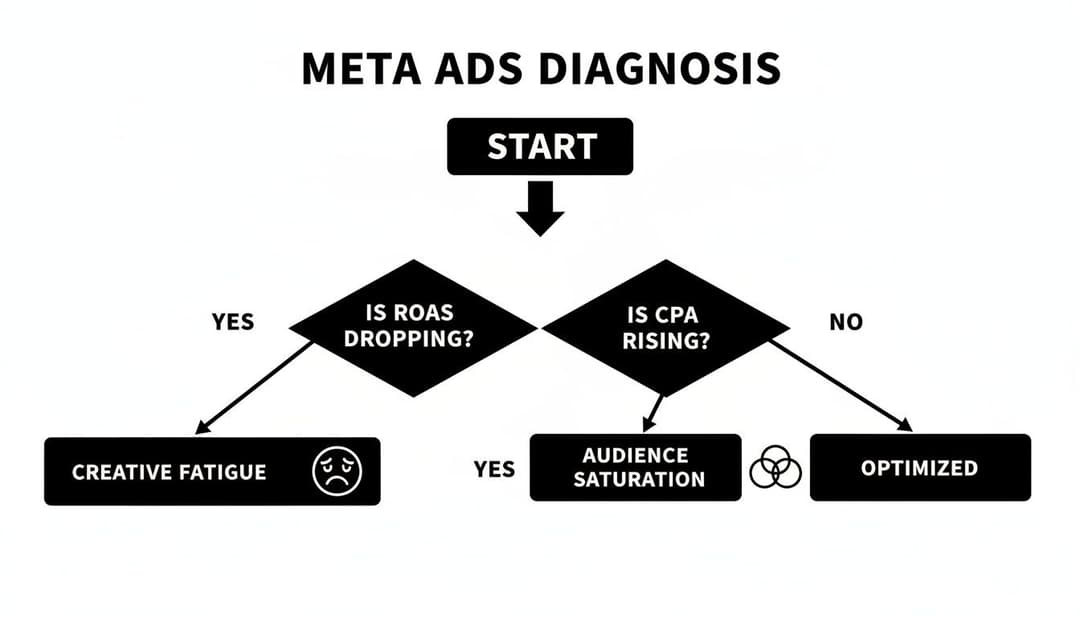
The flowchart makes it clear: your primary pain point (ROAS vs. CPA) dictates your next move, saving you from wasting time and money on the wrong fix.
Another hidden gem is the Audience Overlap tool. If you're running multiple ad sets targeting similar interests, they might be bidding against each other and driving up your costs. If you spot a significant overlap (anything over 20-30%), it's a clear signal to consolidate your ad sets or refine your targeting to create more distinct audiences.
And if your ads just stop running altogether, that's a different problem. You can find more in our guide on what to do when your Facebook ads are not delivering. This disciplined approach is what turns optimization from a frustrating guessing game into a structured, repeatable process.
Mastering Creative and Audience Testing
Alright, you've pinpointed the issues. Now comes the fun part. Real, sustainable growth on Meta isn't about one-off fixes; it's about building a high-velocity testing machine. This is where you stop putting out fires and start proactively discovering your next big winner.
We all know creative is the biggest lever you can pull. But the world's best ad shown to the wrong people is just a waste of money. The goal is to create a repeatable system for testing both your ads and your audiences, so you can isolate what works and get clean, actionable data.
Structuring Your Creative Tests
I see this all the time: a marketer tests a new ad with a fresh image, a different headline, and new copy all at once. It bombs. What went wrong? The image? The hook? The offer? There's no way to know.
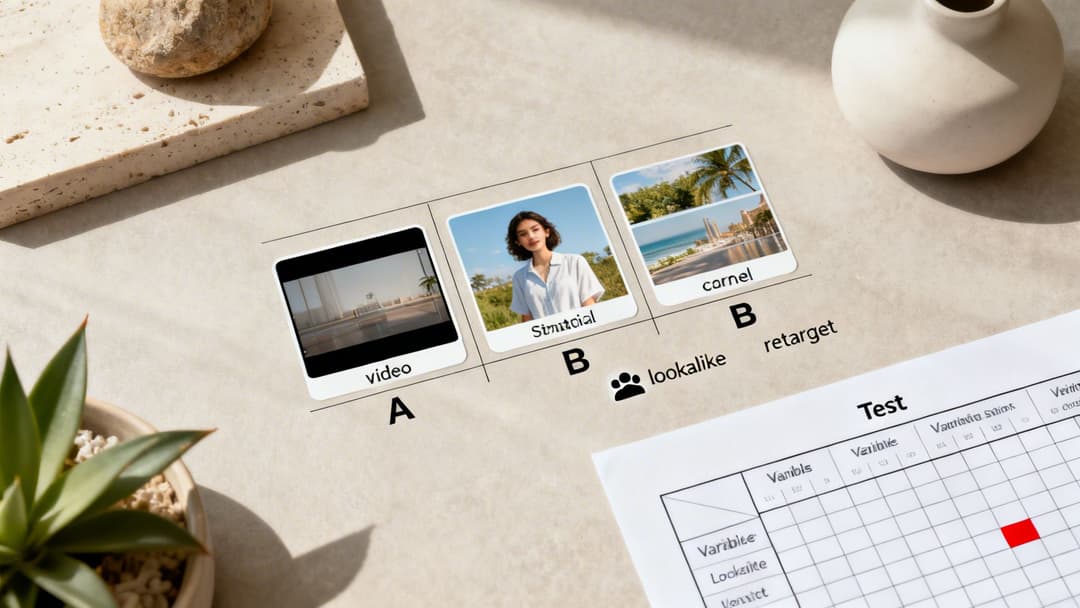
Disciplined testing means isolating one variable at a time. Start with a simple hypothesis. For example, "I bet a raw, user-generated-style video will feel more authentic and beat our polished studio ad."
Now, you have a clear A/B test:
- Ad A (Control): Your current champ (the polished studio video).
- Ad B (Variable): The new challenger (the UGC video), but with the exact same headline and primary text as Ad A.
This approach gives you clean data. If Ad B gets a higher click-through rate or a lower CPA, you know with confidence it was the video format that made the difference.
A single winning creative can be the difference between a break-even campaign and one hitting a 3x ROAS. But that winner has a shelf life. A structured testing pipeline is your insurance policy against creative fatigue.
For e-commerce brands, good product visuals are non-negotiable. To crank out consistently clean product shots for your ad creatives without endless photoshoots, a tool like an AI Ghost Mannequin Generator can be a lifesaver. It helps create those professional, on-model-without-the-model shots at scale, freeing you up to test more important things like hooks and angles.
Building an Audience Testing Framework
Just like your ads, your audiences will go stale. Hammering the same Lookalike or interest-based audience for months on end is a surefire way to see your costs creep up as you hit saturation. You need a framework to constantly prospect for new pockets of customers.
I like to break audiences down into simple temperature tiers:
- Hot Audiences: These are your slam dunks. Think cart abandoners from the last 7 days or recent Instagram post engagers.
- Warm Audiences: This group knows you but might need a nudge. This includes all website visitors from the last 90 days, video viewers, or even past purchasers you want to upsell.
- Cold Audiences: Total strangers. These are your pure prospecting audiences built from interests or Lookalikes.
Here’s a powerful but often overlooked strategy: value-based Lookalike audiences. Don't just upload your entire customer list. Instead, segment that list by Lifetime Value (LTV) and create a Lookalike from only your top 10% of customers. You're telling Meta, "Go find me more people who look like my best buyers, not just any buyer." It's a small tweak that can massively upgrade the quality of your prospecting traffic.
The Role of AI in High-Velocity Testing
Manually building out dozens of A/B tests is a brutal, mind-numbing grind. This is exactly where AI-powered platforms completely change the game. Instead of you building a handful of ads, you feed the system the raw ingredients:
- 5 Headlines
- 5 Primary Texts
- 5 Images or Videos
The platform can then instantly generate 125 unique ad combinations (5x5x5) and launch them into a structured testing campaign. This is a scale of testing that's physically impossible to manage by hand.
From there, the system chews through the performance data, quickly flagging the winning headlines, visuals, and copy that are actually moving the needle. It turns a week-long manual test into something that can run in 24 hours. This not only speeds up your learning but gives you a constant flow of validated creative assets for your scaling campaigns. You get to focus on strategy, not tedious setup.
To go even deeper on this, check out our full guide on Facebook ad creative testing methods and see exactly how to put these techniques into practice.
Advanced Bidding And Budget Strategies
Great creative gets people to stop scrolling, but your bidding and budget strategy is what actually turns that attention into profitable results. This is where you give Meta's algorithm its marching orders—whether that’s getting as many sales as possible, hitting a specific cost per lead, or maintaining a target return on spend.
Too many marketers stick with the default settings and hope for the best. But getting strategic here is what separates the pros from the amateurs. It’s the difference between telling the algorithm to "go find some customers" and giving it a GPS coordinate with the most efficient route.
Choosing The Right Bidding Strategy
Meta has a few bidding options, but you'll likely live inside three of them. The key isn't finding the "best" one, but knowing which one to deploy for the job at hand. Each one serves a totally different purpose.
Here’s how the main players stack up and when I use them:
Highest Volume: This is Meta’s "pedal to the metal" option. You set a budget, and the algorithm’s only job is to get you the most conversions it can for that money. It’s perfect for campaigns where maximizing raw numbers is the goal, and you can stomach some swings in your cost per result.
Cost Per Result Goal: This puts the guardrails on. You tell Meta the average cost you’re willing to pay for a conversion. If you know a lead is only profitable for your SaaS company below $50, you set that as your goal. The algorithm will then hunt for conversions around that price, even if it means sacrificing some volume to stay on target.
ROAS Goal: This is the go-to for pretty much every e-commerce brand. You define the minimum Return On Ad Spend you need. Setting a 3x ROAS goal tells Meta to only bid on users it believes will generate at least $3 in revenue for every $1 you spend. It’s incredibly powerful for protecting your margins, but it absolutely requires accurate conversion value tracking to work.
A B2B company running a webinar registration campaign will likely use a Cost Per Result Goal to keep acquisition costs predictable. A DTC brand, on the other hand, will almost always lean on a ROAS Goal to ensure every sale is a profitable one.
Campaign Budget Optimization vs Manual Budgets
Once you’ve picked your bid strategy, the next question is how to divvy up the cash. You’ve got two main choices: letting Meta do it with Campaign Budget Optimization (CBO) or controlling it yourself with manual ad set budgets (ABO).
With Campaign Budget Optimization (CBO), you set a single budget for the entire campaign. Meta's algorithm then automatically shifts that budget to the best-performing ad sets in real time. It’s a beast for scaling because it does the heavy lifting for you, constantly feeding your winners and starving your losers.
But manual ad set budgets, or Ad Set Budget Optimization (ABO), definitely still have a place in my playbook. I use ABO when I need tight control over spending, especially during testing. If I'm trying out three new audiences, ABO ensures each one gets an equal, predetermined budget to prove itself.
Think of it this way: CBO is like giving your fund manager a lump sum and telling them to get you the best overall return. ABO is like telling them to put exactly $1,000 into Apple and $1,000 into Google, no matter how they’re performing. Each has a strategic purpose.
When you're ready to scale a winning campaign, the golden rule is to make small, steady budget increases. A bump of around 20% every 24-48 hours is a proven way to feed the algorithm more spend without shocking it back into the learning phase. For a deeper dive, check out our guide on Meta ads budget allocation strategies. This patient, methodical approach is how you scale smoothly and sustainably.
Using AI and Automation for Scalable Growth
Trying to manage modern Facebook ads optimization by hand is like trying to win a Grand Prix on a bicycle. You might be pedaling as hard as you can, but you're fundamentally outmatched. To see real, scalable growth today, you have to bring AI and automation into your workflow. This is how you shift from putting out fires to building a proactive system for scaling your winners.
The most important AI you work with every day is Meta's own algorithm. It has become incredibly smart, and it now heavily rewards advertisers who feed it clean, reliable data. This makes having a solid Conversions API (CAPI) setup non-negotiable. Without it, you're not just flying blind; you're starving the algorithm of the very signals it needs to find your best customers.
You can see this evolution in Meta's own platform updates. Recent tweaks to their AI algorithm delivered some serious performance lifts. Benchmarks from early 2026 showed conversion campaigns hitting a 1.38% CTR and sales objectives reaching an average 2.79 ROAS. These wins were powered by models that could process much longer user behavior histories and even factor in organic engagement to make smarter delivery choices. You can dig into the full story on how Meta's AI drives performance to really get what's under the hood.
Automating Creative and Audience Discovery
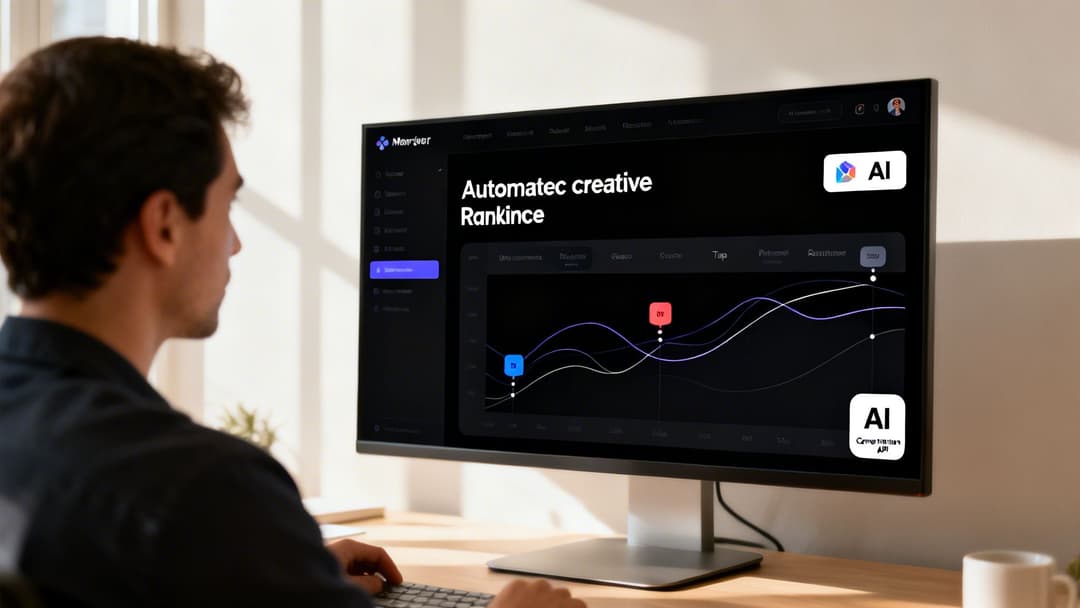
Beyond Meta's own tech, dedicated AI platforms can completely change how you work. These tools plug directly into your ad account and churn through your historical performance data, acting like a tireless co-pilot for all your optimization efforts. They can automatically flag your best-performing creatives and most profitable audiences based on your actual results.
Picture this: Instead of spending hours manually building out a dozen ad variations, you just upload your raw assets. Drop in a handful of headlines, a few different primary texts, and your top images or videos. An AI platform can then generate and launch hundreds of unique ad combinations in minutes, all structured perfectly to find what works.
This automated approach gives you insights at a speed and scale that are simply impossible to do by hand. The benefits are pretty clear:
- Rapid Learning: You get statistically significant data on which messages and visuals actually resonate, and you get it in a fraction of the time.
- Resource Allocation: You can see instantly which creative elements are driving your key metrics—like ROAS or CPL—and then double down on them.
AI doesn't just make you faster; it makes you smarter. It surfaces hidden patterns in your data, like which specific headline pairs best with a particular video style, giving you a repeatable formula for success instead of just one-off wins.
From Reactive Fixes to Proactive Scaling
The real magic of automation is its ability to create a system for growth. Once the AI identifies your winning ad components, it can use them to automatically build and launch new campaigns designed purely for scale. This is where you finally stop putting out fires and start building a predictable revenue engine.
A classic pain point for every marketer is creative fatigue. An AI co-pilot can monitor performance trends and flag ads that are starting to burn out before they crater your overall ROAS. It can then suggest or even automatically roll out fresh creative variations based on concepts that have already proven themselves.
This creates a powerful, continuous optimization loop:
- Launch & Test: Rapidly test hundreds of creative and audience combinations.
- Analyze & Identify: The AI automatically pinpoints the top-performing elements.
- Scale & Refresh: Use those winning components to scale up campaigns and proactively swap in fresh creative to keep performance high.
This workflow turns scaling from a risky, gut-driven decision into a data-backed process. You’re no longer just guessing which ad set to pour more budget into. The system shows you exactly what’s working and gives you the confidence to act decisively. If you want to see a more detailed breakdown of this, you can learn more about how AI can supercharge your Facebook ads.
Ultimately, the goal is to make growth predictable. This frees you up to focus on high-level strategy while automation handles the day-to-day grind.
Building Your Optimization Flywheel
Great fb ads optimization isn't about frantic, last-minute fixes or a constant cycle of launching and praying. It's about building a sustainable system—a flywheel that gains momentum with every turn. You create a continuous loop of launching, measuring, and learning that turns your ad account from a source of stress into a predictable growth engine.
This is how you start running your account on hard data, not just gut feelings. It all begins with establishing a clear, repeatable rhythm for managing your campaigns.
This flywheel approach transforms optimization from a chaotic scramble into a structured process. It ensures no detail gets missed and every dollar is working as hard as it can for you.
Establishing Your Weekly and Monthly Cadence
The secret to predictable results is a solid routine. A consistent cadence means you’re always on top of performance, catching problems before they become disasters and jumping on opportunities the moment they appear. Think of it as a set of non-negotiable check-ins with your account.
Your rhythm might look something like this:
- Daily Health Checks (5-10 Minutes): Just a quick scan. Are there any big delivery issues? Any sudden, scary spikes in CPA? You're not making huge decisions here, just making sure the ship is sailing smoothly.
- Weekly Creative Refresh & Testing (1-2 Hours): This is where the real work happens. Dig into last week's test results, scale up any clear winners, and get your next batch of creative tests live to stay ahead of ad fatigue.
- Monthly Strategic Review (2-3 Hours): Time to zoom out. Look at the big picture trends in ROAS, customer acquisition cost, and audience performance. This is where you plan your next major strategic moves, like testing a completely new offer or audience segment.
This structure keeps your momentum up and breaks the all-too-common cycle of launching a campaign, then forgetting about it until it's already bleeding money.
Building Your Creative Library
The heart of your flywheel is a 'creative library'—a catalog of ad components you’ve already proven work. After just a few weeks of consistent testing, you'll have data-backed insights on what actually moves the needle with your audience.
You’ll know which hooks stop the scroll, which value props get the click, and which visuals connect the most. Instead of staring at a blank page for every new ad, you'll be assembling them from a collection of winning "parts."
Your creative library is your greatest competitive advantage. It’s a proprietary playbook built from your own data, telling you exactly how to talk to your customers. An ad built from proven components has a much higher probability of success right out of the gate.
For instance, your data might show that headlines screaming "free shipping" consistently crush ones focused on a percentage discount. Just like that, "free shipping" becomes a go-to component in your library for future ads. This is how you methodically de-risk every new campaign you launch.
The Continuous Optimization Loop
Your flywheel operates on a simple, powerful four-stage loop that feeds itself. This is the cycle that separates accounts that thrive from those that are constantly struggling to stay afloat.
- Launch & Test: Put new creative and audience hypotheses out into the world. Maybe you're pitting a value-based Lookalike against a broad interest audience.
- Measure Performance: Give the ads enough time to collect real data, usually 3-5 days. Keep your eye on the one metric that matters for that specific campaign, whether it’s ROAS, CPL, or CPA.
- Learn & Document: Now, analyze the results. Did the new creative beat your control? Did that new audience bring in a lower CPA? Whatever you find, document it in your creative library.
- Scale or Iterate: Pour more budget into the undeniable winners. For the losers or inconclusive tests, figure out what you learned, create a new hypothesis, and feed it right back into the "Launch & Test" stage.
This whole flywheel is fueled by data, and accurate signals are everything. For lead generation, offer and intent signals are especially crucial. In fact, lead gen campaigns on Facebook are still crushing it in 2026, with the highest average click-through rate (CTR) of 2.53%—a massive 61% better than traffic campaigns. You can find more insights like these in these 2026 Facebook Ads CTR benchmarks.
This data-first approach pulls emotion and guesswork out of your fb ads optimization. You're no longer just hoping for the best; you're building a system where improvement is inevitable. And if you want to get even more out of Meta's algorithm, knowing how to manage its initial learning period is key. We cover how to navigate the campaign learning phase with automation in another article. By combining a systematic flywheel with a deep platform understanding, you build a truly resilient and scalable advertising machine.
FB Ads Optimization FAQ
Even with the best strategy, you're going to have questions. It's just part of the game. I get asked all the time about the nitty-gritty details, so I've put together some quick-fire answers to the most common ones I hear from marketers in the trenches of fb ads optimization.
How Often Should I Test New Creatives?
There's no magic number here, but the best teams I know are always testing. If you have a decent budget—say, over $5,000/month—you should be rolling out 2-4 new creative concepts every single week.
Now, this doesn't mean reinventing the wheel each time. You could be testing new opening hooks, tweaking a headline, or just iterating on a visual style that’s already working. The goal is to have an 'always-on' testing mindset so you can stay ahead of creative fatigue before it tanks your performance.
What Should I Check First If My CPA Is Suddenly Increasing?
A sudden spike in your Cost Per Acquisition (CPA) is the classic red flag that sends marketers into a panic. Before you start tearing your campaign apart, take a breath and check these three things in this exact order:
- Frequency: Look at your ad set frequency over the last 7 days. If you see it creeping above a 3 or 4 for a cold audience, you're probably just fatiguing them.
- Creative Performance: Dig into the individual ad data. Has a specific ad's Click-Through Rate (CTR) fallen off a cliff? Are negative comments popping up? That's a huge sign of creative burnout.
- Audience Overlap: Jump into Meta's Audience Overlap tool. You might be surprised to find your ad sets are bidding against each other for the same users, driving up costs for no good reason.
A systematic diagnosis is everything. Reacting emotionally to a rising CPA without finding the root cause is one of the quickest ways to make a bad situation even worse.
When Should I Use Advantage+ Shopping Campaigns?
Advantage+ Shopping Campaigns (ASC) can be a game-changer for e-commerce brands, but only if you have your house in order. They work best when you have a solid Pixel and Conversions API setup with plenty of historical conversion data. If your main goal is driving online sales and you trust Meta's AI, let it run.
But you'll want to stick with a manual campaign setup when you need more control. For instance, I'd go manual if I were launching a time-sensitive offer to a specific customer list, trying out some radically new messaging, or running a campaign for something other than e-commerce, like lead generation. If you're still getting the hang of the platform, our guide on what Facebook Ads Manager is can help you navigate these different campaign types.
Ready to stop the manual grind and unlock scalable growth? AdStellar uses AI to launch, test, and scale your Meta campaigns 10x faster, turning creative chaos into predictable revenue. Discover how performance marketers are building their optimization flywheels at https://www.adstellar.ai.