So, how much do Instagram ads really cost? The short answer is that you can generally expect to pay somewhere between $0.40 to $2.00 per click (CPC) and $5 to $10 per 1,000 impressions (CPM).
But that's just a ballpark figure. The honest answer is: it depends. There’s no simple price tag on Instagram ads because your final cost is shaped by your campaign goals, your industry, and the strategy you bring to the table.
What You Can Expect to Pay for Instagram Ads
Asking about the cost of Instagram ads is a bit like asking about the price of a car—it all comes down to the model, the features, and who else is trying to buy it. Think of it less like a fixed-price item on a shelf and more like a live auction. The price you pay is constantly influenced by who you're trying to reach, what you want them to do, and how many other businesses are bidding for their attention at that very moment.
To even begin planning a budget, you have to get familiar with the basic ways Meta charges for ads. These are the core metrics that will dictate your spending and, more importantly, help you figure out if your campaigns are actually working.
Understanding Key Ad Cost Metrics
You'll run into two main pricing models time and time again: Cost Per Click (CPC) and Cost Per Mille (CPM).
- Cost Per Click (CPC): This is exactly what it sounds like—you pay each time someone clicks on your ad. This model is your best friend when your primary goal is to drive traffic to a website, a specific landing page, or a product. If you're chasing direct actions, CPC is the metric you'll be watching.
- Cost Per Mille (CPM): "Mille" is just a fancy Latin word for a thousand. With CPM, you pay a set price for every 1,000 times your ad is shown (an impression). This is the go-to for brand awareness campaigns where the main objective is simply to get your message in front of as many eyeballs as possible, not necessarily to drive immediate clicks. If you want to dive deeper, you can learn more about how to evaluate cost per impression rates in our detailed guide.
This chart gives you a quick visual breakdown of what you can typically expect for these key metrics.
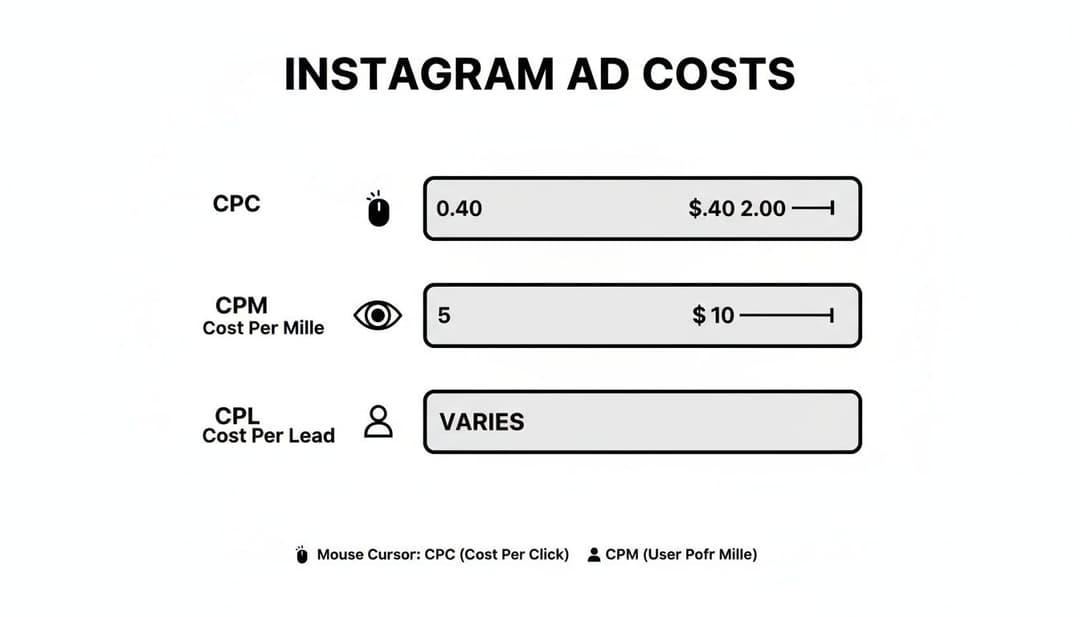
As you can see, while CPC and CPM have some general benchmarks, the cost per lead (CPL) is all over the map. That’s because it depends on much more specific conversion actions that vary wildly from one business to another.
To help you budget, here’s a quick reference table showing some common cost ranges based on your campaign goals.
Average Instagram Ad Cost Benchmarks by Campaign Objective
| Campaign Objective | Average CPC (Cost Per Click) | Average CPM (Cost Per 1,000 Impressions) | Average CPL (Cost Per Lead) |
|---|---|---|---|
| Brand Awareness | $1.50 - $3.00 | $5.00 - $10.00 | N/A |
| Traffic/Clicks | $0.40 - $2.00 | $7.00 - $12.00 | $20.00 - $40.00 |
| Lead Generation | $1.00 - $2.50 | $8.00 - $15.00 | $15.00 - $50.00+ |
| Conversions (Sales) | $0.80 - $2.50 | $10.00 - $20.00+ | Highly Variable |
These numbers are a great starting point, but keep in mind that they can shift based on dozens of factors, which we'll get into next.
Real-World Cost Benchmarks
Looking back, the cost of advertising on Instagram has definitely had its ups and downs, driven by the platform's explosive growth and the sheer amount of competition.
Right now, average CPC rates tend to hover between $0.40 and $2.00 per click. You'll find yourself paying toward the higher end of that range if you're in a super competitive space like e-commerce or finance. In the same vein, CPM rates have mostly settled in the $5 to $10 range after swinging more wildly in past years.
How the Meta Ad Auction Really Works
First things first, let's bust a common myth: the highest bidder does not always win the ad spot. If you think of the Meta ad auction like a simple flea market where cash is king, you're missing the bigger picture.
A much better way to think about it is like a contest to find the perfect tenant for a prime piece of real estate—in this case, your target user's Instagram feed. It’s not just about who can pay the most rent. The landlord (that’s Meta) cares a whole lot about the quality of the tenant (your ad) and how much value they bring to the neighborhood (the user's experience).
After all, a disruptive, low-quality tenant who pays top dollar might just end up driving away other valuable community members. This is why a high-quality, relevant ad can often beat a competitor with a much bigger budget. The whole system is designed to reward advertisers who make the platform a better place, which is great news for keeping your Instagram ad costs down.
The Three Pillars of the Ad Auction
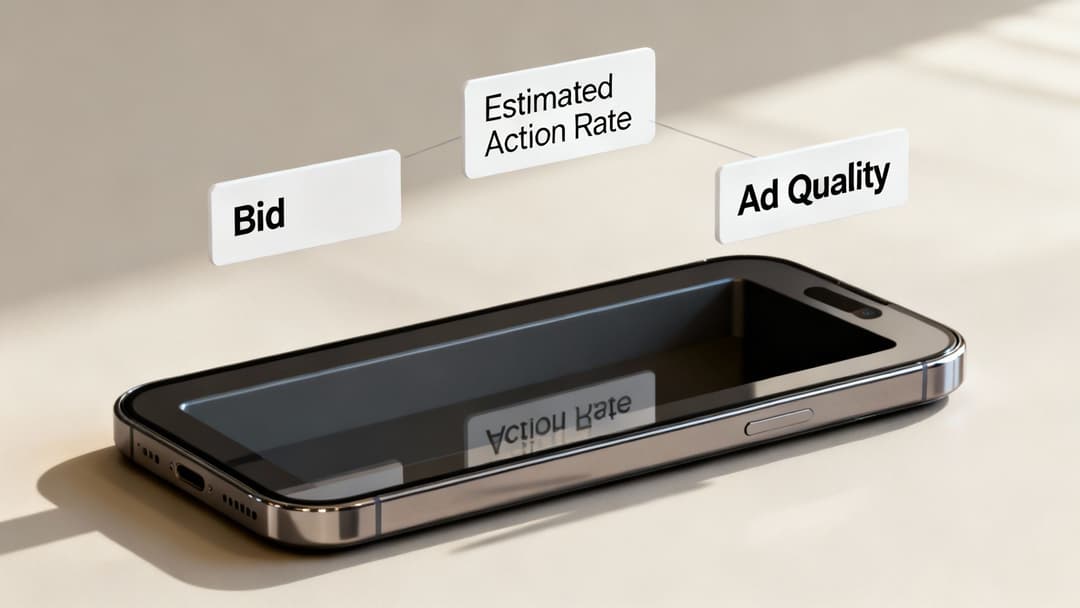
So, how does Meta pick the winner? Every time an ad spot opens up, it calculates a "total value" score for every ad in the running. This score boils down to three core ingredients that every advertiser needs to master. You’ll be managing these moving parts inside tools like the Facebook Ads Manager where you control these inputs.
Your Bid: This one’s the most straightforward. It's the maximum amount you’re telling Meta you're willing to pay for your goal, whether that’s a click, a lead, or a full-blown sale. Think of it as your "rent offer."
Estimated Action Rates: This is Meta’s crystal ball. It predicts how likely a specific user is to actually take the action you want them to. It looks at the user's past behavior, your ad's track record, and a ton of other signals to guess the probability of a conversion.
Ad Quality: This is the secret sauce, and it's a huge, often overlooked, piece of the puzzle. Ad quality is all about how relevant and engaging your ad is to the person seeing it. High positive feedback (likes, comments, shares) and low negative feedback (people hiding your ad) will send this score soaring.
In a nutshell, Meta's formula looks something like this: (Your Bid x Estimated Action Rate) + Ad Quality = Total Value. That little formula is huge. It means an amazing ad quality score can dramatically lift your total value, even if your bid is on the modest side.
Ultimately, the ad with the highest total value gets the placement. This setup ensures that even advertisers with smaller budgets can compete and win by focusing on what really matters: creating high-quality, relevant experiences for their audience. That’s the real key to managing your Instagram ads cost.
The Five Key Factors Driving Your Ad Spend
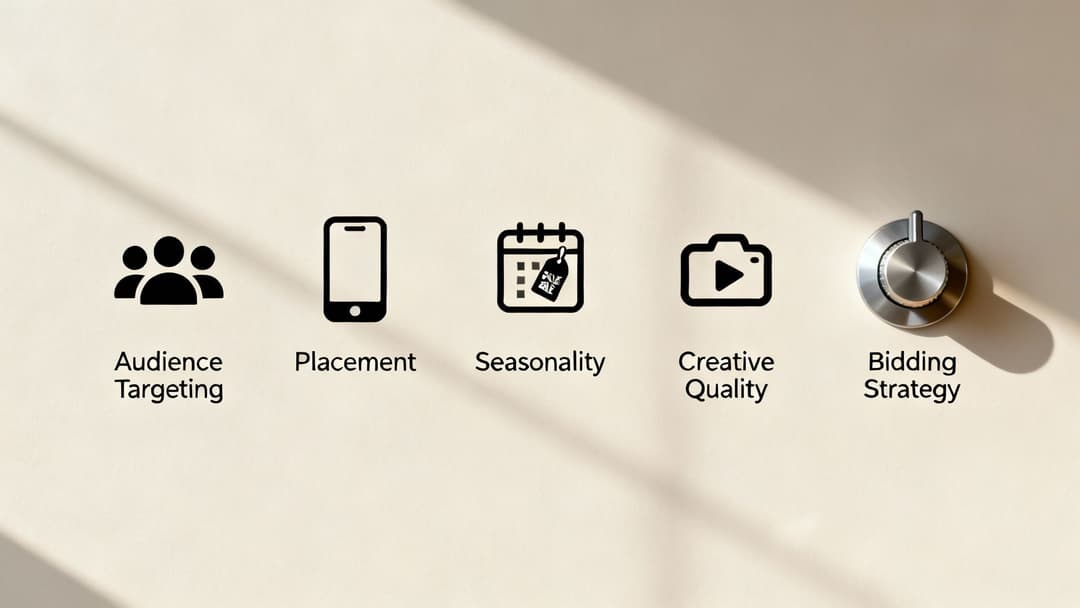
The Meta ad auction is a dynamic marketplace, not a vending machine where you just pop in a coin and get a fixed-price ad. Your actual Instagram ad cost is always in flux, influenced by a handful of powerful variables.
Getting a handle on these five core factors is the key to diagnosing why your spend is high and, more importantly, how to take back control of your budget. Think of them as the main dials you can turn to fine-tune your campaign performance and seriously improve your return on ad spend (ROAS).
Audience Targeting
Who you're trying to reach is easily one of the biggest drivers of your ad costs. It's a classic supply and demand situation. A broad, loosely defined audience is often cheaper to reach on a CPM basis simply because there are millions of them available.
But what about a super-specific, high-intent audience? Say, "newly engaged couples actively shopping for wedding photographers." That group is much smaller and far more valuable to competitors, which naturally drives up the auction price.
It might feel counterintuitive, but paying a higher CPM to reach that hyper-targeted audience can actually slash your overall cost per sale. You’re paying a premium to get in front of the right people, which means more efficient conversions. If you're struggling to nail down who that is, you can learn more about how to identify a target audience in our comprehensive guide.
Ad Placement
Where your ad shows up on Instagram—whether it’s in the Feed, Stories, Reels, or the Explore tab—directly impacts what you pay. Every placement is its own mini-marketplace with unique inventory levels and advertiser demand.
- Instagram Feed: This is prime real estate. It's often the most competitive and expensive placement because of its high visibility.
- Instagram Stories & Reels: Can offer lower CPMs because the sheer volume of available inventory is massive.
- Explore Tab: Tends to be less expensive and is perfect for reaching people who are in a discovery mindset.
For most campaigns, using Advantage+ placements is a great starting point. It lets Meta’s algorithm do the heavy lifting, automatically finding the most cost-effective spots for your specific ad and objective.
Seasonality and Competition
Advertising costs aren't set in stone throughout the year; they ebb and flow with the market. The most notorious example is Q4, when the holiday shopping frenzy sends competition through the roof. During big events like Black Friday and Cyber Monday, don't be surprised if your CPMs double or even triple as every brand on the planet floods the platform with promotions.
On the flip side, quieter periods like mid-summer can be a goldmine for cost-effective advertising. Smart advertisers use these lulls to test new creative and build up their retargeting audiences at a much lower cost, getting them ready for the pricier peak seasons.
Creative Quality
In the battle for attention, your ad creative is your frontline soldier. A thumb-stopping video or a striking graphic will grab more engagement, which Meta's algorithm rewards with a better Ad Quality score. As we've covered, a high Ad Quality score directly lowers your costs in the auction.
A boring, low-effort ad with a bland stock photo won't just perform poorly—it will actively cost you more money to show to the same number of people. Investing in high-quality creative is a direct investment in lowering your Instagram ads cost.
Your Bidding Strategy
Finally, how you tell Meta to spend your money plays a huge role. Your bidding strategy is the instruction you give the algorithm about what to prioritize.
- Highest Volume (Lowest Cost): This tells Meta to get you the most results possible within your budget. It's fantastic for maximizing reach but gives you less control over the final cost for each result.
- Cost Per Result Goal (Cost Cap): This lets you set a specific target cost for an action, like a purchase or a lead. It’s great for keeping costs stable, but it can limit your campaign's reach if your target is set too low for the auction to win placements.
Testing different bidding strategies is the only way to find that perfect sweet spot between getting enough volume and maintaining an efficient cost for your specific goals.
How to Set a Realistic Instagram Ads Budget
So, how much should you actually spend on Instagram ads? Forget picking a number out of thin air. The smartest way to set a realistic budget is to work backward from what you want to achieve. Instead of asking, "What should I spend?" you should be asking, "What results do I need?"
This goal-first approach is a game-changer. It stops you from either pulling the plug on a campaign before it has a chance to gather data or throwing money at a strategy you haven't proven yet. When you define a clear objective from the start, every dollar you spend has a purpose.
Start with Your Desired Outcome
The foundation of any good budget is a simple formula that directly connects your goals to your ad spend. This little calculation takes the guesswork out of the equation and grounds your budget in real business results.
Desired Results x Estimated Cost Per Result = Starting Budget
Let's say your goal is to get 100 new signups for your weekly newsletter. If you figure it'll cost you around $5 for each new lead, your starting budget is $500. See? Now every dollar is working toward that specific goal of 100 signups.
This formula is powerful because it forces you to think about the entire customer journey. A huge part of this is understanding what it truly costs to get a new customer. To really nail this down, it's worth learning more about your customer acquisition cost calculation here, as it’s a critical piece of the puzzle.
Sample Budget Scenarios
Naturally, your budget is going to look different depending on your business and your ambition. What a local coffee shop needs is worlds away from what a global e-commerce brand requires. Let’s walk through three common scenarios to see how this plays out in the real world.
These examples show just how much your financial commitment will change based on different goals and business scales.
Local Business Dipping Its Toes In ($500/month): Picture a local yoga studio that wants to sell 20 introductory class passes for $25 each. They set a target cost per acquisition (CPA) of $25, meaning they’re willing to spend up to the full price of the pass to get a new student in the door. That puts their starting budget at $500. This is a perfect amount for testing out local targeting, running some brand awareness ads, and driving traffic to their booking page.
Scaling E-Commerce Brand ($5,000/month): Now imagine a growing online store aiming for 250 sales a month. Their average product costs $50, and they've decided they're willing to spend up to $20 to acquire each new customer. Their monthly ad budget comes out to $5,000. This gives them enough firepower to run top-of-funnel campaigns to find new audiences and bottom-of-funnel retargeting ads to reel in those abandoned carts.
B2B Company Chasing High-Value Leads ($10,000+/month): A SaaS company needs 100 qualified leads for its hungry sales team. They know that each closed deal is worth thousands of dollars, so they set a target cost per lead (CPL) of $100. This puts their starting budget at a healthy $10,000 per month. With this kind of investment, they can afford to target very specific professional audiences, test a wide range of ad creatives, and seriously optimize their lead funnels to get the highest quality prospects.
Proven Strategies to Lower Your Instagram Ads Cost
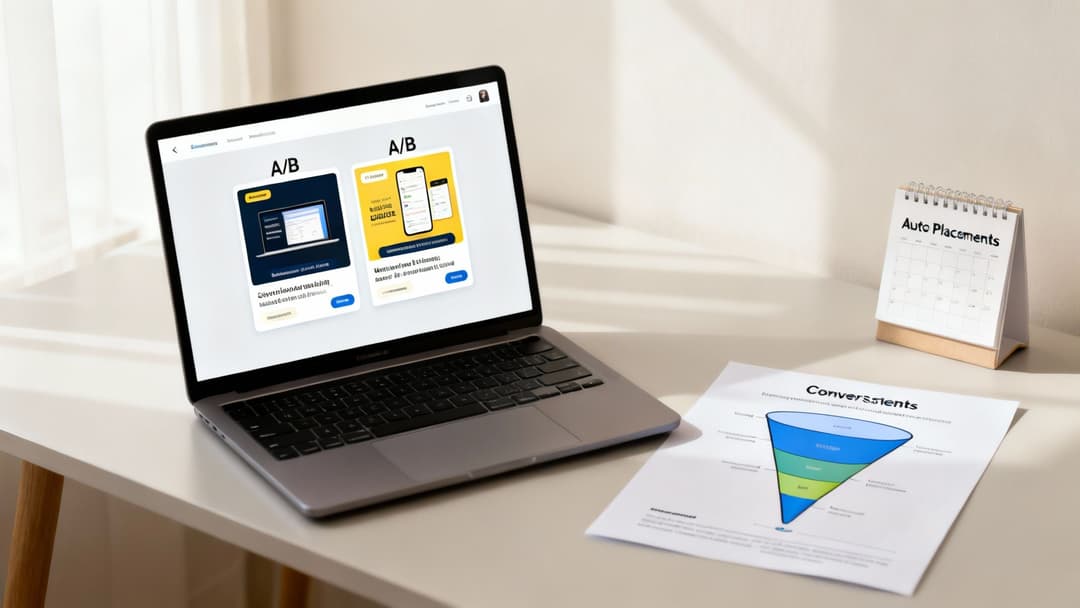
Knowing what drives your Instagram ad costs is one thing, but actually taking control is where the real work begins. With the right game plan, you can make your budget work so much harder, turning every dollar spent into a genuine investment instead of just another line item.
These aren't just theories—they are battle-tested strategies that directly tilt the ad auction in your favor, helping you get better results without emptying your pockets.
Let the Algorithm Find the Cheapest Placements
It’s so tempting to hand-pick the ad placements you think will perform best, like the main Feed or Stories. But that’s often a costly mistake. You might be completely ignoring less competitive, and therefore cheaper, placements where your audience is still hanging out.
This is where Advantage+ Placements (what used to be called Automatic Placements) becomes your secret weapon. When you check this box, you’re giving Meta’s powerful algorithm the keys to the car. It can now hunt for the most cost-effective spots for your ad across its entire network, automatically shifting your budget to wherever it’s getting the lowest cost per result.
Think of it like a smart investment portfolio. You wouldn't put all your money into a single stock, right? Instead, you diversify and let an expert find all the hidden opportunities for growth.
A/B Test Your Creatives Relentlessly
Your ad creative is probably the single biggest lever you can pull to lower your costs. An ad that hits the mark gets more engagement, which boosts its Ad Quality score and earns you cheaper inventory in the auction. But you’ll never find that winning ad without systematic testing.
Stop guessing what will resonate with your audience. Let the data do the talking.
- Test one variable at a time: Isolate what's actually working by changing only the headline, the main image, or the call-to-action button in each ad variation.
- Give it a real budget: Don't skimp here. Your A/B test needs enough budget and time to gather data that’s actually statistically significant.
- Analyze and iterate: Once you find a winning element, that becomes your new control. Now, start testing another variable against it.
This constant cycle of testing and optimizing is the backbone of long-term success. For e-commerce brands especially, it’s worth looking into high-profit Facebook ad strategies to refine your approach even further and squeeze out more profit.
Build Powerful Retargeting Funnels
Here’s a simple truth: getting a brand-new customer is almost always more expensive than winning over someone who already knows you. This is exactly why retargeting is one of the most efficient ways to drive down your overall acquisition costs.
By creating custom audiences based on actions people have already taken—like visiting your site or watching a video—you can serve up super-relevant ads to a warm, engaged group.
Retargeting isn't just about showing the same ad again. It’s about continuing the conversation. If someone abandoned their cart, show them an ad with a small discount or a friendly reminder of the awesome stuff they left behind.
This strategy sends conversion rates through the roof because you’re talking to people who have already raised their hands. Your ad spend becomes instantly more effective. For a deeper look, our guide on ad spend optimization unpacks more advanced techniques.
Master Your Ad Relevance Diagnostics
Meta doesn't leave you in the dark. It gives you direct feedback on how your ads are stacking up through its Ad Relevance Diagnostics. This dashboard breaks down your ad’s performance into three crucial areas:
- Quality Ranking: How your ad’s perceived quality compares to other ads competing for the same eyeballs.
- Engagement Rate Ranking: How your ad’s expected engagement rate stacks up against the competition.
- Conversion Rate Ranking: How your ad’s expected conversion rate compares to other ads with the same goal.
If you see an "Average" or "Below Average" score in any of these areas, you’ve just found your starting point for optimization. It’s a bright, flashing sign from Meta telling you exactly where your ad is falling short, so you can fix it and get a better deal in the auction.
Measuring Success Beyond Basic Metrics
Getting a low cost-per-click feels great, but let's be honest—it's a vanity metric. If those cheap clicks aren't turning into actual business, they don't mean much. Nailing your Instagram ad costs is only half the battle. The other half is figuring out what's actually moving the needle for your bottom line.
To do that, you have to look past the surface-level numbers. The real goal is to connect your ad spend directly to revenue. Making this mental shift is the secret to building a sustainable, long-term advertising strategy.
From Ad Clicks to Business Impact
The savviest advertisers I know are obsessed with metrics that tell the full story of their investment. Three of the most powerful are Return On Ad Spend (ROAS), Customer Acquisition Cost (CAC), and Customer Lifetime Value (CLV).
Customer Acquisition Cost (CAC): This is your all-in cost to land a single new customer. The formula couldn't be simpler: Total Ad Spend ÷ Number of New Customers = CAC. It tells you exactly what you paid to win that person over.
Return On Ad Spend (ROAS): This shows you the revenue your ads bring in for every dollar you put out. You calculate it as Total Revenue from Ads ÷ Total Ad Spend = ROAS. It’s a direct measure of profitability. A ROAS of 4:1 means you’re making $4 for every $1 you spend.
Customer Lifetime Value (CLV): This is the total profit you predict you'll make from a customer over their entire relationship with your brand. It’s a bit more complex to figure out, but it provides absolutely essential context for your CAC.
A high Customer Acquisition Cost might seem alarming at first. But what if a $100 CAC brings in a customer with a CLV of $1,000? That’s an incredibly profitable exchange. This is the kind of insight that separates good advertisers from great ones.
Getting a handle on these key performance indicators finally closes the loop between what you're spending and how you're growing. It lets you see which campaigns and audiences aren't just getting cheap clicks, but are actually driving the most profitable outcomes for your business. This data-backed approach ensures every dollar you invest is working to build a stronger, more sustainable company.
Got Questions About Instagram Ad Costs? We’ve Got Answers.
Jumping into Instagram ads always brings up a few key questions, especially around the budget. Let's tackle some of the most common ones advertisers ask when they're getting their campaigns off the ground.
What’s the Absolute Minimum I Can Spend on Instagram Ads?
You can technically get started with as little as $1 per day. That said, think of that as just turning the lights on.
For Meta's algorithm to actually learn who your best audience is and start optimizing your ads, you'll want to give it more data to work with. A daily budget of at least $5-$10 per ad set is a much more realistic starting point to see any real traction.
Are Instagram Stories Cheaper to Run Than Feed Ads?
It’s not always a clear-cut answer, but often, yes. Placements like Stories and Reels can come with a lower Cost Per Mille (CPM), which is the cost for 1,000 impressions.
This usually happens because there's just more ad space available in Stories and Reels compared to the ultra-competitive main Feed. But cheaper doesn't always mean better. The right placement depends entirely on your campaign goal and what your ad actually looks like, so you’ve got to test it out for yourself.