If you’re serious about optimising Facebook ads, you need to think beyond just tweaking a few headlines or swapping out an image. That’s just tinkering.
True optimisation means building a repeatable system for audience discovery, relentless creative testing, and data-backed scaling. It's about creating a growth engine, not just a few winning ads.
A Modern Framework for Optimising Facebook Ads
The days of finding one unicorn ad and riding it for six months are long gone. The key to winning on Meta today is having a strategic framework that treats every single campaign as a chance to learn something new.
This isn't about stumbling upon a magic bullet. It’s about building a machine that consistently spits out high-performing ads because you have a structured, repeatable process behind it. The best performance marketers I know treat it like a science—less luck, more process.
This guide is that process. We’re moving past the generic tips and laying out an actionable roadmap that covers every critical lever you can pull. To see how this fits into the bigger picture, it's helpful to understand its place in broader social media marketing strategies.

What This Guide Covers
We’re going to break down the entire optimisation workflow, from how you set up your account to how you scale your winners. The goal is to give you a clear, step-by-step framework you can put to work right away.
Here’s a look at what’s inside:
- Foundational Campaign Structure: How to build a clean, scalable account structure that actually makes testing and analysis straightforward.
- Audience and Creative Testing: A systematic way to test audiences, creative, and copy to find what works—and find it fast.
- Budget and Bidding Strategies: A deep dive into Meta's bidding options and how to put your budget where it will have the biggest impact.
- Data-Driven Scaling: How to read the data, spot the real winners, and scale them up without blowing up your CPA.
The advertisers crushing it on Meta aren't the ones with the deepest pockets. They're the ones with the most rigorous testing frameworks. Your ability to learn and iterate faster than the competition is your single biggest advantage.
We'll also look at how new tools are changing the game. Platforms like AdStellar AI are built to automate the tedious stuff—like bulk ad creation and analysis—so your team can test hypotheses at a scale that just wasn't possible before. You can learn more about how to use AI to enhance your Facebook ads and iterate faster.
By the end of this, you’ll see why a methodical approach isn't just a good idea—it's the only reliable path to growth.
Building a Scalable Campaign Structure for Success
Your ability to optimize Facebook ads doesn't start in the reporting dashboard. It begins long before you ever look at a single metric, right back at the campaign structure itself. A messy, illogical setup is a surefire way to guarantee confusion and wasted ad spend. On the flip side, a clean, scalable framework is the foundation for clear insights and profitable growth.
Think of it like building a house—a weak foundation will compromise everything you build on top of it.
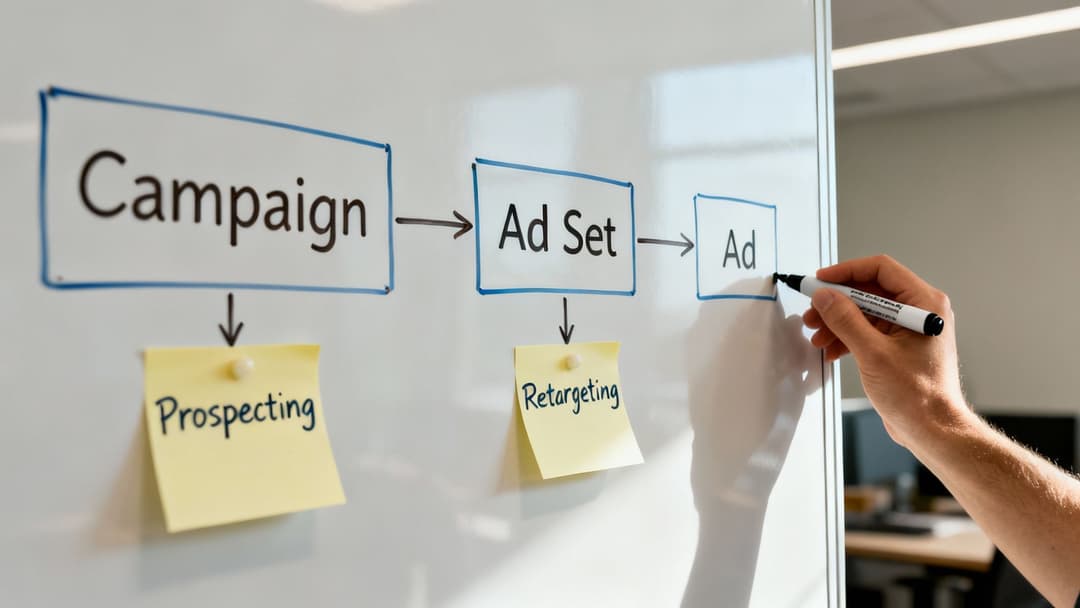
This structure is your control panel. It’s how you test, learn, and scale. Without a deliberate setup, you can’t isolate what’s working and what isn’t. Was it the audience, the creative, or the copy that fell flat? A disorganized account makes it impossible to know for sure, leaving you guessing instead of making data-driven decisions.
And the scale of this opportunity is massive. Facebook's ad reach hit 2.28 billion users globally as of January 2025, a 4.3% year-over-year increase. With the platform reaching nearly 60% of internet users, a structured approach is the only way to navigate this vast ecosystem efficiently.
The Consolidated vs. Granular Debate
One of the first questions that comes up is how simple or complex to make your campaigns. Honestly, the answer depends entirely on your budget, business goals, and where you are in your testing journey.
- The Consolidated Framework: This is the more modern approach. It involves fewer campaigns—often just one for prospecting and one for retargeting. Inside, you use a handful of broad ad sets and let Meta's algorithm do the heavy lifting with Advantage Campaign Budget (CBO). This setup is ideal for advertisers with larger, more stable budgets who trust the algorithm to find pockets of opportunity.
- The Granular Approach: This is all about control. You create many distinct campaigns or ad sets, each targeting a very specific audience segment (e.g., one for a lookalike, another for a specific interest). This method, using Ad Set Budgets (ABO), gives you more manual control over spend, which is perfect for the initial testing phase when you need to guarantee budget behind each variable.
Pro Tip: Start with a granular ABO structure to test your core audience hypotheses. Once you've found clear winners that consistently deliver, consolidate them into a CBO campaign to scale efficiently. This gives you the best of both worlds: tight control during testing and algorithmic efficiency during scaling.
Establishing a Clear Naming Convention
A consistent naming convention is one of those simple disciplines that is completely non-negotiable. It saves hours of headaches down the line and allows anyone on your team to understand a campaign's purpose at a glance. Without it, your Ads Manager becomes an indecipherable mess.
A practical format to follow might look something like this:
[Date]_[Funnel Stage]_[Audience Type]_[Country]_[Objective]
For example, an ad set named 2024.10.28_TOF_LAL1%-Purchasers_US_Conversions instantly tells you everything you need to know:
- Launch Date: October 28, 2024
- Funnel Stage: Top of Funnel (Prospecting)
- Audience: A 1% Lookalike of past purchasers
- Geography: United States
- Campaign Goal: Conversions
This level of clarity transforms your reporting. You can filter, analyze, and compare performance across different strategies without ever having to click into every single ad set. For more ideas on organizing your account, check out our guide on structuring your Facebook ad sets for maximum impact.
Separating Prospecting and Retargeting
Finally, the most fundamental rule of a scalable structure: strictly separate your prospecting (cold audiences) and retargeting (warm audiences). These two groups have completely different levels of intent, and your messaging, creative, and performance expectations need to reflect that.
Mixing them in the same campaign completely muddies your data. Retargeting will almost always have a higher ROAS and lower CPA, which can artificially inflate your campaign's overall performance and mask poor results from your prospecting efforts.
Always create distinct campaigns for each:
- Prospecting Campaign: Target lookalikes, interests, and broad audiences. The goal here is pure new customer acquisition.
- Retargeting Campaign: Target website visitors, video viewers, and email list subscribers. The goal is to nurture interest and drive conversions from people who already know you.
This separation is the very first step toward building a structure that gives you clear signals, supports methodical testing, and ultimately allows you to scale your winners with confidence.
Mastering Creative and Copy Testing at Scale
If your campaign structure is the skeleton, your creative is the heart. It's the single biggest lever you can pull to optimize your ads, but let’s be honest—most teams just throw stuff at the wall and hope something sticks. That's not a strategy; it's a lottery.
Real, sustainable growth comes from a methodical, repeatable system for creative iteration. This isn't about chasing a mythical "unicorn" ad. It's about building an engine that constantly churns out new ideas, tests them rigorously, and learns from every single result, whether it’s a winner or a dud. It’s time to move beyond simple A/B tests and embrace a more sophisticated, multi-variant approach.
Building Your Creative Testing Matrix
A structured approach starts with a testing matrix. Think of it as a simple framework for isolating and testing one variable at a time. Instead of launching a bunch of completely different ads and wondering why one worked, you deliberately test individual elements to understand their specific impact.
Your matrix should break down every component of your ad:
- The Hook: The first 3 seconds of a video or the opening line of your copy. What actually stops the scroll?
- The Angle/Value Prop: The core message. Are you hitting a pain point, highlighting a key benefit, or showing off a unique feature?
- The Format: Gritty, user-generated video versus a polished studio shot. A static image versus a carousel.
- The CTA: The specific instruction you give. Is it a direct "Shop Now," a softer "Learn More," or a benefit-driven call like "Get Your Free Trial"?
- The Copy: Are you telling a long-form story or hitting them with short, punchy benefit statements?
By isolating these variables, you get clean, actionable data. For example, you could test three different hooks using the exact same video, copy, and CTA. The winner tells you which opening resonates most, and you can bake that learning into all future creative. Simple, but incredibly powerful.
Adopting a High-Tempo Testing Mindset
The whole point of this is to increase the volume and speed of your tests. The more hypotheses you can run through the system, the faster you'll land on winning combinations. And this is precisely where manual ad creation becomes a massive bottleneck, holding teams back from the scale needed for rapid learning.
The advertisers who win on Meta aren't necessarily the ones with the biggest budgets—they're the ones with the fastest learning loops. Your ability to test, learn, and iterate on creative is your ultimate competitive advantage.
This is where automation becomes a total game-changer. Imagine a DTC brand wanting to test user-generated content (UGC) against their professional studio shots. Manually, they might create a handful of variations and call it a day. With automation, they could test 10 different UGC clips against 5 studio videos, each paired with 4 unique headlines and 3 different CTAs. Suddenly, you're launching hundreds of ad variations in minutes, not days.
Tools built for this purpose allow you to develop a true creative engine. To see how this works in practice, you can explore our detailed guide on the best creative automation tools for advertisers. These platforms are what separate the pros from the amateurs, helping you move from slow, manual work to a high-volume testing machine.
A Practical Example: SaaS vs. DTC
Let’s look at how two different businesses might put this into practice.
For a SaaS Company: Their main goal is generating qualified leads. A testing matrix here would likely focus on different messaging angles.
- Hypothesis: Pain-point-focused copy will outperform benefit-led copy.
- Test: They create two ad sets. One uses headlines like "Tired of Wasting Hours on Manual Reports?" The other set goes with "Automate Your Reporting and Save 10 Hours a Week."
- Variable Control: The visuals and CTAs are identical across both campaigns.
- Learning: The results will show, clear as day, whether their audience is more motivated by solving a pain or achieving a gain.
For a DTC E-commerce Brand: Here, the goal is direct sales and a solid ROAS. Their matrix will probably focus more on visual formats.
- Hypothesis: Authentic, low-fi UGC videos will drive a higher ROAS than polished, professional ads.
- Test: They pit an ad set with 5 different customer-submitted videos against an ad set with 5 professionally shot product videos.
- Variable Control: The ad copy, offer, and audience targeting are kept exactly the same.
- Learning: This test tells them which visual style actually convinces people to buy, informing their entire creative strategy moving forward. As you look to streamline your ad workflow and explore bigger-picture ideas, you might find inspiration in frameworks like these actionable clothing brand marketing strategies.
This systematic approach turns creative from a guessing game into a data-driven science. By building a testing matrix and using automation to execute at scale, you create a powerful, repeatable engine for growth.
Advanced Bidding and Budget Management Strategies
Nailing your creative and copy is only half the battle. The other half is won by intelligently managing your money. This is where you translate campaign goals into direct instructions for Meta’s algorithm, making your ad spend work smarter, not just harder.
Choosing the right bidding strategy isn't just a technicality—it’s a declaration of your primary objective. Are you trying to squeeze out the most conversions possible for your budget? Or are you laser-focused on maintaining a specific cost per action? Each choice sends a completely different signal to the delivery system.
The numbers don't lie. Facebook advertising remains an essential channel for any performance marketer, largely due to its economic efficiency and massive scale. In 2025, the platform maintained an average cost per click of just $0.42, making it one of the most cost-effective channels out there. The conversion metrics are just as impressive, with ads hitting an average conversion rate of around 8.25%. It's no surprise that over 75% of global social media ad budgets flow into Facebook and Instagram. For more stats, check out this Facebook ads data compilation on cropink.com.
Meta Bidding Strategy Decision Matrix
Picking the right bidding strategy on Meta is mission-critical for hitting your business goals. This isn't a "set it and forget it" choice; it's about aligning your financial targets with the algorithm's marching orders.
To simplify things, here’s a quick-reference table breaking down when to use each of Meta’s primary bidding options.
| Bidding Strategy | Primary Goal | Best Used When... | Key Consideration |
|---|---|---|---|
| Highest Volume (Lowest Cost) | Maximize results within a set budget | You're launching a new campaign, gathering data, or focused on awareness/traffic. | Spends the full budget to get the most conversions, regardless of individual cost. Can be volatile. |
| Cost Per Result Goal (Cost Cap) | Maintain a specific average CPA | You have a clear profitability target and need to control acquisition costs. | The algorithm aims for an average, so some results will be above/below your goal. Good for stable scaling. |
| ROAS Goal (Minimum ROAS) | Achieve a minimum return on ad spend | You're an e-commerce brand with clear conversion value tracking and profitability is the top priority. | Requires accurate conversion value data. Can limit delivery if your ROAS target is too aggressive. |
| Bid Cap | Control the maximum bid in any auction | You're an advanced media buyer who deeply understands auction dynamics and wants to prevent overpaying for any single result. | Puts a hard ceiling on your bids, which can severely restrict reach if your cap is too low to be competitive. Use with caution. |
Ultimately, your choice depends entirely on what you’re trying to achieve. Start with Highest Volume to get a baseline, then move to a Cost or ROAS goal once you have enough data to set a realistic target.
CBO vs. ABO: The Budget Allocation Decision
Just as important as what you bid is how you allocate your budget. Meta gives you two core options here: Advantage Campaign Budget (CBO) and Ad Set Budget (what we used to call ABO).
Advantage Campaign Budget (CBO)
With CBO, you set one overarching budget at the campaign level. Meta’s algorithm then does the heavy lifting, automatically shifting that budget to the best-performing ad sets in real-time.
CBO is your scaling engine. Once you've identified winning audiences and creatives, consolidating them into a CBO campaign lets Meta put your money where it will generate the highest return—no constant manual tinkering required.
Ad Set Budget (ABO)
ABO is the classic approach where you set a specific, dedicated budget for each individual ad set. This gives you granular control over how much you spend testing each audience.
This manual control makes ABO the undisputed champion for the testing phase. When you need to find out which audience or creative is the real winner, you have to ensure each one gets a fair, dedicated budget. CBO would just prematurely dump money into an early "winner," starving your other tests of the data they need to prove their potential.
This decision tree visualizes a simple workflow for handling creative performance, which is a core part of allocating your budget effectively.
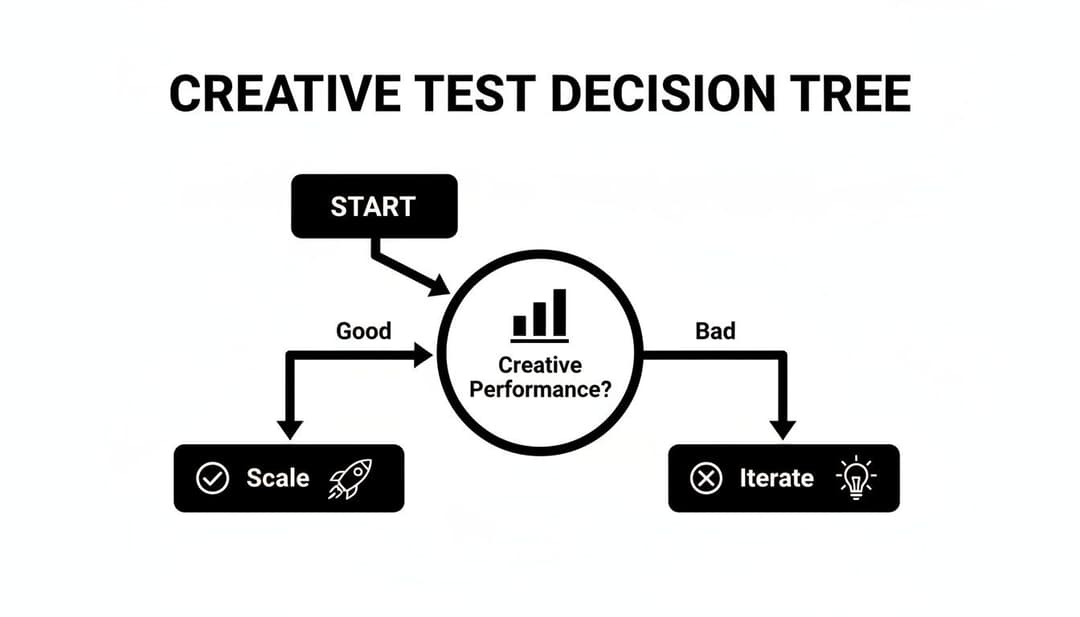
The logic is simple: your budget strategy should either be fueling proven winners or funding the next round of iterations on underperformers.
Protecting the Learning Phase
The "learning phase" is that critical period after you launch a campaign (or make a big edit) where Meta's algorithm is gathering data to figure out how to best deliver your ads. Getting out of this phase is crucial for stable, predictable performance.
To avoid accidentally resetting it, steer clear of these common mistakes:
- Changing your bid or budget by more than 20% at once.
- Making significant changes to your targeting or creative assets.
- Pausing the campaign for more than seven days.
By using ABO for controlled testing and switching to CBO for efficient scaling, you create a powerful system for managing your budget. For a deeper dive into making every dollar count, check out our guide on ad spend optimization.
Turning Analytics Into Actionable Insights
Data without interpretation is just noise. The real skill in optimizing Facebook ads isn't just staring at a dashboard full of numbers; it’s seeing the story the data is telling you about your customers and your creative. It’s about moving past vanity metrics and focusing on the KPIs that actually move the needle for your business.
So many advertisers get hung up on Click-Through Rate (CTR) or Cost Per Click (CPC). While these metrics have their place, they don’t tell you if you're actually making money. The real optimization begins when you anchor every decision to the metrics that matter most: Cost Per Acquisition (CPA), Return On Ad Spend (ROAS), and eventually, Lifetime Value (LTV).

Uncovering Hidden Pockets of Performance with Breakdowns
One of the most powerful—and criminally underused—tools in Ads Manager is the "Breakdown" feature. This is where you graduate from seeing what happened to understanding why. By slicing your data, you can uncover hidden pockets of high performance or diagnose exactly where a campaign is bleeding cash.
Instead of just accepting an ad set's overall CPA, you can break it down to see how it performs across dozens of different segments. This simple action can reveal some absolute game-changers.
Here are the essential breakdowns I live by in my weekly analysis:
- By Placement: Is Instagram Stories outperforming the Facebook Feed by 2x? That’s a huge signal telling you where to pour your creative resources.
- By Age & Gender: You might find that your 35-44 female audience has a CPA that's 50% lower than any other group. Boom. That's your cue to build a new ad set laser-focused on this high-value demographic.
- By Region: What if you see that California is driving all your results, but Texas is a money pit? You can either exclude Texas or, better yet, create a separate campaign with creative tailored specifically for that state.
These breakdowns transform a single, average metric into a dozen actionable data points, helping you refine your targeting and creative with surgical precision. For a deeper dive into this process, check out our complete guide to marketing campaign analytics.
A Simple Framework for Weekly Performance Reviews
To avoid making reactive, emotional decisions, you need a consistent weekly review process. This isn't about nervously checking stats every hour. It’s a dedicated block of time to analyze performance and make smart, strategic moves.
Your review should be guided by a handful of simple questions:
- What's Winning? Pinpoint the top-performing campaigns, ad sets, and ads based on your main KPI (CPA or ROAS). What do they have in common? Is it a specific creative angle, a certain audience, or a particular placement?
- What's Sinking? Find the ads and ad sets dragging down your overall performance. Is the frequency skyrocketing, signaling ad fatigue? Is the CTR in the gutter, suggesting the creative just isn't landing?
- What Are the Opportunities? Based on your breakdowns, what new hypotheses can you test? If one age group is converting like crazy, should you test a lookalike audience based on them?
This structured approach ensures you’re making changes based on real trends, not a single day's random fluctuation. It’s the difference between steering a ship with a map and just getting tossed around by the waves.
Understanding Your Attribution Window
Attribution is simply how Facebook gives credit to your ads for making a sale. Grasping this is critical because it directly impacts how you evaluate what’s working. The two main types are:
- Click-Through: Someone clicks your ad and converts within a set time frame.
- View-Through: Someone sees your ad (but doesn't click) and converts later on.
You can set your attribution window in Ads Manager, and the default is usually "7-day click or 1-day view." This means a conversion gets credited if it happens within seven days of a click or one day of a view.
The attribution window you choose should mirror your customer's typical buying journey. For an impulse-buy DTC product, a shorter window like "1-day click" might be more honest. For a high-ticket B2B service with a long consideration phase, a "28-day click" window tells a much more complete story.
Choosing the right window is crucial. A window that’s too long can inflate your ROAS by taking credit for sales that might have happened anyway. On the other hand, a window that’s too short might underreport your ad's true impact, especially the influence of view-through conversions. Test different settings to see what aligns best with your business model and gives you the clearest picture of performance.
Your Toughest Facebook Ad Questions, Answered
Even the best framework can't cover every weird scenario that pops up when you're deep in the trenches of Ads Manager. Let's tackle some of the most common questions I get from performance marketers. These are the real-world, in-the-weeds challenges that can make or break a campaign.
How Often Should I Actually Be Optimising My Ads?
Everyone wants a magic number, but the honest answer is: it depends on the campaign's age. The one thing you absolutely must avoid is making reactive, daily tweaks. That’s a surefire way to keep the algorithm guessing and prevent your ads from ever finding their groove.
A brand-new campaign needs room to breathe. It has to exit the learning phase, which means you should let it run for at least 3-5 days before you even think about making a significant change. Give it time to gather data.
For your steady, evergreen campaigns, a weekly check-in is the right rhythm. Of course, you’ll want to glance at performance daily to spot any five-alarm fires, but save the big moves—like major budget shifts or creative swaps—for that dedicated weekly review. This is all about making decisions based on solid data, not knee-jerk reactions to a single day's performance.
Help! My Ads Have a High CTR But No One Is Converting. What Gives?
Ah, the classic. This is one of the most frustrating problems because it feels like you're so close. A high CTR with low conversions almost always points to a major disconnect between what your ad promises and what your landing page delivers. You’ve successfully stopped the scroll, but the post-click experience is letting you down.
It's time to audit the entire user journey, from thumb-stop to checkout.
- Message Match: Is the headline on your landing page a carbon copy of your ad headline? It should be.
- Offer Clarity: Is the offer just as clear and compelling on the page as it was in the ad? No hidden surprises.
- Friction Points: How fast does the page load on a mobile device? Be honest. A slow page is a conversion killer, period.
Other culprits could be a clunky checkout process or a lead form that feels like an interrogation. Before you touch your ads again, you need to test different landing pages or obsess over optimizing the current one. Create a seamless, trustworthy path from the ad to the final conversion.
A high CTR with low conversions is just an expensive way to buy traffic. It tells you the problem isn't your ad's creative—it's what happens next. Fix the destination before you spend another dollar sending people there.
When Should I Use Advantage Campaign Budget vs. Ad Set Budget?
This isn't a matter of which one is "better," but which one is right for your current goal. The choice boils down to whether you're in a testing phase or a scaling phase. Think of Ad Set Budget (ABO) as your tool for surgical control, and Advantage Campaign Budget (CBO) as your tool for automated efficiency.
Use Ad Set Budget (ABO) when you need to force-spend on specific variables for a clean test. It’s perfect for testing new audiences or a batch of new creatives because it guarantees each ad set gets an equal, dedicated budget to prove its worth.
Once you’ve found your winners and you're ready to pour fuel on the fire, switch over to Advantage Campaign Budget (CBO). CBO gives Meta's algorithm the keys, allowing it to dynamically push your entire campaign budget to the top-performing ad sets in real time. It's far more efficient for scaling because it automatically backs your best horses, maximizing your return without you having to manually shift budgets around all day.
What's the Best Way to Fight Ad Fatigue?
Ad fatigue is not an "if," it's a "when." It's the inevitable point where your audience has seen your ad so many times that they start ignoring it, and your performance craters. The only real defense is a good offense: a proactive creative testing pipeline.
Keep a close eye on your ad frequency. Once that number starts creeping above 3-4 for a prospecting audience, it’s a flashing red light that you need to rotate in something fresh. And don't just swap one image for a slightly different one. You need to test fundamentally different hooks, angles, formats, and copy.
This is where having a tool to bulk-create and launch dozens of variations becomes a massive advantage. It lets you build a "creative backlog" of tested ads. So, the moment you see the early signs of fatigue, you have fresh creative locked and loaded, ready to keep your campaigns healthy and performance on track.
Ready to stop the guesswork and start scaling your Meta campaigns with precision? AdStellar AI automates the entire testing workflow, from bulk ad creation to AI-powered performance insights. Launch hundreds of creative variations in minutes, identify your top performers automatically, and turn your winning ads into a repeatable growth engine. Discover how performance marketers are building and optimising campaigns 10x faster at https://www.adstellar.ai.