Paid acquisition rarely fails all at once. It starts with a familiar operating problem.
Search is already running. Meta is active. LinkedIn might be producing a few promising deals. Leads still come in, but the answers get harder to trust. Sales questions lead quality. Finance wants revenue by channel. Marketing spends more time reconciling platform reports with CRM data than deciding what to test next.
Many growth teams hit the same wall. The person managing paid media is buried in edits, reporting lives in spreadsheets, and creative testing slips because launch capacity is limited. Effort goes up. Decision quality does not.
That is usually the point when leadership starts asking whether an agency would fix the problem.
Sometimes the answer is yes. Sometimes an agency adds another layer between the team and the customer, and the better move is hiring a stronger operator or using software to remove manual work. The hard part is not deciding whether performance matters. The hard part is choosing the operating model that can support tighter measurement, faster iteration, and clearer budget decisions over the next 12 months.
A good performance marketing agency is one option in that model. It is not a substitute for strategy, clean conversion tracking, or clear ownership inside the company. If those pieces are missing, an agency can improve output while leaving the underlying decision problem in place.
This article looks at the decision the way an operator should. Not just what a performance marketing agency does, but when it makes sense to hire one instead of building in-house or using newer AI-driven platforms. The useful standard is simple: choose the setup that helps your team learn faster, allocate budget with more confidence, and turn paid acquisition into a repeatable growth system.
When Your Growth Strategy Hits a Wall
A familiar version of this shows up around the same time in many growth-stage companies. The founder or head of marketing got early traction through a few paid channels. Costs were manageable, the account structure was simple, and weekly reporting felt good enough. Then the business added new offers, more audiences, more landing pages, and more pressure from sales.
Now the same campaigns that used to scale cleanly start producing mixed signals.
Meta says one thing. Google says another. The CRM shows deals from accounts no one can confidently attribute. The marketing manager spends Monday pulling numbers, Tuesday explaining why lead volume rose while pipeline quality fell, and Wednesday rewriting ads that should have been tested last week.
Practical rule: When your team spends more time reconciling data than changing strategy, you don't have a workload problem. You have an operating model problem.
It is at this stage many companies waste a quarter. They assume the answer is “more effort.” So they ask the internal team to manage more channels, create more assets, and report in more detail. Output rises. Clarity doesn't.
What the wall usually looks like
- Channel growth stalls because campaigns are live, but nobody is systematically testing audiences, offers, and creative angles.
- Reporting gets messy because platform metrics don't line up with sales outcomes.
- Decisions slow down because budget changes require manual analysis across too many tools.
- Ownership gets blurry because marketing, sales, and finance all define success differently.
The issue isn't that paid media stopped working. It's that the business outgrew a lightweight setup.
What actually changes at this stage
Once you're managing meaningful spend, performance work becomes cross-functional. Someone has to connect ad platforms, analytics, CRM stages, lead quality, and revenue. Someone has to decide whether a cheap lead is helping or hurting. Someone has to stop the team from overreacting to shallow metrics.
That “someone” can be an internal team, a specialist agency, or a software-driven workflow. But if nobody owns that system end to end, the company tends to drift into expensive ambiguity.
What Is a Performance Marketing Agency Really
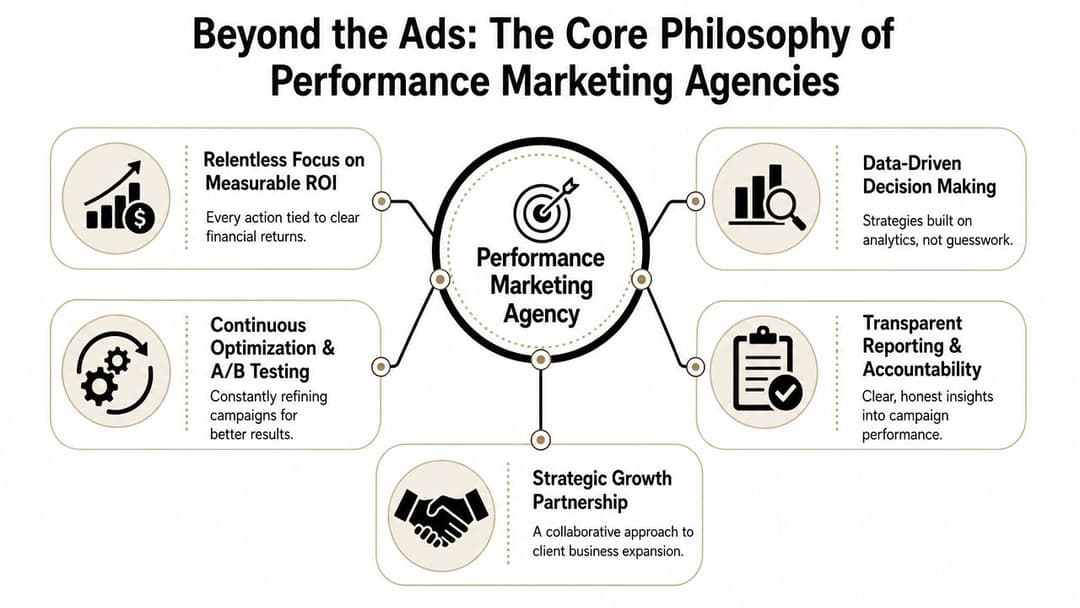
A real performance marketing agency isn't defined by the fact that it buys ads. Plenty of firms buy ads. The difference is what they optimize for and how they prove it.
At a practical level, performance marketing agencies operate like portfolio managers. They allocate budget across channels, audiences, and creative variations. Then they keep rebalancing that mix based on what improves business outcomes, not what looks busy in a platform dashboard.
The real test is measurement
The strongest agencies don't stop at clicks, impressions, or even platform conversions. They're judged on whether they can connect platform activity to business outcomes through closed-loop measurement, combining website analytics, ad platform data, CRM records, and sales outcomes to optimize for CAC, CLV, conversion rate, and revenue rather than clicks alone (closed-loop measurement in performance marketing).
That sounds technical, but the business implication is simple. If the agency only reports what the ad platform can see, you'll often overvalue cheap traffic and undervalue the channels that produce stronger downstream conversion.
What they should do beyond media buying
A competent agency usually does at least four things well:
Translate goals into operating metrics
If your business has a long sales cycle, “more leads” isn't enough. The agency should define stage-based targets that match how revenue is created.Run structured testing
Better teams don't launch random creative and hope. They test messaging, offers, audiences, landing pages, and budget distribution in a deliberate sequence.Build reporting that people can act on
A dashboard isn't helpful if nobody trusts the inputs. Strong agencies make the reporting usable for marketing, sales, and leadership.Reallocate budget without drama
Good operators cut underperforming campaigns early, move money into what's working, and explain the trade-offs clearly.
The agency is useful when it helps your team answer, with evidence, where the next dollar should go.
If you want a practical baseline for how this discipline works at the campaign level, this guide on how to do performance marketing is a good companion to agency evaluation.
Typical Services and Core KPIs
Companies usually hire an agency for campaign execution, then realize the harder problem is measurement. The useful question is not "what services do they offer?" It is "which parts of the funnel can they improve, and which KPIs prove it?"
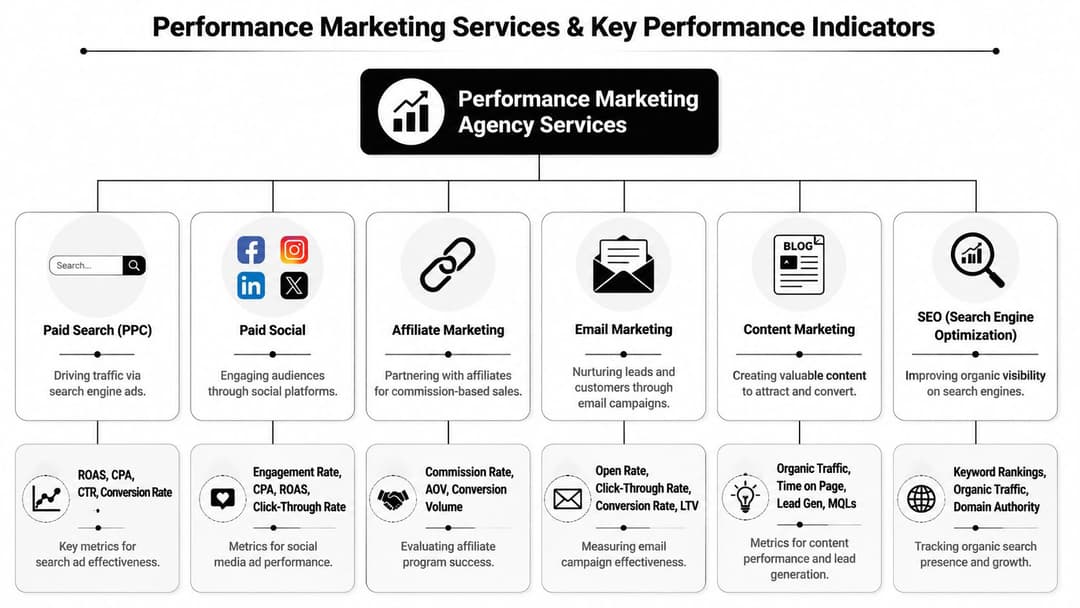
A solid agency maps each service to an operating decision. If paid search is under target, should you change bids, rewrite landing pages, tighten match types, or stop buying low-intent queries? If paid social stalls, is the issue audience saturation, weak creative, poor offer framing, or a slow sales follow-up process? Those are different problems. They need different KPIs.
Paid search and paid social
Search and social often sit under the same paid media budget, but they earn their place in different ways.
Paid search captures demand that already exists. The work usually includes account structure, query control, negative keywords, bidding logic, ad testing, landing page alignment, and conversion tracking. The KPIs that matter depend on the business model. Ecommerce teams usually care about revenue efficiency. Lead generation teams care more about qualified pipeline, booked meetings, and close rates by source.
Paid social does more upfront work. It creates interest, filters audiences, and tests offers before intent is fully formed. That puts more pressure on creative production, audience refresh cycles, and landing page clarity. A social agency that only reports CTR and CPC is giving you surface-level performance. You need to see whether the traffic turns into leads, purchases, or sales conversations that progress.
For both channels, agencies should separate diagnostic metrics from decision metrics:
- CTR and CPC help diagnose whether the ad is earning attention efficiently
- Conversion rate shows whether traffic and landing page intent match
- CPA or CPL shows acquisition efficiency at the point of conversion
- Revenue, pipeline, or qualified opportunity rate shows whether the channel is producing business value
If you want a cleaner read on social reporting before an agency review, use this breakdown of Facebook ad performance metrics.
Display, affiliate, email, and content
These services are useful in the right operating context. They are wasteful when added because an agency wants a broader scope.
| Service | Where it helps | What to watch |
|---|---|---|
| Display and programmatic | Retargeting, branded reach, assisted conversion paths | Incremental lift, frequency, audience overlap, post-click quality |
| Affiliate marketing | Partner-led acquisition with controlled payout terms | Partner quality, conversion consistency, margin impact, order value |
| Email marketing | Lead nurture, abandoned cart recovery, retention, reactivation | Open quality, click behavior, conversion rate, revenue per send |
| Content and SEO | Longer buying cycles, category education, demand capture | Qualified organic traffic, assisted conversions, demo requests, sales influence |
The same logic applies to site experience. If an agency is buying traffic into a weak site, performance stalls fast. For service businesses, that often means the paid team needs to coordinate with whoever owns the site, whether that is an internal web team or an outside partner offering web design and SEO plans.
The KPI trap
The reporting mistake I see most often is metric sprawl. Teams track everything because the platforms make it easy, then fail to decide what changes budget, creative, or channel mix.
A better reporting stack has three layers. First, platform metrics diagnose delivery and engagement. Second, conversion metrics show whether clicks become actions. Third, business metrics tell you whether those actions become revenue, qualified pipeline, or retained customers.
That last layer decides whether the agency is doing its job.
If an agency cannot connect media performance to sales quality, contribution margin, or customer value over time, you are not looking at performance marketing. You are looking at media buying with nicer dashboards.
Understanding Agency Pricing and Engagement Models
Agency pricing matters less than pricing alignment. The wrong fee model creates bad behavior fast.
Some companies obsess over the monthly cost and ignore the incentive structure behind it. That's backwards. You need to know what the agency is rewarded for doing. More work? More spend? Better outcomes? Those aren't the same thing.
Monthly retainer
A retainer is the simplest model. You pay a fixed monthly fee for a defined scope.
This works best when you need steady execution across channels, regular strategy input, and predictable budgeting. It also makes planning easier if your media budget changes from month to month.
The downside is obvious. If scope is vague, the agency can stay “busy” without pushing meaningful progress. Retainers require very clear deliverables, meeting cadence, and performance expectations.
Percentage of ad spend
This model scales the fee with your media budget. It's common because it's easy to administer and aligns loosely with account size.
The benefit is flexibility. If you increase spend, the agency has more room to support execution. The problem is incentive drift. A percentage-of-spend contract can reward budget growth even when the smarter move is to hold or cut spend.
If an agency gets paid more when you spend more, ask how it handles the month when the right answer is to reduce spend and fix conversion issues first.
Hybrid or performance-linked models
Hybrid structures combine a base fee with incentives tied to defined outcomes. In theory, this improves alignment. In practice, it only works when tracking is trustworthy and both sides agree on what counts.
If your attribution is messy, performance fees create arguments instead of accountability. If your measurement is solid, they can work well for businesses with clear funnel stages and stable conversion definitions.
What to compare before you sign
Don't compare pricing models in isolation. Compare what's included.
- Scope depth matters more than the label on the contract.
- Creative production responsibility needs to be explicit.
- Reporting ownership should be written down.
- Data integration work should never be assumed.
- Exit terms tell you a lot about how confident the agency is.
For teams trying to benchmark service packaging in adjacent digital work, reviewing examples like web design and SEO plans can be useful because they show how agencies bundle scope, support, and deliverables in plain terms.
If you're comparing specialist paid media partners, this overview of a Facebook ads agency model can help you pressure-test where management fees stop and strategic value should begin.
Agency vs In-House vs AI Platform A Modern Comparison
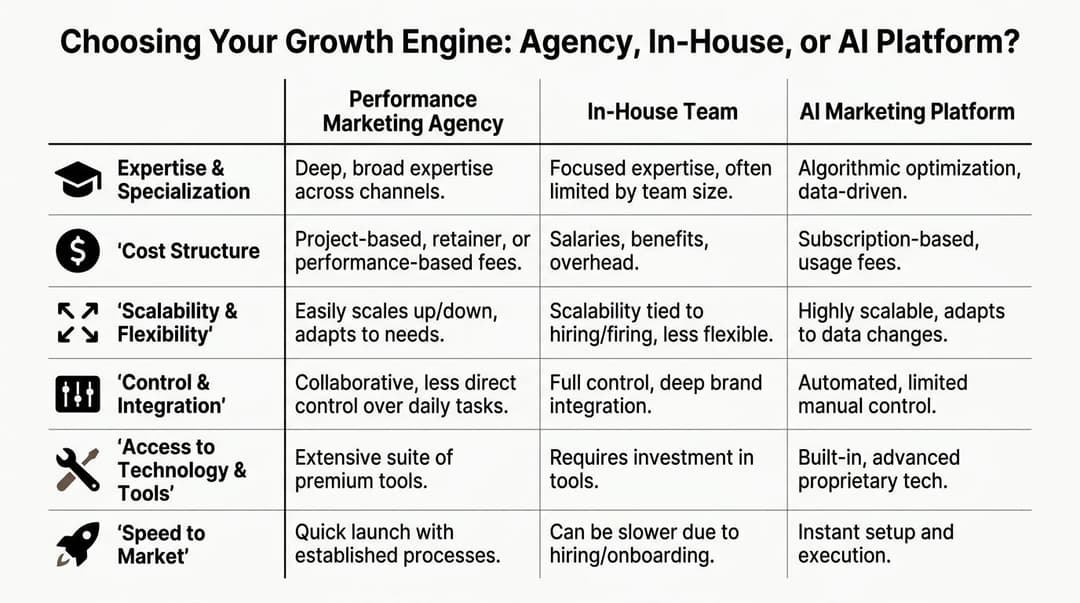
This is the decision many organizations are making now. Not agency or nothing. Agency, in-house, or AI-assisted execution.
The old assumption was that agencies brought expertise, in-house teams brought control, and software was just a reporting layer. That's changed. The agency model is being reshaped by talent shortages and AI-driven execution, and agency leaders in 2026 are positioning themselves around AI-powered optimization and rapid iteration rather than manual buying alone (agency model shifts driven by AI and talent constraints).
Where agencies still make sense
Agencies are strongest when you need cross-channel pattern recognition, faster ramp-up, and an external team that already knows how to structure testing, reporting, and budget governance.
They also make sense when your internal team is senior enough to manage the relationship. A weak internal owner plus an agency often produces lots of activity and weak accountability. Someone on your side still needs to define success, challenge assumptions, and connect marketing decisions to company priorities.
When in-house is the better move
In-house is usually the right answer when your paid program is a core strategic capability, your product and audience are nuanced, and you need deep integration with sales, product marketing, lifecycle, and brand.
The trade-off is speed. Building a good in-house team takes hiring time, onboarding time, and systems work. If one person leaves, execution can stall. And many companies underestimate the operational burden of maintaining creative throughput, data cleanliness, and testing discipline without external support.
Where AI platforms change the equation
AI platforms are most useful when your bottleneck is execution speed, repetitive build work, or analysis lag.
If your team already knows the strategy but can't launch enough creative variants, can't keep up with audience testing, or spends too much time in campaign setup, software can remove the friction. In that setup, the platform doesn't replace judgment. It compresses the manual work between idea and launch.
For Meta-heavy teams, one example is performance marketing AI, which reflects how these tools are being used to accelerate testing and optimization workflows.
Later in the process, it helps to see how another operator frames this shift in practice:
A simple decision lens
Use this when deciding between the three models.
- Choose an agency if you need outside expertise, channel coverage, and faster execution without building a larger team first.
- Choose in-house if paid acquisition is central to your competitive advantage and you can support hiring, tooling, and management overhead.
- Choose an AI platform if your strategy is sound but your team is constrained by production speed, launch volume, or repetitive optimization work.
The hidden trade-off most teams miss
The core trade-off isn't only cost. It's coordination.
A good agency coordinates specialists. A good in-house leader coordinates functions. A good AI platform coordinates workflow. The right answer depends on where your bottleneck lives.
If your issue is weak strategy, software won't fix it. If your issue is slow execution, another meeting with your agency won't fix it either. And if your issue is that nobody owns the full funnel, hiring one media buyer in-house won't solve that.
Your Practical Checklist for Evaluating Agencies
Most agency selection processes are too soft. The team likes the pitch, likes the deck, likes the chemistry, and then discovers three months later that reporting is shallow and testing is inconsistent.
A better evaluation process forces the agency to show how it operates.
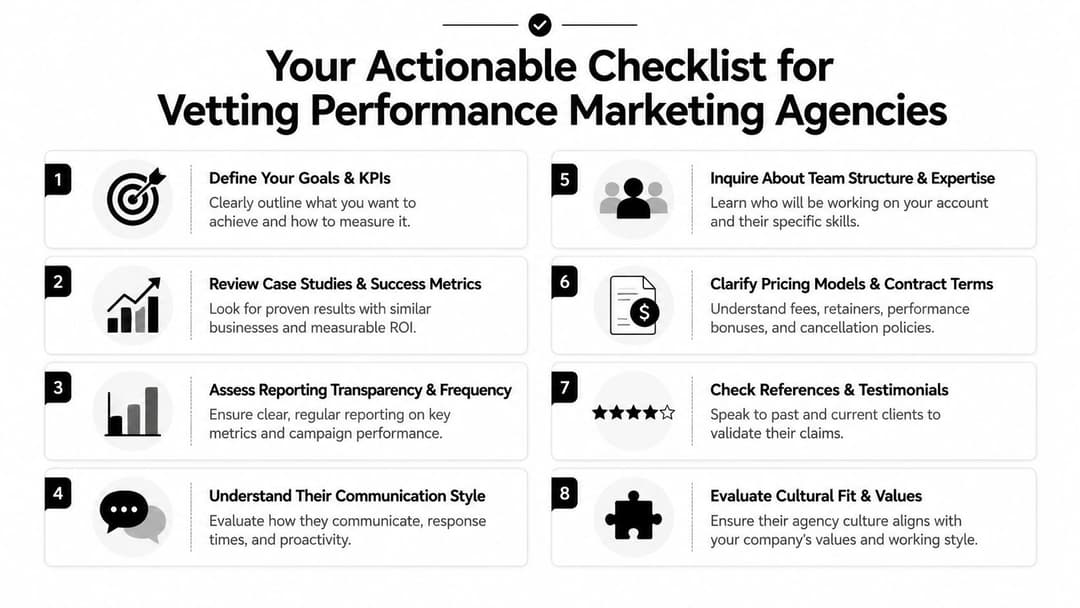
One of the clearest signs of maturity is technical infrastructure. A mature performance agency runs a modern data stack with ETL tools and a warehouse to normalize data, which supports reliable A/B testing and optimization and gives buyers a way to judge sophistication beyond last-click reporting (modern data stack for marketing agencies).
Questions about data and attribution
Start here, because weak measurement ruins everything downstream.
- Ask how they connect platforms to revenue. If the answer stays inside ad managers, that's a warning sign.
- Ask what they do about inconsistent source data. Mature teams should talk about normalization, cleanup, and governance.
- Ask how they handle attribution disagreements between platform data and CRM outcomes. You want a practical answer, not theory.
- Ask what they consider a trustworthy conversion signal. This reveals whether they optimize for convenience or business reality.
The fastest way to expose a shallow agency is to ask what happens when platform-reported performance looks strong but sales quality drops.
Questions about testing and execution
A lot of agencies promise optimization. Fewer can explain their testing process clearly.
Use questions like these:
- What's your method for prioritizing creative tests?
- How do you decide whether a performance drop is a creative problem, audience problem, offer problem, or landing page problem?
- What does the first month of testing usually focus on?
- How often do you refresh concepts in paid social?
Look for structured thinking. If every answer sounds improvised, expect inconsistent execution.
Questions about team structure and communication
Don't buy the pitch team if the work will be done by someone else.
| What to ask | What you want to hear |
|---|---|
| Who will actually run the account? | Named roles, clear responsibilities, access to specialists |
| How do you communicate performance changes? | Regular cadence plus escalation for material issues |
| What does reporting include? | Insight, diagnosis, and next actions. Not just screenshots |
| How do you onboard a new client? | A defined plan for tracking, baselines, creative, and priorities |
What good answers sound like
Good agencies usually speak in operating language. They talk about data flow, test design, budget movement, lead quality, CRM stages, and decision criteria. Weak agencies stay high level. They talk about “driving growth” and “improving ROI” without showing how they work.
That difference matters more than polished branding.
Next Steps What to Ask Before You Sign
By the time you're in serious conversations, generic questions won't help. Every agency can say it's data-driven. Every agency can say it focuses on ROI. You need questions that force operational detail.
There's a real gap in the market here. Buyers need better ways to evaluate whether an agency can attribute results beyond last-click reporting and connect marketing data to sales workflows, including the use of cohort analysis where appropriate (evaluating agencies beyond last-click reporting).
RFP questions worth asking
Use questions that reveal how the agency thinks under real conditions:
- Walk us through your first 30 days. What do you audit first, what do you leave alone, and how do you establish baselines?
- Describe a campaign that underperformed. How did your team diagnose the issue, and what changed next?
- How do you connect marketing data to sales outcomes? Ask for the workflow, not a slogan.
- What reporting do you give executives versus channel managers? The answer should reflect different decision needs.
- How do you use segmentation? For B2B, ask specifically about firmographic, technographic, and engagement-based segmentation.
- How do you approach cohort analysis in longer buying cycles? If they work in complex funnels, they should be comfortable here.
- What events or signals do you need from our systems to optimize properly?
- How do you handle tracking resilience when platform data is incomplete? Topics like the Facebook Conversion API often become part of the discussion.
- What would make you recommend reducing spend rather than increasing it?
- Who owns creative testing, and how is winning creative turned into the next test plan?
The final screen
Before you sign, ask one more question that many teams skip.
What will this partnership look like when it is not going well?
A serious agency will answer directly. It will talk about how issues surface, who gets involved, how fast changes happen, and what decisions require client input. That answer tells you more than most case-study slides ever will.
The best choice usually isn't the firm with the biggest promise. It's the partner, team, or platform that fits your actual operating constraints and can help you make better decisions consistently.
If your team's main bottleneck is Meta execution speed rather than strategy, AdStellar AI is one option to evaluate alongside agencies and in-house hiring. It's an AI-powered platform for launching, testing, and scaling Meta campaigns faster through bulk ad creation, one-click launches, and performance insights tied to metrics like ROAS, CPL, and CPA.