To really make Instagram ads work, you have to get out of the "boost post" mindset and learn your way around Meta Ads Manager. This is where the real magic happens—it’s about getting crystal clear on your campaign goals, building smart audiences from your own data, and creating video creative that stops the scroll because it looks like it belongs there.
Why Run Instagram Ads in a Crowded Market

It’s easy to look at the endless scroll of an Instagram feed and wonder if there’s any space left for your brand. I get it. But here’s the thing: Instagram isn't just another social media app anymore. It’s a full-blown engine for business growth, especially for brands that understand how its ad ecosystem really works.
The platform’s true value isn't just about how many people are on it, but why they're on it. People are actively using Instagram to discover new things, research products, and—most importantly—to buy. This means your ads aren't seen as annoying interruptions; they’re often welcome solutions. Users almost expect to find new products in their Feeds, Stories, and Reels, making it one of the few places where ads feel like a natural part of the experience.
The Scale of the Opportunity
The numbers backing Instagram's ad platform are pretty staggering, and they show zero signs of slowing down. Just look at the sheer scale of it all.
The table below paints a clear picture of just how massive the Instagram advertising channel has become, and where it's headed.
| Metric | 2022 | 2026 Projection | Key Takeaway |
|---|---|---|---|
| Global Ad Revenue | $22.01 Billion | $42.52 Billion | Revenue is set to nearly double, showing immense advertiser confidence and effectiveness. |
| Global Ad Reach | 1.44 Billion Users | 1.74 Billion Users | Your potential customer base is not only huge but still growing at a rapid pace. |
| Ad Reach Growth (YoY) | 6.8% | 5.5% (as of 2025) | The platform continues to expand its influence, pulling in new users you can target. |
This isn't just abstract growth; it's a reflection of an ad environment where automation and smart strategy are becoming non-negotiable for capturing market share. As of 2026, Instagram's ad revenue is projected to hit an incredible $42.52 billion, a massive jump in just four years. That kind of money only flows where results follow.
At its core, the reason to run Instagram ads is simple: your customers are already there, and they’re in a buying mood. The entire platform is built to make it easy for people to go from discovery to purchase.
More Than Just Getting Seen
While getting your brand name out there is great, the real power of running Instagram ads is in driving measurable actions. Success isn't about impressions; it's about performance.
Here's where it gets good:
- Next-Level Targeting: You can get incredibly specific, layering interests, behaviors, and demographics to pinpoint your ideal customer. Better yet, you can create powerful Custom and Lookalike Audiences from people who’ve visited your site or are already on your customer list.
- A Full Creative Toolkit: You’re not stuck with one format. From immersive Stories and viral-style Reels to multi-product Carousels, you can tell your story and show off your products in the way that makes the most sense for your goals.
- Tools Built for Conversion: Features like Instagram Shops, product tags, and clear call-to-action buttons are all designed to shrink the path from seeing an ad to making a purchase. It’s all about turning passive scrollers into active customers.
Thinking about where to begin? Our guide on how to promote on Instagram is a great starting point for those first steps. The aim isn't just to exist on the platform, but to strategically tap into an audience that's ready and willing to buy. A well-run ad strategy is what separates stagnant brands from those achieving scalable growth.
Building Your Technical Foundation in Ads Manager
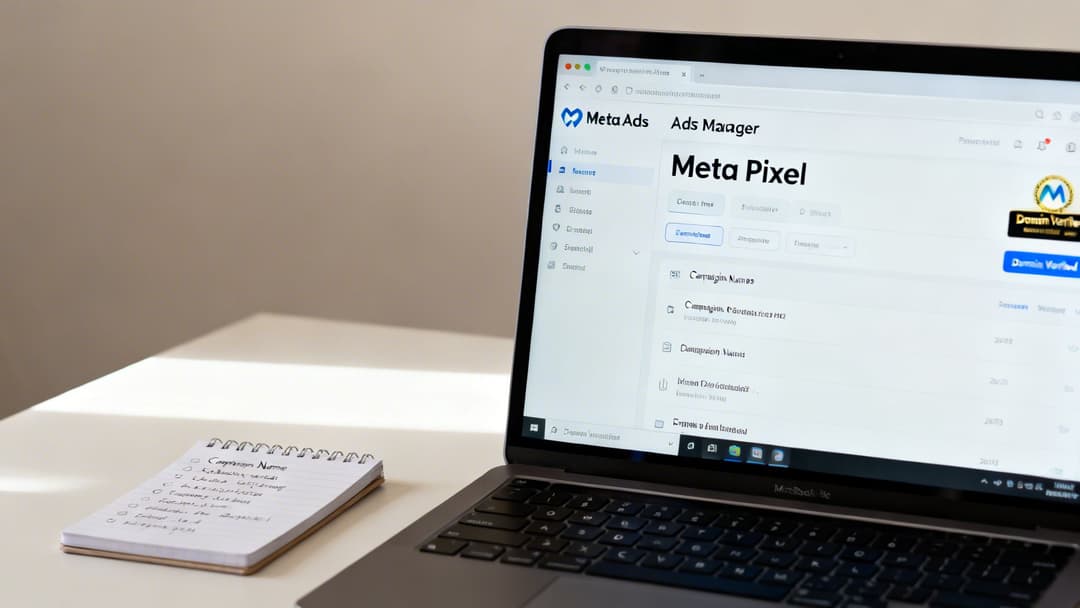
Let's be honest—the technical setup isn't the glamorous part of running Instagram ads. But while everyone else is obsessing over the perfect creative, seasoned pros know the real money is made (or lost) in the backend of Ads Manager.
Think of it this way: a brilliant ad without a solid technical foundation is like a sports car with flat tires. It might look great, but it’s going nowhere. Nailing this part from the start is what separates the campaigns that scale from the ones that stall out and burn cash.
First Things First: Secure Your Data with Domain Verification
Before you even think about your first ad, you need to verify your domain. This isn't just a suggestion from Meta; it's an absolute must-do. Verifying proves you own your website, which is critical for building trust and unlocking essential tracking features.
In a world where privacy updates are the new norm, this is how you tell Meta that your conversion events are legitimate and should be prioritized. It’s a simple step, but it’s the key that unlocks accurate measurement.
Master Your Tracking with the Meta Pixel and AEM
With your domain verified, it’s time to install the Meta Pixel. This little piece of code is the heart of your entire advertising ecosystem. It lives on your website, watching how users interact and sending all that priceless data back to Ads Manager. Paired with Aggregated Event Measurement (AEM), Meta's answer to iOS tracking limitations, it's how you make sense of performance.
This setup is non-negotiable for a few big reasons:
- See What’s Working: You can actually track which ads are driving sales, sign-ups, or any other action on your site. No more guessing.
- Unlock Powerful Retargeting: It lets you build audiences of people who’ve visited your site, like someone who abandoned their cart. These are your warmest leads.
- Fuel High-Quality Lookalikes: Your Pixel data is the source material for building Lookalike Audiences, which is still one of the best ways to find new customers.
- Train the Algorithm: You’re feeding the algorithm the data it needs to find more people who will take the actions you care about.
You'll need to configure up to eight AEM events and rank them by priority. For an e-commerce brand, a typical hierarchy would be Purchase at the top, followed by Initiate Checkout, Add to Cart, and then View Content. This ensures Meta always captures your most valuable conversions.
Think of your Pixel as your campaign’s central nervous system. It sends vital signals back to the brain (Ads Manager) so it can learn, adapt, and make smarter decisions about where to allocate your budget.
If you're new to the platform where all this magic happens, our guide on what Facebook Ads Manager is is the perfect place to get your bearings.
Structure Your Account for Clarity and Scale
A messy ad account is a recipe for disaster. It leads to confusing data, duplicated efforts, and wasted money. Before you spend a single dollar, create a consistent naming convention that you can stick to. A clean structure makes it incredibly easy to see what’s working at a glance.
Try a format that tells a story:
- Campaign:
[Date]_[Objective]_[Offer]_[Region]- Example:
2026_01_15_Sales_WinterBoots_US-CA
- Example:
- Ad Set:
[Audience]_[Targeting]_[Placement]- Example:
LAL1%-Purch_Fitness-Int_IG-Reels
- Example:
- Ad:
[Format]_[Angle]_[CTA]- Example:
Video_UGC-Review_ShopNow
- Example:
Finally, take your tracking a step further by creating Custom Conversions. These let you track ultra-specific actions that matter to your business, like someone visiting a "thank you" page after a specific lead form or spending a certain amount of time on your pricing page. This trains the algorithm to hunt for the exact results that move the needle for you.
Developing a Winning Instagram Campaign Strategy
Jumping into Meta Ads Manager without a game plan is the fastest way to burn through your ad budget. A winning strategy isn't about guesswork—it's about making smart, deliberate decisions before you even think about hitting "Publish."
This is the real heart of running profitable Instagram ads. The choices you make right here, from your campaign objective to your audiences and budget, are direct instructions to Meta's algorithm. You’re telling it exactly what a "win" looks like for your business. Get this right, and you're building a foundation for profitability from day one.
Choosing the Right Campaign Objective
The very first choice you have to make in Ads Manager is also the most important: the campaign objective. This isn't just a label for your own reference; it's a direct command that tells the algorithm who to show your ads to.
Pick ‘Sales’, and Meta goes on the hunt for people with a history of pulling out their credit cards. Select ‘Awareness’, and it will focus on getting your ad in front of the most eyeballs for the lowest cost, paying little attention to whether they buy anything.
Here’s a breakdown of the most common objectives you'll be using:
- Awareness: Perfect for new brands or product launches. The goal is simple: get seen by as many people as possible in your target market.
- Traffic: Use this when you want to send people to a specific landing page or blog post. But be careful—the algorithm will find you clickers, not necessarily buyers.
- Leads: A must for service businesses or anyone with a longer sales cycle. This optimizes for users who are likely to fill out a form, sign up for a webinar, or book a call.
- Sales: This is the go-to for e-commerce. You're telling Meta to find people who are most likely to complete a purchase, add to their cart, or initiate a checkout.
Think of it like giving directions to a taxi driver. 'Awareness' is like saying, "just drive around the city," while 'Sales' is "take me straight to the bank." Your objective sets the destination.
Building Your Core Audiences
Once you know your destination, you need to decide who you're picking up along the way. While broad targeting has its moments, the real magic happens when you start layering specific audiences. This is how you get beyond basic demographics and connect with people who actually want to buy what you're selling.
You'll be working with three main types of audiences:
- Saved Audiences: This is your foundation for cold traffic. You build these by layering interests, behaviors, and demographics. For instance, you could target women aged 25-45 in Canada who are interested in "yoga," "meditation," and are tagged with the "Engaged Shoppers" purchase behavior.
- Custom Audiences: These are your money-makers. Built from your own data, these audiences are made up of people who already know you—website visitors, email subscribers, or people who abandoned their cart. Retargeting these warm leads is often the most profitable part of any ad account.
- Lookalike Audiences: This is where Meta’s AI really gets to work. You can give Meta a Custom Audience (like your list of best customers) and ask it to find new people with similar traits. A 1% Lookalike is a small, highly-similar audience, while a 10% Lookalike is much broader.
For an e-commerce store, a killer strategy is creating a 1% Lookalike Audience from your "Purchase" pixel event. You're essentially telling Meta: "Go find the top 1% of people in this country who look exactly like my existing customers." It's one of the highest-quality cold audiences you can build.
Campaign Budget Optimization vs Ad Set Budgeting
The last piece of the strategic puzzle is your budget. How are you going to spend your money? Your choice comes down to Campaign Budget Optimization (CBO) and Ad Set Budgeting (ABO).
| Feature | Campaign Budget Optimization (CBO) | Ad Set Budgeting (ABO) |
|---|---|---|
| Budget Control | Set one budget at the campaign level; Meta distributes it automatically. | Manually set a specific budget for each ad set. |
| Best For | Scaling campaigns with proven audiences and creatives. | Testing new audiences or creatives with a fixed, controlled spend. |
| Typical Use Case | A scaling campaign with several winning ad sets targeting different Lookalike audiences. | A testing campaign where you need to spend exactly $20/day on each of three different audiences. |
With CBO, you set one budget for the whole campaign, and Meta’s algorithm shifts the money to your best-performing ad sets in real-time. It’s incredibly efficient for scaling because it automatically backs your winners.
With ABO, you control the spend at the ad set level. This gives you total manual control, which is perfect for testing. You can guarantee each new audience gets a fair shot with a dedicated budget. For more on budgeting and putting together a full strategy, check out our comprehensive paid social advertising guide.
A classic workflow is to use ABO for your testing campaigns. Once you find a winning audience or creative, you move it into a new CBO campaign to scale it up.
Creating Ad Creative That Stops the Scroll
Let’s be honest. In the endless river of content that is the Instagram feed, your creative is your one and only shot to make someone pause. You can have the most brilliant targeting and a perfect strategy, but it all counts for nothing if your ad is simply invisible.
The goal here isn't just to make something pretty. It’s to create something that shatters a user’s mindless scrolling pattern. This means your visuals and your words need to work in tandem to create an immediate, attention-grabbing hook that feels like it belongs on the platform, not like a jarring ad.
Why Video Is Your Most Powerful Tool
If you only take one thing away from this section, make it this: you need to be making video ads. Static images definitely still have a role to play, particularly in retargeting campaigns, but when it comes to grabbing fresh attention and driving real performance, video is king. All the action is happening in Reels and Stories, and that’s exactly where your ads need to be.
The data backs this up, and it’s not even a close call. Performance metrics from 2025 showed video ads hitting a 1.87% CTR—the highest of any format out there. Reels alone grew to account for a massive 53% of all ad placements by the end of the year.
Even more telling, short videos under 15 seconds boast an incredible 82% completion rate, and ads that simply show a human face can lift conversions by as much as 35%. It's clear where the momentum is.
The numbers don't lie. A video-first strategy isn't just a "best practice" anymore; it's a fundamental requirement for getting results. Your creative process should always begin with the question, "How can we show this in a short, punchy video?"
This focus on video doesn't mean you need a Hollywood-sized production budget. Far from it. In fact, many of the top-performing ads we see are lo-fi, user-generated content (UGC) style videos. They feel authentic and blend right into a user's feed, which is exactly what you want.
Modern ad platforms like AdStellar AI are built around this very idea of rapid creative production and testing, as you can see below.
The entire workflow is designed to help you quickly generate hundreds of ad variations so you can constantly test new video hooks, copy angles, and audience combinations without wasting time.
The Anatomy of a High-Performing Video Ad
Creating a winning video ad isn't about luck; it's about following a proven framework built for today's short attention spans. Every successful video ad on Instagram, whether it’s for Reels or Stories, shares a few key components.
Get these three elements right, and you're already ahead of the game:
- The Three-Second Hook: You have less than three seconds to earn someone's attention. That’s it. Your opening shot has to be visually arresting, ask a provocative question, or make a surprising claim. Don't waste a single frame on slow introductions or fancy logo animations. Get straight to the point.
- Mobile-First Vertical Format: Your ads absolutely must be designed for a vertical, full-screen experience (9:16 aspect ratio). This means using large, easy-to-read text overlays and making sure your key visuals are centered. Always assume the viewer will have their sound off, so burn captions into every single video. No exceptions.
- Clear Branding and Call-to-Action: While your ad should feel native, it still has a job to do. Make sure your brand is visible within the first few seconds—don’t save it for the end. Then, wrap up with a clear, direct call-to-action (CTA) that tells the user exactly what to do next. "Shop Now" or "Learn More" should be both a button and written out as text on the final screen.
If you're looking for some solid inspiration, check out these compelling examples of video ads that nail these principles.
Writing Copy That Complements Your Visuals
Your ad copy and headline are there to support the visual, not to tell the whole story by themselves. The best copy is short, direct, and adds a bit of context or urgency to what the user is already seeing in the video.
Use the headline to state your main offer or value proposition loud and clear. For the primary text, keep it concise—the first one or two lines are all that's visible before the "see more" cutoff. That’s where you need to land your most important message.
Finally, a few well-placed emojis can add some visual flair and break up the text, but don’t go overboard. The tone should always feel authentic and conversational, just like everything else on the platform.
Hitting "launch" on your campaign isn't the finish line—it's the starting gun. The real work begins now, turning that daily ad spend into a healthy, predictable profit. This is where the top-tier advertisers pull away from the pack: they have a data-driven system for managing, tweaking, and scaling their live ads.
Once your ads are out in the wild, your job title effectively changes to "analyst." You need to be in Ads Manager every day, learning to read the story your metrics are telling. Are people clicking? More importantly, are they buying? And is the cost sustainable? Nailing these answers quickly is the secret to running Instagram ads that actually make you money.
Daily Health Checks and Core Metrics
First thing every morning, your ritual should be opening a customized Ads Manager dashboard. Forget the vanity metrics like impressions and reach. You need to be laser-focused on the numbers that directly impact your bank account.
Here are the vital signs you should be monitoring obsessively:
- Return on Ad Spend (ROAS): For any sales campaign, this is your north star. It’s a simple calculation: for every dollar you spend, how much revenue do you get back? If your ROAS is below 1.0, you’re actively losing money.
- Cost Per Acquisition (CPA) or Cost Per Result: This tells you exactly what you're paying for a specific outcome, whether it's a purchase, a lead, or an app install. You have to know your target CPA to know if your campaigns are truly profitable.
- Click-Through Rate (CTR) (Link): This is the percentage of people who saw your ad and actually clicked the link. A dismal CTR is often the canary in the coal mine, signaling that your creative just isn't connecting with your audience.
These three metrics don't live in a vacuum; they tell a story together. A fantastic CTR is great, but if it doesn't translate into a profitable ROAS or CPA, it's just a distraction. Your mission is to find the ads that deliver across the board.
Think of yourself as a campaign doctor. Your daily check-in is about reading the vital signs. A sudden drop in ROAS or a spike in CPA is a symptom that requires immediate diagnosis and treatment.
This creative decision tree helps visualize how your campaign goal should have informed your creative, which in turn dictates the metrics you’ll focus on now.
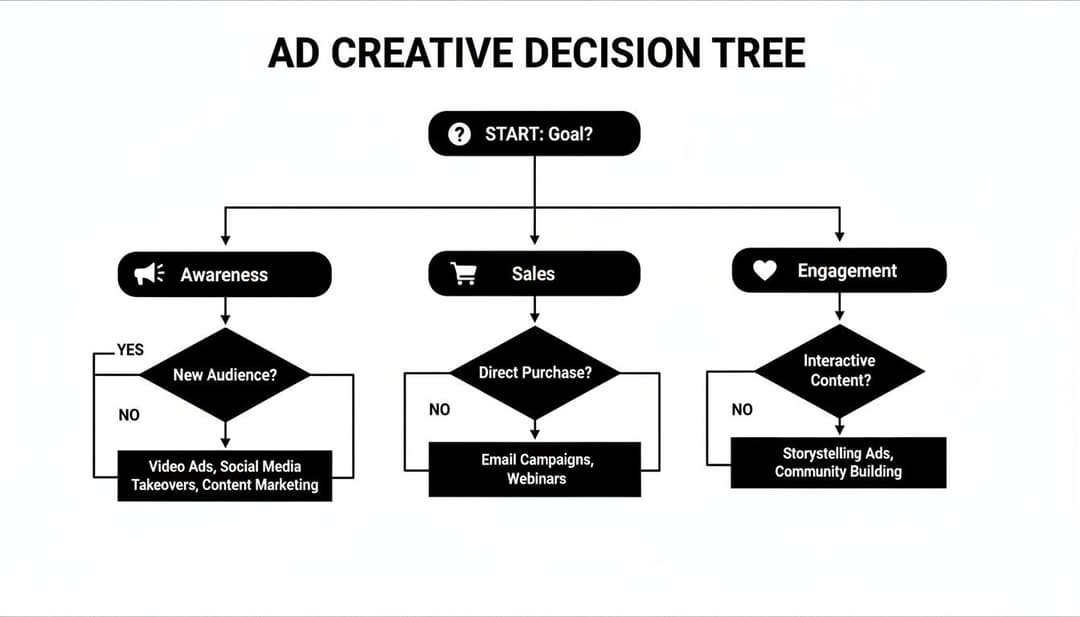
As the flowchart shows, if your goal is "Sales," your creative needs to push for action. That makes ROAS and CPA your go-to metrics for deciding what lives and what dies.
The Cut, Keep, or Scale Framework
After you’ve read the data, it's time to make a move. A simple but brutally effective framework is to decide whether you’re going to cut an ad set, keep it running, or scale the budget.
When to Cut an Ad Set
Knowing when to kill a failing ad set is one of the most important skills for protecting your budget. Don't fall into the trap of emotional attachment or hoping for a miraculous turnaround. Be ruthless. Cut it if:
- It has zero purchases after spending 1-2x your target CPA. At that point, the algorithm has had enough budget to find a buyer, and it came up empty.
- The ROAS is consistently below your break-even point. Give it a couple of days to find its footing, but if it’s not making you money, it’s costing you money. Pull the plug.
- The CTR is painfully low (think below 0.5%) and the CPM is high. This is a toxic combination that means your creative and audience are a terrible match, and you're overpaying for the privilege.
When to Scale a Winning Ad Set
Finding a winner is a great feeling, but this is where a lot of advertisers get trigger-happy and mess things up. Scaling too fast is like flooring the gas pedal on a cold engine—it shocks the algorithm, can reset the learning phase, and completely torpedo your performance.
The right way to scale is slowly and steadily. Increase the budget by no more than 20-30% every 24-48 hours. This gradual bump gives the algorithm time to adjust, find more customers, and maintain a stable CPA. For a deeper look at making these kinds of data-backed adjustments, check out our guide on advanced Facebook Ads optimization techniques.
Troubleshooting Common Performance Issues
Even the best campaigns run into trouble. Sooner or later, you'll see performance dip, and you need to know how to fix it. Here’s a quick-hitter guide to two of the most common problems you'll face.
| Problem | Potential Cause | Actionable Solution |
|---|---|---|
| High CPMs (Cost Per 1,000 Impressions) | Your audience is too small, too niche, or highly competitive. | Broaden your targeting. If you're using a 1% Lookalike, test a 3% or 5% Lookalike to give the algorithm more room to run. |
| Sudden Delivery Drop | Ad fatigue. Your audience has seen your ad too many times and has started to ignore it. | Immediately pause the fatigued ad. Launch a fresh creative to that same winning audience with a new hook, angle, or visual. |
Ultimately, optimization is a relentless cycle: analyze the data, make one strategic change, and measure the impact. This disciplined, data-first process is what separates the advertisers who get lucky from the ones who build predictable, profitable growth engines.
Common Questions About Running Instagram Ads
No matter how long you've been in the game, running Instagram ads always throws a few curveballs. The platform is constantly shifting, and the strategies that worked wonders last year can fall flat today. Let's dig into some of the most common questions we hear to help you sidestep the usual pitfalls and build a genuinely profitable ad strategy.
Getting these fundamentals right is the difference between burning through your budget and creating a consistent, scalable revenue engine for your business.
How Much Should I Actually Spend on Instagram Ads
This is the million-dollar question, isn't it? While there’s no single magic number, there’s a smart way to figure it out. A solid starting point for a brand new campaign is $20 to $50 per day for each ad set you're testing. This gives the algorithm enough fuel to push past the dreaded "learning phase" without breaking the bank.
The real secret isn't your total budget, but how you use it. Start small, find your winning creative and audience combos, and then scale the ads that are actually delivering a positive ROAS or hitting your target Cost Per Acquisition (CPA).
Think of your initial budget as buying data, not just sales. Spend just enough to learn what works, then pour your ad spend into the proven winners.
Of course, larger brands might be spending thousands daily, often letting Meta's Campaign Budget Optimization (CBO) do the heavy lifting by automatically pushing spend to the top-performing ad sets and creatives.
What Is the Best Instagram Ad Format
Heading into the rest of 2026, there’s no contest: vertical video for Reels and Stories is king. The performance data is crystal clear—video drives higher engagement and better click-through rates than static images. It's what users are on the platform to see, and it's what the algorithm is built to promote.
That said, a well-rounded strategy always includes a mix of formats for different objectives:
- Reels Ads: Perfect for broad, top-of-funnel reach. Use them to hook new audiences with entertaining, scroll-stopping content.
- Stories Ads: Incredible for creating immersive, full-screen experiences. Throw in interactive elements like polls and stickers to engage warmer audiences who already know you.
- Carousel Ads: Still a powerhouse for e-commerce. They're excellent for showcasing multiple products, highlighting different features, or telling a step-by-step story.
While a simple static image can still get the job done for direct-response retargeting, your focus for new customer acquisition has to be on creating authentic video that feels like it belongs on the platform.
Why Are My Instagram Ads Not Getting Impressions
It’s one of the most frustrating feelings in advertising: you hit "Publish," and then... crickets. Your ad gets zero or just a handful of impressions. This delivery problem almost always comes down to a few usual suspects.
First, take a hard look at your audience size. If it's too niche (think under 100,000 people), the algorithm might just struggle to find enough users to serve your ad to, effectively killing delivery.
Second, your bid or budget might be too low. You're in a constant auction for your audience's attention. If your competitors are willing to pay more for the same users, your ads are going to get left on the bench.
Third, make a habit of checking your Account Quality dashboard. Meta could have rejected an ad for a policy violation, which brings delivery to an immediate halt. It happens to the best of us.
Finally, think about ad fatigue. If you’ve been running the same creative for weeks, its performance will inevitably tank, and Meta's algorithm will stop prioritizing it. You need a system for rotating in fresh creatives. For another perspective on promotion basics, you can learn more by reading our article on what boosting a post means on Instagram.
How Can AI Tools Improve My Instagram Ad Performance
AI-powered platforms are built to solve the two biggest bottlenecks that stop marketers from scaling their Instagram ads: creative production and data-driven optimization.
Tools like AdStellar AI take all the tedious, manual work off your plate. Instead of spending hours in Ads Manager building a few ad variations, you can generate hundreds of creative, copy, and audience combinations in minutes.
The real power comes next. The AI automates the entire testing process, digging through performance data in real-time to find the exact combinations driving the best results, whether that's your highest ROAS or lowest CPA. Features like auto-scaling then shift your budget to those winners automatically, making sure every dollar you spend is working as hard as possible.
Ready to stop guessing and start scaling? AdStellar AI is the fastest way to launch, test, and optimize your Meta ad campaigns. Our platform automates bulk ad creation and uses AI-driven insights to find your winning ad combinations 10x faster. Start your free trial today and unlock more revenue from your ad spend.