So, what does a social media marketer really do all day? If you’re picturing someone just scheduling a few posts and calling it a day, think again. The role is far less about simple posting and much more about being the strategic architect of a brand’s entire social presence.
Think of them as conductors, weaving together content, advertising, and community interaction into a single, cohesive brand story that actually drives business results.
The Three Pillars of a Social Media Marketer's Day
A great social media marketer is a master juggler, constantly balancing three core responsibilities. These pillars—Content, Ads, and Community—form the bedrock of their daily work, ensuring every tweet, post, and comment ladders up to bigger goals like building brand awareness, generating qualified leads, or driving sales.
It’s a dynamic role that requires a unique blend of creativity and sharp, data-driven analysis.
This diagram breaks it down beautifully, showing how the job branches out into three distinct yet deeply connected functions.
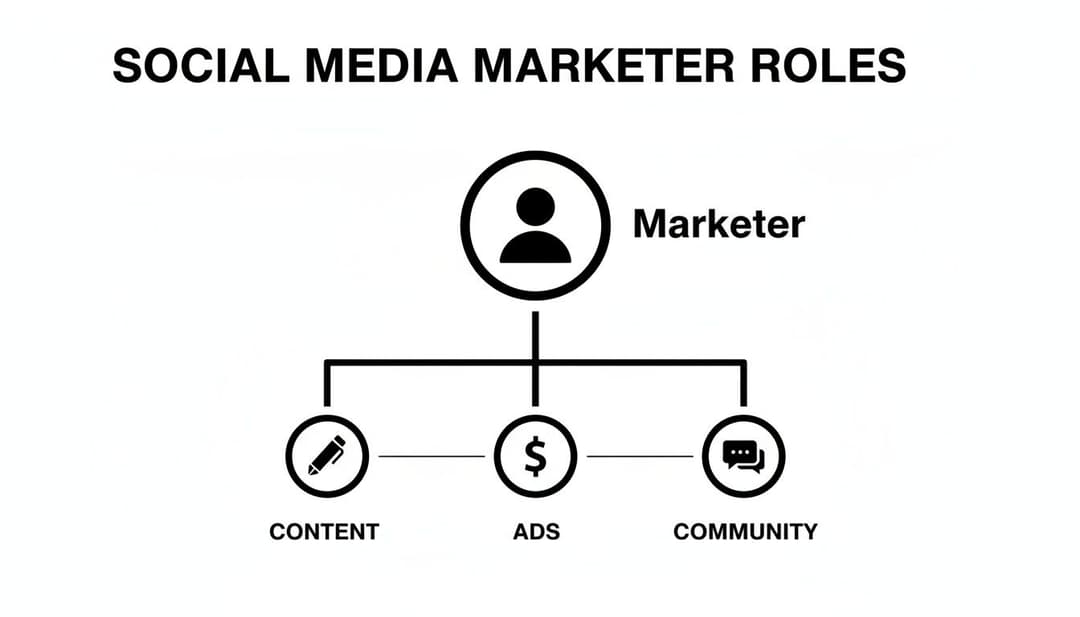
As you can see, these duties are what transform a basic social media profile into a powerful, revenue-generating engine for the business. Getting a handle on these three areas is the key to understanding what a modern social media marketer truly brings to the table.
A Breakdown of Core Responsibilities
Let’s dig a little deeper into what each of these pillars actually entails. While the activities in each area are different, they are constantly feeding into one another. For example, a great insight from a customer comment can spark the next big content idea, and a top-performing organic post is the perfect candidate to amplify with a paid ad budget.
The real magic happens when these three pillars work in total harmony. A brilliant ad campaign will fall flat without compelling content, and great content can't reach its full potential without smart distribution and an engaged community cheering it on.
To give you a quick snapshot, this table breaks down the main activities and goals for each responsibility area.
Core Responsibilities of a Social Media Marketer
| Responsibility Area | Key Activities | Primary Goal |
|---|---|---|
| Content Strategy | Building content calendars, writing copy, producing videos and graphics, and digging into performance data. | To build brand awareness, educate the audience, and entertain followers, turning passive scrollers into genuine fans. |
| Paid Advertising | Building campaigns, setting budgets, targeting audiences, A/B testing creatives, and obsessing over ROAS and CPL. | To drive measurable conversions, generate leads, and hit specific business targets with a positive return on investment. |
| Community Engagement | Responding to comments and DMs, managing brand reputation, sparking conversations, and gathering user feedback. | To build rock-solid brand loyalty, provide front-line customer support, and cultivate a strong, positive community around the brand. |
Ultimately, a marketer’s success depends on their ability to manage these domains not as separate tasks, but as interconnected parts of a single, unified strategy.
Crafting Content That Captures Attention
 If you ask someone what a social media marketer does, they’ll probably talk about posting. While that’s true, it’s only the tip of the iceberg. Great social media isn't about just hitting “publish.” It’s about acting as the brand's editor-in-chief, carefully curating every single thing the company says and shows online.
The real job is to create posts, videos, and stories that stop the endless scroll and actually earn a moment of someone's attention.
This isn’t a guessing game. It's a calculated mix of creative instinct and hard data. Marketers don’t just throw ideas at the wall; they dig into performance analytics to see which topics, formats, and tones are resonating. That intel is then used to build a forward-looking content calendar.
Think of the calendar as the master plan. It strategically maps out themes and post schedules to align with bigger business goals, whether that’s a new product launch or a big seasonal sale.
Developing a Data-Backed Content Strategy
A huge chunk of a marketer’s day is spent sifting through performance data, trying to understand how people behave and what makes them tick. The goal is to create content that serves a real purpose for the audience. Generally, people follow brands online for a few key reasons:
- To learn something new: Think how-to guides, industry insights, or any content that solves a nagging problem.
- To be entertained: This is where funny memes, relatable stories, and behind-the-scenes glimpses come in to humanize the brand.
- To find products and deals: Followers are often your most loyal customers, and they want to be the first to know about new arrivals, sales, and exclusive offers.
A savvy marketer knows how to balance these content pillars to keep their feed fresh and valuable. Getting this right requires a deep understanding of who the ideal customer is and what they’re looking for online. The value of high-quality creatives in digital marketing simply can't be overstated.
A successful social media marketer knows that content is a conversation, not a monologue. They listen to what the data and the community are saying, then craft messages that resonate on a human level.
Adapting to Different Platforms and Formats
What kills it on LinkedIn will almost certainly flop on TikTok. A huge part of the job is tailoring every piece of content to the platform it lives on. A formal, text-heavy update just doesn't work in the fast-paced, visual world of short-form video.
This means a social media marketer has to be a creative chameleon. They need to be fluent in the language and format of every platform. In 2026, they’re creating content for a massive global audience where 5.17 billion people—that’s 62.6% of the world's population—are active social media users.
This has pushed two formats to the forefront: short-form video, which now accounts for 43% of all social content consumed, and ephemeral content like Stories, which an incredible 1.1 billion people watch every single day.
If organic content is the soul of a brand's social presence, paid advertising is the engine that drives the business forward. This is where a social media marketer directly connects their work to revenue, shifting from community builder to data-driven strategist.
Here, the focus is pure performance. Every dollar spent has a job to do and is tracked relentlessly against concrete business goals. The marketer is responsible for managing ad budgets, turning high-level objectives into tactical campaigns, and hitting specific targets like Return on Ad Spend (ROAS) or Cost Per Lead (CPL). It's less about gut feelings and more about cold, hard numbers.

This setup is a perfect snapshot of a modern marketer's reality. They’re constantly balancing the creative side, like hopping on a video call to direct content, with the analytical side, digging into performance data on their laptop. That blend of art and science is what makes paid social so powerful.
From Campaign Setup to Performance Analysis
The day-to-day life of a paid social specialist is a constant cycle of creating, testing, and tweaking. They live inside ad platforms, fine-tuning campaigns to squeeze every drop of performance out of the budget.
A campaign’s journey from idea to reality usually involves these key steps:
- Campaign Building: This is the foundation. You define the goal (like driving sales or capturing leads), set the budget, and select a bidding strategy that aligns with your objective.
- Audience Targeting: Here, you build your ideal customer profile using demographics, interests, and online behaviors. You also create retargeting lists to bring back people who have already visited your website.
- Creative Testing: Marketers never assume they know what works. They run A/B tests on everything—ad copy, images, videos—to let the data reveal which ad combinations truly connect with the audience.
- Real-Time Monitoring: Once live, the job is far from over. They keep a close eye on key metrics, ready to shift money away from ads that are lagging and double down on the ones that are flying.
This whole process is about turning raw data into smart decisions. Knowing how to navigate the nuances of paid social ads is a critical skill that truly sets great marketers apart.
Automating for Scale and Strategy
The sheer amount of work needed to launch and test ads effectively can be staggering. Manually creating hundreds of ad variations—each with unique copy, creative, and targeting—is not just tedious, it’s a recipe for burnout and mistakes. This is where automation tools become a performance marketer's best friend.
For a performance marketer, time spent on manual setup is time not spent on high-level strategy. The goal is to automate the tedious tasks so you can focus on the strategic decisions that actually move the needle.
Mastering paid advertising is non-negotiable. With global spend projected to hit a staggering $276 billion in 2026, it's clear why performance teams invest so heavily in platforms like Meta. When done right, the returns are massive, with an average ROI of $5.20 per $1 invested, making social a top channel for customer acquisition. As you can explore in more detail within global trend reports, this is exactly why tools like AdStellar AI are so valuable. They automate the bulk creation of hundreds of ad combinations, freeing marketers to focus on meticulously segmenting audiences and scaling campaigns without getting buried in manual work.
Building Community and a Memorable Brand Voice
Beyond just posting content and running ads, a social media marketer’s most crucial role is to be the brand’s living, breathing voice and online guardian. This isn't just about firing off replies to comments. It’s about cultivating a genuine community, managing the brand’s reputation, and turning happy customers into your most passionate cheerleaders.
Think of the marketer as a digital diplomat. They’re on the front lines, navigating tricky conversations, solving customer service hiccups in a public forum, and putting a human face on the brand with every single interaction. Their job is to build relationships, not just chase sales.
Establishing a Consistent Brand Persona
A memorable brand voice is what makes a company feel like a trusted friend instead of a faceless corporation. The social media marketer is the one who defines this voice and ensures it’s used consistently across every tweet, story, and DM.
Developing this persona means answering some fundamental questions:
- Is our brand witty and playful, or more formal and authoritative?
- Do we embrace emojis and modern slang, or do we keep it strictly professional?
- How do we sound when we’re celebrating praise, addressing criticism, or just answering a simple question?
This consistency is everything. When your followers know what to expect, they feel a much stronger connection, which makes them far more likely to stick around and stay loyal.
A brand's voice is its personality online. It’s the difference between a robotic, corporate presence and a relatable identity that people actually want to follow and interact with. This is where a marketer’s people-centric skills become non-negotiable.
From Engagement to Advocacy
Exceptional community management transforms passive scrollers into active, engaged members of your tribe. This doesn’t happen by accident. It's the result of proactive engagement—sparking conversations, asking thought-provoking questions, and celebrating the content your own users create.
To keep a finger on the pulse of their audience, marketers have to be masters of social listening. For example, using tools for social listening on YouTube can uncover a goldmine of unfiltered feedback and customer sentiment. You can even discover great tips on how to effectively promote your brand on Instagram just by paying attention to what your community is already talking about.
Ultimately, the goal is to create such a positive and memorable experience that your customers become your advocates. These are the people who will jump into comment threads to defend you, share your posts with their friends, and leave glowing reviews—all because a marketer took the time to build a real, human connection with them.
The Modern Marketer's Toolkit and Skills
 So, what really goes into being a great social media marketer? It’s not just about knowing how to schedule a post. The best in the business are part artist, part scientist, and part strategist—all rolled into one.
Their real magic is in blending these different sides to turn a clever idea into something that actually moves the needle for the business. This isn't just about understanding one platform; it's about seeing how the entire digital world fits together.
The Essential Skill Categories
A marketer's abilities usually fall into three main areas. You can’t succeed without all three, as each one builds on the others to create a strategy that resonates with people and delivers real results.
- Creative Skills: This is the heart of the content. We're talking sharp copywriting for captions and ad copy, a good eye for graphic design to make posts pop, and enough video editing know-how to create the short-form clips that dominate feeds.
- Analytical Skills: This is where the science comes in. It’s the ability to dive into the numbers, understand data interpretation, and track Key Performance Indicators (KPIs) to figure out what's working and, just as importantly, what isn't.
- Strategic Skills: This is the big-picture thinking. It covers everything from campaign planning and smart budget management to building laser-focused audience targeting strategies that put content in front of the right people.
These skills are completely intertwined. An insight from the data might spark a new creative campaign, while the overarching strategy ensures every single post has a purpose.
A social media marketer’s true value is their ability to connect creative execution with analytical proof. They don't just make pretty posts; they make posts that are proven to work.
A strong marketer needs the right tools to bring their skills to life. Here’s a quick breakdown of the core skills and the types of tools they use every day.
Essential Skills and Supporting Tools for Social Media Marketers
| Core Skill | Description | Example Tools & Platforms |
|---|---|---|
| Content Creation | Writing compelling copy and designing visually engaging posts and videos that capture attention. | Canva, Adobe Creative Suite, CapCut |
| Community Management | Interacting with the audience by responding to comments, messages, and fostering a positive brand community. | Sprout Social, Agorapulse, Native Platform Inboxes |
| Campaign Strategy | Planning, executing, and overseeing social media campaigns from concept to completion to meet business goals. | Asana, Monday.com, Spreadsheets |
| Data Analysis & Reporting | Tracking KPIs, interpreting analytics, and creating reports to measure performance and inform future strategy. | Google Analytics, Native Platform Analytics (e.g., Meta Business Suite), HubSpot |
| Paid Social Advertising | Creating, managing, and optimizing paid ad campaigns to reach specific audiences and drive conversions. | Meta Ads Manager, TikTok Ads Manager, AdStellar |
Having the right software isn't just a "nice-to-have"—it's essential for managing the chaos and making smart, data-backed decisions.
The Tools of the Trade
Skills get you started, but tools are what let you scale. A social media marketer's day is spent juggling a whole host of software that helps them automate tasks, manage their workflow, and dig deeper into the data.
This is especially true when you consider that 73% of global internet users aged 16 and over now use social media to research brands. With a potential audience of 5.66 billion users, marketers have to sift through a mountain of data to create content that actually connects. For instance, knowing that Instagram delivers the best ROI for 70% of marketers helps them decide where to invest their time and money. You can get a closer look at data like this in HubSpot's latest marketing statistics.
To manage this complexity, they lean heavily on specialized software. For anyone looking to level up their own toolkit, our guide to the best AI tools for marketing is a great place to start.
AI-powered platforms like AdStellar, for example, are becoming absolutely critical for paid social. These tools can automatically create and test hundreds of ad variations in the time it would take a human to make just a few. This frees the marketer from mind-numbing manual work, allowing them to focus on high-level strategy and optimization, which ultimately saves time and drives much better campaign results.
A Day in the Life of a Social Media Marketer
To really get what a social media marketer does, you have to step inside their world for a day. Forget any ideas about a predictable 9-to-5. This role is a constant juggle, a high-wire act of balancing creativity, community engagement, and cold, hard data. One minute you're brainstorming a viral video, the next you're deep in an analytics dashboard.
Let's walk through what a typical day might look like.
Morning: The Performance Pulse Check
The day almost always kicks off with a performance deep dive. The first 90 minutes are sacred—dedicated to seeing how campaigns performed overnight. This means jumping straight into the ad platforms to check which campaigns are hitting their ROAS (Return on Ad Spend) targets and which ones are bleeding money.
At the same time, they're tackling the community inbox. This isn’t just about clearing notifications; it’s about responding to DMs, answering questions in the comments, and flagging urgent customer issues for the support team. This morning ritual is crucial because it sets the priorities for the entire day.
Midday: Switching Between Creative and Analytical Modes
With the immediate fires put out, the focus shifts. The middle of the day is a blend of creative production and even deeper analysis. This could mean scripting a short-form video for TikTok, punching up the copy for next week’s Facebook ads, or briefing a designer on a new batch of creatives.
For anyone serious about crushing it in this role, this is where applying advanced social media manager tips can really make a difference in strategy and day-to-day execution.
This creative work is often paired with an analytical sprint. The marketer might be pulling a weekly performance report, trying to spot trends in audience engagement, or building out new custom audiences for the campaigns they just planned.
Afternoon: Strategic Planning and Looking Ahead
Afternoons are usually reserved for the big picture. This might be a meeting with stakeholders to walk them through last month's results and lay out the strategy for the next quarter. Or it could be dedicated time for building out the content calendar and doing some good old-fashioned competitor research to find new angles.
Ultimately, a marketer’s day is a mix of proactive planning and reactive problem-solving. If the strategic, data-driven side of this job gets you excited, you might be leaning more toward a performance marketing path. You can learn more about a performance marketing career to see how those skills overlap and diverge.
The day typically winds down by scheduling posts for tomorrow and making final budget tweaks to the live ad campaigns, ensuring everything is set to perform while they're gone.
Frequently Asked Questions About the Role
So, what's it really like to be a social media marketer? It’s a role that’s often misunderstood. Let’s pull back the curtain on a few of the most common questions to give you a real-world look at the career, its hurdles, and where it's headed.
What Is a Typical Career Path for a Social Media Marketer?
Most people don’t just land a senior social media job on day one. The journey usually starts with a generalist position, like a Social Media Coordinator. Here, you’ll get your hands dirty with a little bit of everything—crafting posts, scheduling content, and jumping into conversations with the community.
Once you’ve got the fundamentals down, you can start to specialize. The paths usually diverge into a few key areas:
- Performance Marketing: This is for the data lovers. You'll focus exclusively on paid social ads, steering large budgets, and obsessing over ROAS.
- Content Strategy: If you’re the creative mind, this is your lane. You’ll lead the charge on everything from video production to big-picture campaign storytelling.
- Community Management: For those who thrive on connection, this path involves building and scaling brand communities, often for major companies with massive followings.
From these specializations, you can climb the ladder to roles like Social Media Manager, Director of Social, or even Head of Growth, where you're not just managing channels but shaping the entire digital strategy.
What Are the Biggest Challenges in This Role?
Hands down, one of the biggest struggles is proving ROI. You’re always under the microscope to tie social media activity directly back to hard business metrics like leads and sales. A viral post is great, but if it doesn't move the needle on revenue, it's just a vanity metric.
The sheer speed of the industry is another major challenge. Social platforms are in a constant state of flux—new algorithms, new features, and new user behaviors pop up overnight. What worked like a charm last month might be totally useless today. It forces you to be a perpetual student.
The real grind is just keeping up. A great social media marketer isn't just reacting to trends; they're trying to get ahead of them, ready to pivot their entire strategy at a moment's notice to stay effective.
Finally, burnout is a very real threat. Social media never sleeps, and the pressure to be "always on" can be immense, especially if you're managing a global community or navigating a brand crisis after hours.
Ready to stop wasting time on manual ad setup and focus on strategy that actually drives revenue? AdStellar AI helps you launch, test, and scale your Meta campaigns 10x faster. Automate your ad creation and unlock better performance today.