Let's get back to basics. If you've ever run a brand awareness campaign, you've definitely come across CPM. It stands for Cost Per Mille—or, in plain English, the cost per 1,000 ad impressions.
Think of it like renting a billboard on a busy highway. Your cost is based on the sheer volume of cars that pass by, not how many people actually pull over and visit your store. It’s the classic metric for measuring how many eyeballs you’re getting on your ads.
What CPM Actually Means For Your Campaigns
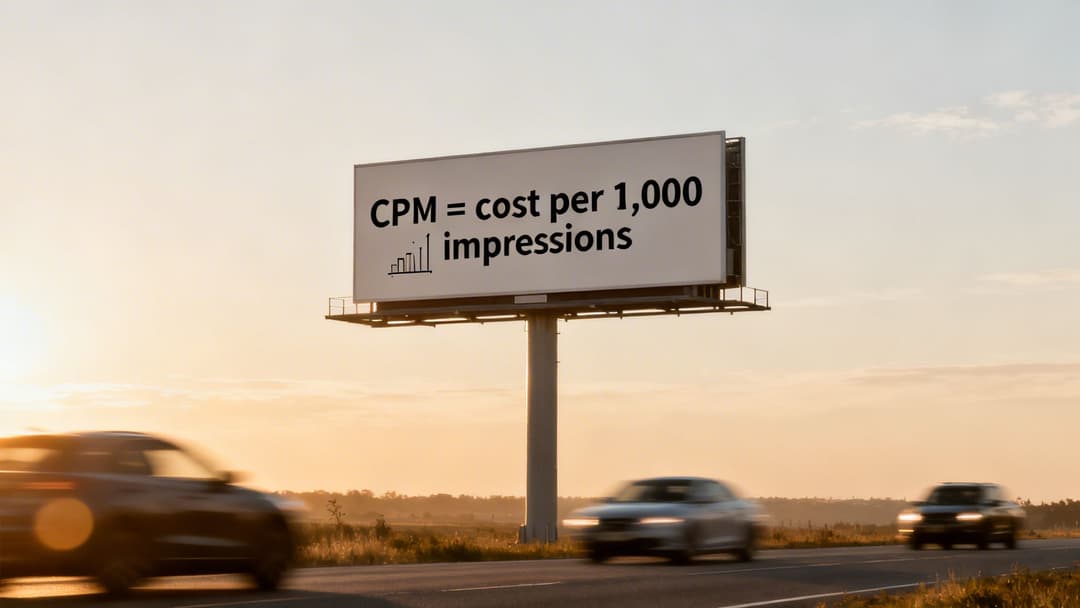
At its heart, CPM is a pricing model. You agree to pay a certain amount every time your ad is shown 1,000 times. Each time your ad appears on a screen, that’s called an impression.
It's crucial to remember that an impression only means your ad was delivered successfully. It doesn't mean someone clicked, engaged, or even really noticed it. You're paying for visibility, plain and simple.
This isn't some new digital marketing fad, either. The concept of "cost per mille" comes straight from old-school print advertising, where newspapers and magazines sold ad space based on their circulation numbers (i.e., thousands of potential readers). That model transitioned seamlessly into the digital age, where platforms like Meta and Google can track every single impression with pinpoint accuracy.
For a quick overview, here's a simple breakdown of what CPM entails.
CPM Ads at a Glance
| Component | Description |
|---|---|
| Definition | Cost Per Mille, or the price an advertiser pays for 1,000 ad views or impressions. |
| Primary Goal | To maximize brand visibility and reach, getting an ad in front of as many people as possible. |
| Calculation | Calculated by dividing the total ad spend by the total number of impressions, then multiplying by 1,000. |
This table serves as a handy reference, but let's dive into how you'll actually use this in your day-to-day work.
The CPM Formula in Action
Calculating CPM is refreshingly straightforward. It’s the standard way to compare how cost-effective different ad placements are, no matter how big or small the budget.
CPM = (Total Campaign Cost / Total Impressions) x 1,000
Let's run a quick example. Say your agency just spent $2,000 on a Meta campaign, and it generated 500,000 impressions.
Plugging that into the formula: ($2,000 / 500,000) x 1,000 = $4.00 CPM.
This means you paid exactly $4.00 for every 1,000 times your ad was displayed. If you want a deeper dive into what platforms count as a view, check out our guide on what are impressions on social media.
Why CPM Isn't Obsolete
In a world obsessed with clicks (CPC) and conversions (CPA), it's easy to dismiss CPM as a vanity metric. But that’s a mistake.
CPM is still the go-to metric for brand awareness campaigns where the main goal is just getting your name out there. It’s all about maximizing your reach for a fixed budget. Plus, savvy marketers are using low CPM bids to power their creative testing, quickly seeing which ad variations catch on before pouring money into conversion-focused campaigns. It's a cheap and effective way to gather initial data.
How To Calculate CPM With Real-World Examples
Knowing the CPM formula is one thing. Putting it to work with confidence is what separates the pros from the beginners. Let's walk through how to calculate CPM in the real-world situations you’ll actually face as a marketer. The math is simple, but the insights are what really count.
The formula itself never changes:
CPM = (Total Ad Spend / Total Impressions) x 1,000
Think of this equation as your universal translator for ad visibility. It standardizes the cost of getting eyes on your ads, giving you a clear benchmark to compare performance across different campaigns, platforms, or even client accounts.
DTC Brand Example on Meta
Imagine a direct-to-consumer (DTC) brand launching a new product. They’re running a campaign on Meta (Facebook and Instagram) focused purely on generating buzz and getting their new item in front of as many people as possible.
Here's what their campaign looks like:
- Total Ad Spend: $5,000
- Total Impressions Generated: 750,000
Now, let's plug those numbers into the formula:
- Step 1: First, divide the total cost by the impressions: $5,000 / 750,000 = $0.00667
- Step 2: Next, multiply that result by 1,000: $0.00667 x 1,000 = $6.67
The CPM for this campaign is $6.67. This means the brand paid exactly $6.67 every time its ad was shown one thousand times. An agency can now take this number and stack it up against industry benchmarks or other client campaigns to see how cost-efficient they really were.
B2B SaaS Display Ad Example
Now, let’s switch gears. Picture a B2B SaaS company using display ads on niche, industry-specific websites. Their goal is to promote a new whitepaper and build top-of-funnel awareness with a very specific professional audience.
Here’s their data:
- Total Ad Spend: $10,000
- Total Impressions Generated: 950,000
Let's run the numbers again:
- Step 1: $10,000 / 950,000 = $0.0105
- Step 2: $0.0105 x 1,000 = $10.50
Their CPM is $10.50. This is higher than the DTC example, but that doesn't mean it's bad. In fact, this might be a fantastic result, since reaching a specialized B2B audience on premium websites is always more expensive. Context is everything.
If you want to model different scenarios without breaking out the calculator every time, a Facebook ad cost calculator can make things much easier.
Planning Budgets by Working Backwards
Here's where understanding CPM really becomes a superpower: planning. Instead of just analyzing what happened, you can work backwards to forecast what’s possible with a future budget.
Let's say you have a $2,000 budget to work with and you've set an ambitious goal to hit a $5.00 CPM. You can flip the formula around to figure out how many impressions your budget needs to buy.
Estimated Impressions = (Total Budget / Target CPM) x 1,000
Plugging in the numbers gives us: ($2,000 / $5.00) x 1,000 = 400,000 impressions.
Just like that, you know your campaign has to generate 400,000 impressions to hit its efficiency goal. This kind of quick forecasting is critical for setting realistic goals and confidently managing budget expectations with your clients or team.
CPM vs. CPC vs. CPA—Choosing Your Bidding Strategy
Picking the right bidding model can feel like the make-or-break decision that separates a winning campaign from a budget black hole. At the heart of it all, you need a solid grasp of the big three: CPM (Cost Per Mille), CPC (Cost Per Click), and CPA (Cost Per Acquisition). Each one is a tool for a different job.
Let's break it down with a simple analogy.
- CPM is paying for eyeballs. You're buying visibility and brand awareness. The goal is to get your ad in front of as many relevant people as possible, making it perfect for building buzz.
- CPC is paying for interest. Here, you only pay when someone is interested enough to click your ad. This drives traffic directly to your site or landing page.
- CPA is paying for results. This is the bottom line. You only pay when someone completes a specific action you care about, like making a purchase or filling out a lead form.
This flowchart shows how your total spend and the number of impressions you get are the two simple ingredients needed to figure out your CPM.
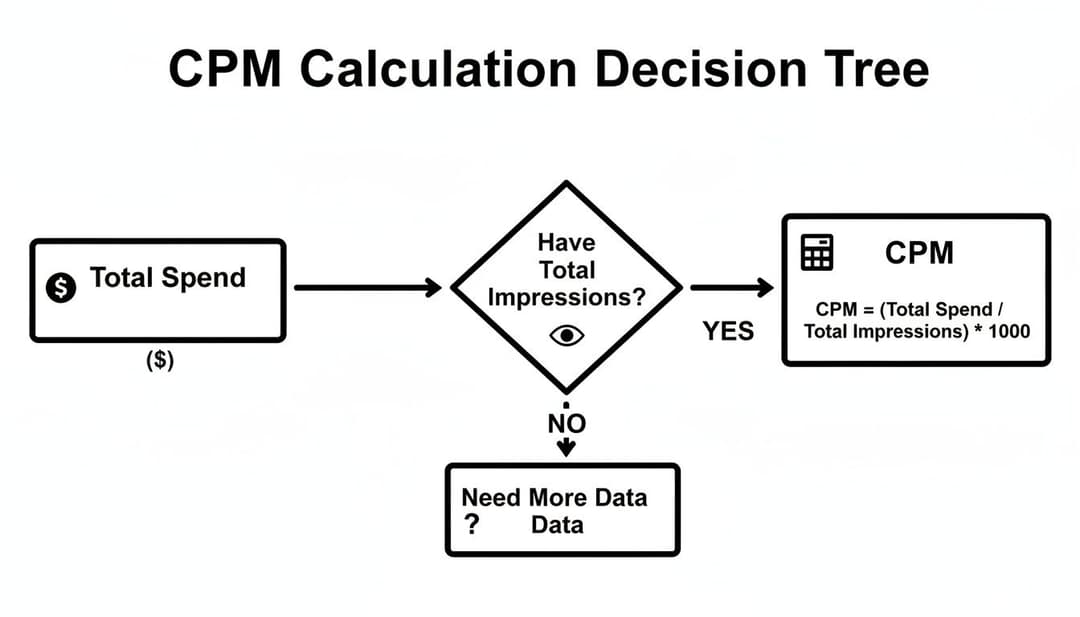
As you can see, the relationship is straightforward: your total ad spend and total impressions directly determine the cost-effectiveness of your visibility. This basic concept is the foundation for all ad pricing, since every click and conversion has to start with an impression.
A Head-to-Head Comparison of Bidding Models
Each model comes with its own set of strengths, best-case scenarios, and potential traps. A seasoned media buyer knows which tool to pull out of the toolbox for the job at hand and isn't afraid to switch tactics as a campaign matures.
For example, a new product launch might kick off with a CPM strategy to build mass awareness. As interest grows, you might switch to CPC to drive traffic to your shiny new product page. Finally, once you have enough data, you'd optimize toward a CPA goal to focus purely on sales.
This table puts the three models side-by-side to help you make smarter strategic calls.
CPM vs. CPC vs. CPA: A Strategic Comparison
| Metric | What You Pay For | Primary Goal | Best For | Key Risk |
|---|---|---|---|---|
| CPM | 1,000 Impressions | Brand Awareness & Reach | New product launches, audience building, and creative testing. | You could pay for thousands of impressions that result in zero clicks or conversions. |
| CPC | A Single Click | Traffic & Engagement | Driving visitors to a landing page, blog post, or product page. | High traffic with low conversion rates can drain your budget without delivering actual results. |
| CPA | A Specific Action (e.g., Sale) | Conversions & Leads | E-commerce sales, lead generation, and maximizing return on ad spend (ROAS). | Can get expensive and become hard to scale if your conversion rate is low or inconsistent. |
Ultimately, there’s no single "best" model. The right choice depends entirely on what you're trying to achieve with your campaign. Knowing your options is the first step toward building a flexible and powerful advertising strategy.
When Clicks Just Aren't Enough
While CPM is all about visibility and CPC focuses on traffic, most performance marketers are ultimately judged on one thing: results. This is where CPA takes center stage and becomes the metric that truly matters. If you want to dive deeper into this conversion-focused model, check out our complete guide on what is cost per acquisition and how to calculate it.
Beyond our own guides, a critical skill is learning how to manage and lower your Cost Per Acquisition (CPA). This model directly ties your ad spend to actions that generate revenue, making it an incredibly powerful tool for proving ROI.
A truly effective strategy isn't about picking one model and sticking with it forever. It's about building a customer journey where each bidding strategy plays a specific, tactical role in guiding people from initial awareness all the way to a final, profitable action.
When To Use CPM Bidding In Your Campaigns
Understanding the math behind different bidding models is just the start. The real magic happens when you know exactly which lever to pull for the right campaign, at the right time. So let's move past the theory and get into the practical strategy of it all.
Many performance marketers write off CPM as a “vanity metric.” That’s a huge mistake. When you wield it correctly, CPM becomes a powerful, cost-effective tool for filling the top of your funnel and gathering the data you need to make smarter decisions down the line.
Maximizing Reach On Meta
On platforms like Facebook and Instagram, CPM is your go-to bidding strategy when mass visibility is the name of the game. It’s perfect for those high-impact moments where getting in front of as many people as possible is your number one job.
Here’s when it really shines:
- Launching New Products: You just dropped a new product. Your first mission? Let the world know it exists. A CPM campaign blankets your target audience with the announcement, creating that crucial first wave of buzz and awareness.
- Building Remarketing Audiences: To run a killer remarketing campaign, you first need a big pool of people who’ve seen your brand. A low-cost CPM campaign is the fastest way to populate your top-of-funnel audiences, priming them for the conversion-focused ads you'll show them later.
- Testing Creative Concepts: Before you pour your budget into a CPA campaign, you have to know which ads actually grab attention. Running ads on a CPM basis lets you test tons of creative variations on broad audiences to see which images, headlines, and videos stop the scroll at the lowest cost.
Dominating Display Networks
Outside of social media, CPM is the engine that drives most display advertising. If your goal is to saturate a market and build unshakable brand recall, paying for impressions is the most direct path to get there.
A CPM-based display campaign works like a digital billboard. It ensures your brand shows up again and again across the hundreds of websites your target customer visits. The goal isn't an immediate click—it's about creating a lasting mental footprint.
This approach is a game-changer for B2B brands trying to establish themselves as an authority in their niche or for DTC companies aiming to become a household name. You're essentially buying a constant presence, making sure that when a customer is finally ready to make a purchase, your brand is the first one that comes to their mind.
Fueling AI-Powered Optimization
The rise of AI in advertising has given CPM a whole new purpose. Low-cost CPM bidding is the perfect way to feed hungry AI algorithms the massive amounts of data they need to find winning ad combinations.
Think of it like this: an AI tool can sift through thousands of data points to find the perfect mix of creative, copy, and audience. But to do that, it first needs a tidal wave of performance data to learn from. A CPM campaign delivers all that raw material—impressions, view-throughs, and initial clicks—for pennies on the dollar compared to a conversion campaign.
This data allows an AI-powered system to rapidly test hundreds of variations, identify the creative-and-audience pairings with the highest potential, and then tell you exactly what to scale in a CPC or CPA campaign. In this setup, CPM isn't the final play; it's the affordable first step that unlocks scalable, high-ROAS performance.
Understanding CPM Benchmarks And Trends In 2026
Your CPM is just a number until you put it in context. Knowing if your costs are high, low, or just right is what turns raw data into a real strategy. It tells you if you're getting a great deal or overpaying, and helps you set budgets that actually make sense.
These costs are anything but static. They swing wildly based on where you're advertising, what industry you're in, and even the time of year. For any performance marketer trying to stay profitable, getting a handle on these swings is non-negotiable.
Key Factors Driving CPM Costs
Seasonality is one of the biggest movers. You can practically set your watch to it. Costs always skyrocket in Q4 as e-commerce brands pile into platforms like Meta for Black Friday and the holiday rush, sparking intense bidding wars for the same ad space.
Geography also plays a massive role. It’s a simple reality that reaching an audience in a high-income market like the United States costs a lot more than in an emerging one. In 2026, the data showed the average eCommerce Facebook CPM in the US was $16.08, while in India, it was a mere $1.36. That’s a huge difference for any brand thinking about going global.
Finally, you have to account for industry competition. Crowded and lucrative spaces like finance or B2B SaaS will always have higher CPMs than less saturated niches, such as local services.
Average CPMs on Meta Platforms
Looking at the recent trends on Meta gives you a clear picture of just how much things can change. For instance, performance marketers saw average Facebook CPMs dancing between $6-9 throughout 2023-2024 in major markets.
In March 2024, the benchmark was $7.33. It dipped to $6.05 in January during the typical post-holiday slowdown but jumped to $8.80 in November as Black Friday bidding wars heated up. That’s a 30%+ surge driven almost entirely by e-commerce. You can see more detailed data and explore the full dataset of social media ad costs on guptamedia.com.
This constant fluctuation underscores a crucial point for modern advertisers: efficiency tools are no longer a luxury. In a competitive environment with rising costs, leveraging AI to find the most cost-effective audience and creative combinations is necessary for maintaining a healthy return on ad spend.
Remember, a high CPM isn't automatically a bad thing, especially if you’re reaching a valuable, high-intent audience that converts. On the flip side, a rock-bottom CPM means nothing if those cheap impressions don't lead to any real business results.
For a more detailed look at what impacts pricing, you might be interested in our deep dive on the cost per 1000 impressions. By understanding these benchmarks, you can better evaluate the performance of your own CPM ads.
Actionable Tactics To Lower Your CPM Today
Knowing your CPM is one thing. Actually driving it down is where great campaigns are made. Every dollar you save on impressions is a dollar you can reinvest to get your ads in front of more people, stretching your budget further than you thought possible.
Here are a few battle-tested tactics we use to lower CPM without gutting ad quality.

First up, try broadening your audience targeting. It sounds counterintuitive, I know. While hyper-specific audiences feel right for conversions, they’re often packed with competitors, which drives up costs. By expanding your targeting just a bit, you give the ad platform room to find less-contested, cheaper impressions. You might even uncover some valuable new audience pockets you didn't know existed.
Next, get serious about improving your ad creative. Platforms like Meta reward ads that people actually want to see. When your creative is relevant and engaging, your quality scores go up. The direct result? The platform shows your ad more often and at a lower cost. It’s their way of saying, "Thanks for not annoying our users."
Optimize Your Campaign Settings
Beyond your audience and creative, the nuts and bolts of your campaign setup offer some of the easiest wins for lowering CPM. A few simple tweaks here can make a surprising difference.
- Leverage Automatic Placements: It can be tempting to hand-pick your placements, but trust the algorithm on this one. Choosing automatic placements lets platforms find the most cost-effective spots across their entire network—from Feeds and Stories to the Audience Network. It’s a simple way to let the system hunt for bargains on your behalf.
- Monitor Ad Frequency: Nobody likes seeing the same ad a dozen times. When people get tired of your ad, engagement plummets, and your CPMs shoot up. Keep a close eye on your frequency metric. If it starts creeping above 3-4 in a short window, it’s a clear signal that you need to refresh your creative or swap in a new ad.
This push and pull on pricing is nothing new. CPM bidding has powered iconic campaigns for decades, from $10-50 CPM for 20th-century TV slots to the digital giants of today. Just look at Meta’s average CPM in 2023—it jumped from $6.21 in January to $8.80 by November, a perfect example of how seasonal competition inflates impression costs.
Finally, if you're managing a ton of ads, AI-powered creative testing is a total game-changer. Instead of guessing what works, platforms can automate launching hundreds of ad variations to see which creative and audience combos get the best reaction for the lowest CPM. This takes the guesswork out of the equation and lets you scale your winners with confidence.
For a deeper dive into what drives these prices, you can learn more about the average cost per impression.
Frequently Asked Questions About CPM Ads
Even after you've nailed down your strategy, a few nagging questions about CPM ads always seem to linger. Let's clear up some of the most common hangups so you can run your campaigns with total confidence.
Is A Low CPM Always A Good Thing?
Not at all. In fact, a rock-bottom CPM can be a serious red flag. Sure, it means you’re getting cheap impressions, but it could also mean you’re reaching a low-quality audience that has zero interest in what you're selling.
Your goal isn't just a low CPM—it's an efficient CPM. You want the lowest possible cost to get in front of an audience that's actually likely to move down your funnel. Always look at CPM in the context of other crucial metrics, like your click-through rates (CTR) and your final cost per acquisition (CPA).
Why Is My CPM So High?
Several things can send your CPMs soaring. High competition is the most common culprit; if everyone is bidding on the same audience, it’s going to be a pricey impression. Other usual suspects include:
- Narrow Audience Targeting: Getting hyper-specific with your audience is almost always more expensive.
- Low Ad Relevance: The platforms will charge you more if your ads have low engagement scores and people aren't clicking.
- Ad Fatigue: Costs start to climb when people get tired of seeing the same ad over and over again.
- Seasonality: Costs naturally jump during peak shopping seasons like Q4 when competition is fierce.
How Does Viewability Affect CPM?
This is a huge point of contention. A standard impression just means your ad was loaded, not that a human being actually saw it. Critics love to point out that CPM doesn't account for viewability, with some data suggesting that up to 40% of impressions are never even visible on a user's screen.
But this is where modern analytics come in. When you pair CPM with performance-ranking tools, you can finally see which of those cheap impressions are actually driving results. It turns what was once a blunt instrument into a precision tool for finding valuable audiences. To dig deeper into the history and details, you can find more information on the cost per mille model.
Ready to stop guessing and start scaling? AdStellar AI helps you launch, test, and optimize hundreds of Meta ad variations in minutes, not hours. Use AI to find your winning creative and audience combinations 10x faster. Discover how AdStellar AI can transform your campaigns today.