In 2026, the Facebook ad space is more saturated than ever. Simply running campaigns is no longer a viable strategy; you must create ads that stop the scroll, connect deeply with your audience, and produce tangible business results. What truly distinguishes a mediocre ad from a high-performing one? It isn't just about a polished creative or a witty headline. The real difference lies in the strategy behind it.
The best ads on Facebook consistently succeed because they blend a sharp understanding of audience psychology, a crystal-clear value proposition, and a seamless path from click to conversion. They don't just sell a product; they solve a problem or fulfill a desire with precision. This article moves past superficial praise to dissect the strategic frameworks, creative hooks, and psychological triggers that fuel top-tier campaigns.
We will analyze seven standout examples, breaking down their creative, copy, and targeting logic. For each, you'll get actionable takeaways and ready-to-use testing ideas to directly apply to your own marketing efforts. Prepare to transform inspiration into execution and learn the repeatable methods that define the most effective Meta ads today.
1. Meta Ad Library
To find the best ads on Facebook, your first stop should always be the source: Meta’s own Ad Library. This free, public database is a goldmine for marketers, offering a transparent look at every ad currently running across Meta's platforms, including Facebook and Instagram. It's the ultimate tool for competitor research and creative inspiration.
The Ad Library allows you to search for any advertiser’s page and see their active creatives in real-time. This direct access is its greatest strength. While third-party spy tools often rely on scraped data that can be incomplete or delayed, the Ad Library provides ground truth straight from the source. You can see the exact copy, visuals, and calls-to-action your competitors are using right now.
Why It's Essential for Marketers
The true power of the Ad Library lies in its strategic application. By analyzing a competitor’s active ads, you can reverse-engineer their marketing strategy. Are they running a limited-time sale? Testing multiple video hooks against the same offer? Targeting different customer segments with unique messaging? The Ad Library reveals these patterns.
- Search and Filter: You can search by advertiser name, keyword, or country. This allows you to perform broad industry scans (e.g., "skincare") or targeted audits of specific competitors.
- Creative Inspiration: See how top brands are designing their visuals and writing their copy. This is an invaluable resource for overcoming creative fatigue and generating fresh ideas.
- Strategy Validation: Before you commit a budget, see if similar offers or angles are already being used in your market. It's a low-risk way to validate your own campaign ideas.
Pros and Cons
| Pros | Cons |
|---|---|
| Authoritative Source: Data comes directly from Meta. | No Performance Metrics: You can't see likes, comments, or conversion data for commercial ads. |
| Completely Free: No subscription or hidden fees are required. | Limited Historical Data: It primarily shows active ads, making it difficult to analyze past campaigns. |
| Simple Interface: Easy to search and browse without a steep learning curve. | Inconsistent Filters: Search functionality can sometimes change or yield inconsistent results. |
Ultimately, the Ad Library is a foundational tool for any serious Facebook advertiser. While it won't show you which ad is "best" in terms of performance, it shows you what is being scaled, which is a powerful indicator of success. Pairing these insights with a solid understanding of campaign construction is key. For those just starting, reviewing the fundamentals of how to set up a successful Facebook ad campaign can help you turn inspiration into profitable results.
Website: https://www.facebook.com/ads/library
2. BigSpy
If the Meta Ad Library is your direct source, BigSpy is your wide-angle lens. This massive third-party ad intelligence tool offers a much broader, multi-platform view, making it a powerful resource for finding the best ads on Facebook and beyond. With over a billion indexed creatives, it helps you quickly spot trends, track competitors, and build a swipe file that goes deeper than just active campaigns.
BigSpy’s value comes from its scale and filtering capabilities. It compiles ad data from ten different platforms, but its Facebook and Instagram dataset is particularly strong. This allows you to see not only what is running now but also what has performed well in the past, an insight the official library lacks. You can analyze an ad's historical "popularity," a directional metric based on likes and engagement, to gauge what resonates with audiences.
Why It's Essential for Marketers
BigSpy helps you move from basic competitor spying to genuine market intelligence. By showing you top-performing and trending ads across your niche, it answers the question: "What's actually working right now?" This is perfect for brainstorming new angles or understanding the creative meta in a crowded market.
- Advanced Filtering: Search by country, language, ad type (video, image), call-to-action, or even landing page technologies. This precision helps you find highly relevant examples fast.
- Trending Ad Feeds: BigSpy curates "Top Charts" that show you the most popular ads, which is an excellent shortcut for creative inspiration and identifying successful formats.
- Downloadable Creatives: Save ads directly to your computer for easy reference when briefing your creative team or building a swipe file.
Pros and Cons
| Pros | Cons |
|---|---|
| Broad Multi-Platform Coverage: Indexes ads from Facebook, Instagram, and eight other networks. | Third-Party Data: Performance metrics are directional, not official Meta data. |
| Practical Filters & Trends: Easy to find popular and trending creatives quickly. | Potential Data Gaps: As a scraper, it might not capture every single ad a competitor runs. |
| Usable Free Tier: Offers a functional free plan for basic research; paid plans are affordable. | Not Real-Time: Data can have a slight delay compared to the official Ad Library. |
BigSpy is an indispensable tool for marketers who need to generate a steady stream of creative ideas and keep a pulse on the competition. While its metrics are estimates, they provide a strong signal for what's gaining traction. Combining these insights with other performance-oriented tools is a smart strategy; for more on this, you can check out some of the best Facebook ads automation tools for 2025 to further refine your campaign execution.
Website: https://bigspy.com
3. AdSpy
For marketers who need to move beyond inspiration and into deep competitive analysis, AdSpy is a powerful, specialized tool. A long-standing player in the ad intelligence space, it's known for its massive searchable database focused primarily on Facebook and Instagram ads. It's a favorite among direct-to-consumer and affiliate media buyers for quickly identifying winning creative patterns and discovering what’s working now.
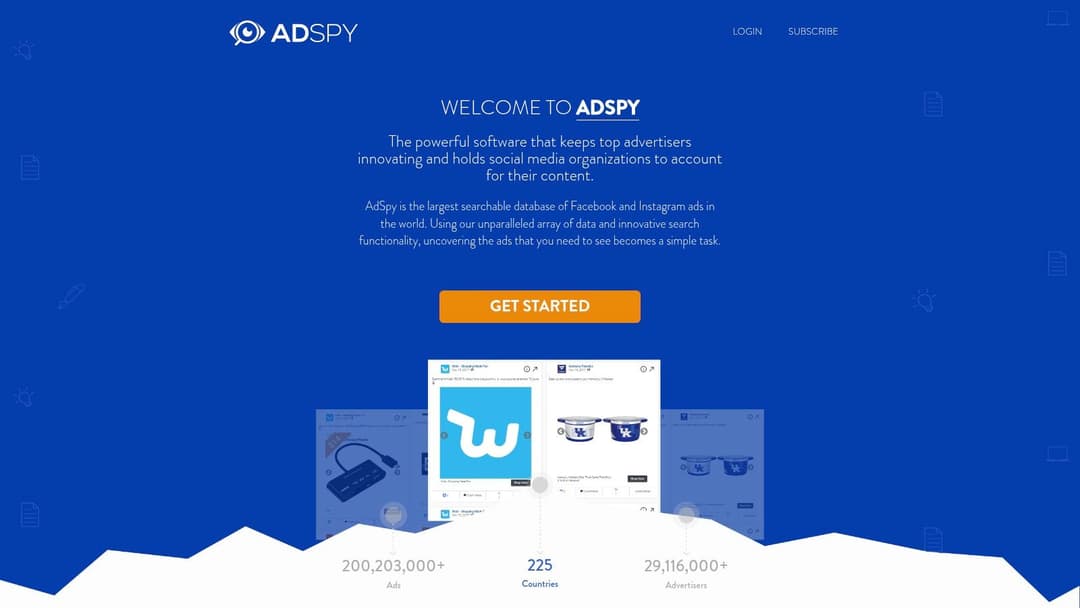
Unlike the Meta Ad Library, which is more of a real-time public record, AdSpy is a historical archive built for speed and deep searching. Its interface is designed for power users who want to slice and dice data with extensive filters. You can search by keywords, advertiser names, CTA buttons, technologies used on the landing page, and even demographic information like age and gender engagement. This makes it an excellent resource for finding some of the best ads on Facebook tailored to specific niches.
Why It's Essential for Marketers
AdSpy’s value is in its speed and depth for research. Where the Meta Library shows what’s currently active, AdSpy reveals a broader historical context, allowing you to spot trends over time. Its filtering capabilities let you drill down with precision to find ads that are not just running, but are likely performing based on engagement metrics (though it doesn't have official conversion data).
- Deep Filtering: Go beyond basic keyword searches. Filter by comments, shares, ad type (image vs. video), and even affiliate network to pinpoint successful campaigns.
- Product & Offer Hunting: A core use case is finding trending products. By searching for keywords related to a niche, you can see which products are being heavily advertised.
- Rapid Ideation: The quick interface lets you sort through thousands of ads in minutes, making it an efficient tool for brainstorming hooks, angles, and visual concepts for your next campaign.
Pros and Cons
| Pros | Cons |
|---|---|
| Massive FB/IG Database: One of the largest searchable ad archives available. | No Official Performance Data: Relies on scraped public engagement, not Meta's internal metrics. |
| Powerful Search Filters: Granular options for precise research and discovery. | Limited Outside Meta: Focus is almost exclusively on Facebook and Instagram ads. |
| Fast & Efficient Workflow: Designed for media buyers who need to find ideas quickly. | UI Skews to Affiliates: Interface can feel more geared toward product discovery than brand strategy. |
AdSpy is a paid tool with a flat monthly rate, making it a serious investment for marketers dedicated to competitive intelligence. It’s less about simple inspiration and more about systematic deconstruction of competitor funnels. The insights gained can directly inform your media buying strategy, helping you with everything from initial creative tests to advanced Facebook ad optimization techniques.
Website: https://www.adspy.com
4. MagicBrief
Where ad spy tools show you what competitors are running, MagicBrief focuses on how you can create something better. It's a creative strategy suite designed to bridge the gap between inspiration and production. The platform combines a curated ad library with powerful briefing, storyboarding, and collaboration tools, making it an operational hub for performance creative teams.
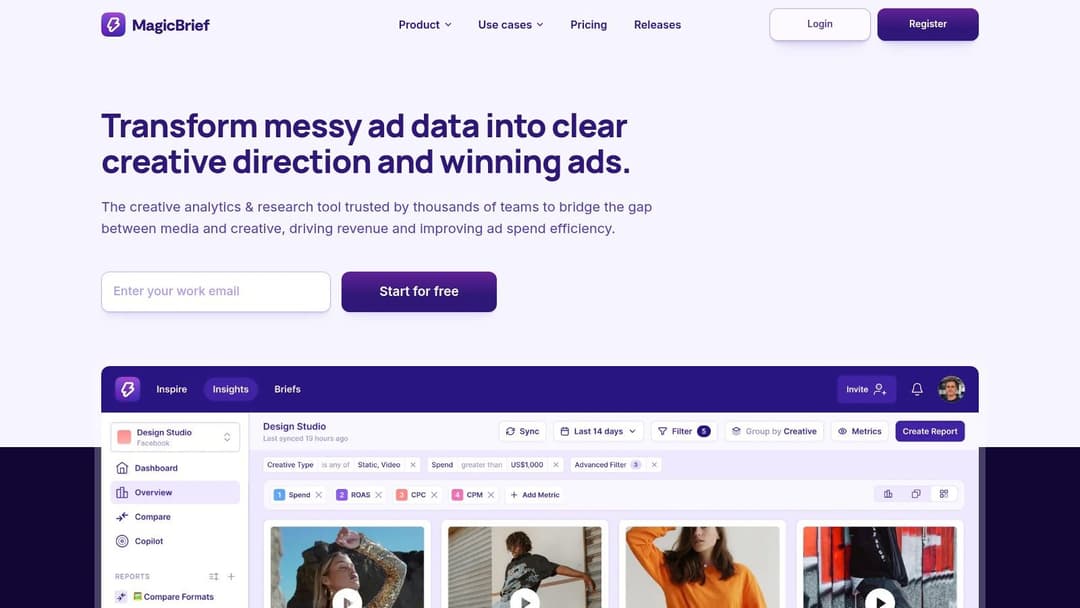
The core idea behind MagicBrief is to move beyond simply saving the best ads on Facebook into a swipe file. It helps teams formalize the creative process by connecting research directly to the production workflow. You can find an inspiring ad, save it, break it down into a structured brief or storyboard, and hand it off to designers or editors, all within one system.
Why It's Essential for Marketers
MagicBrief is built for agencies and in-house teams who need to standardize their creative operations and increase output. Its strength lies in transforming ad research from a passive activity into the first step of a production cycle. Instead of sending messy screenshots over Slack, you can build detailed briefs that producers can act on immediately.
- From Research to Production: Save ads from across the web with its Chrome extension, then use built-in storyboard and brief builders to create actionable production tickets.
- Team Collaboration: Standardize how your team gives feedback, requests new variants, and tracks creative versions. This is especially useful for managing client feedback in an agency setting.
- Curated Inspiration: While it has a broad library, its true value is in helping you build your own curated, tagged, and rated collection of ads relevant to your brand or clients.
Pros and Cons
| Pros | Cons |
|---|---|
| Streamlines Creative Ops: Connects research, briefing, and production in one workflow. | Higher Entry Price: More expensive than standalone ad spy tools. |
| Agency and Team Focused: Excellent for standardizing feedback and managing multiple projects. | Potentially Costly: Some tiers have pricing that scales with ad spend, which can be expensive. |
| Action-Oriented: Moves beyond passive ad-watching to active creative development. | Niche Focus: Less about mass ad spying and more about internal creative process. |
Ultimately, MagicBrief serves teams who recognize that finding good ads is only half the battle; the real work is in producing tested variants quickly and efficiently. By systemizing the handoff from marketer to creator, it helps reduce friction and speed up the testing cycle. The platform's structure is also a great foundation for teams looking to implement new processes, such as using an AI ad creative generation tool to execute on the storyboards and briefs created.
Website: https://magicbrief.com
5. Foreplay
If the Meta Ad Library is the raw ingredient, Foreplay is the professional kitchen built around it. It’s a platform designed specifically for performance marketers to discover, save, organize, and collaborate on ad creative. Foreplay ingests ads directly from sources like the Meta Ad Library and TikTok Creative Center but adds a powerful layer of organizational and creative tools on top.
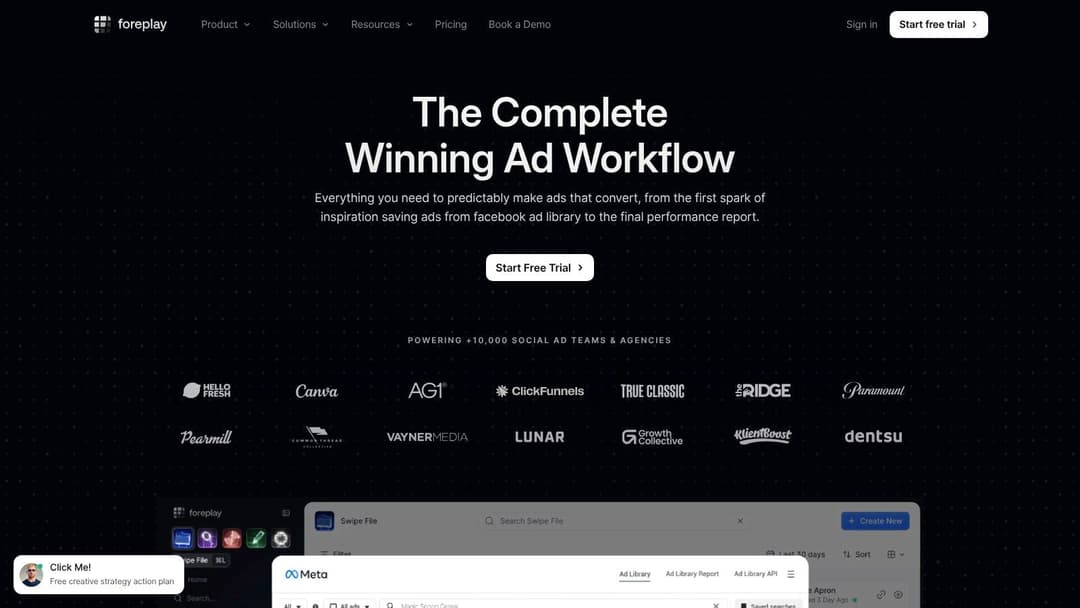
This tool shines for teams that need to go beyond simple inspiration and build a systematic process for creative strategy. Instead of taking endless screenshots, you can save ads to collaborative "Boards," add notes, tag them by campaign type, and even generate new script ideas using its integrated AI. It transforms the chaotic process of finding great ads into a structured workflow.
Why It's Essential for Marketers
Foreplay’s value is in the workflow it creates. It solves the “what next?” problem that arises after finding a good ad. By saving examples into a shared swipe file, marketing teams can build a library of proven concepts, track competitor angles, and brief creative teams or freelancers with concrete examples.
- Organized Swipe Files: Create dedicated boards for different projects, competitors, or ad types (e.g., "UGC Testimonials," "Q4 Holiday Promos"). This keeps your research organized and easily accessible.
- Team Collaboration: Tag teammates in comments, assign tasks, and discuss creative ideas directly on the platform. This centralizes communication that would otherwise be scattered across Slack and email.
- AI-Powered Ideation: Use its AI Script Generator to deconstruct a winning ad and quickly brainstorm new hooks, angles, and calls-to-action for your own brand, accelerating the testing process.
Pros and Cons
| Pros | Cons |
|---|---|
| Purpose-built for creative strategy: The entire tool is designed for saving and acting on ad ideas. | Relies on public data: Like other spy tools, it's dependent on Meta's library, so historical data can have gaps. |
| Excellent for team collaboration: Shared boards, comments, and tags make it ideal for agencies and in-house teams. | Advanced features are paid: Core discovery is useful, but the most powerful tools are on paid plans. |
| Transparent pricing: Plans are not based on your ad spend, making it accessible for brands of all sizes. | Focus is on creative, not performance: You won't see deep performance metrics, only what's publicly available. |
Ultimately, Foreplay is for the marketer who wants to operationalize their creative research. It helps you build a system for finding the best ads on Facebook and turning that inspiration into a pipeline of testable creative. This methodical approach is what separates consistently successful advertisers from those who rely on sporadic moments of inspiration.
Website: https://www.foreplay.co
6. SocialAdScout
While many tools focus only on the ad creative, SocialAdScout goes deeper, allowing marketers to dissect the entire funnel behind an ad. It's a powerful intelligence platform known for its granular filters, making it a favorite among direct-response and affiliate marketers who need to understand not just the ad, but the entire customer journey that follows.
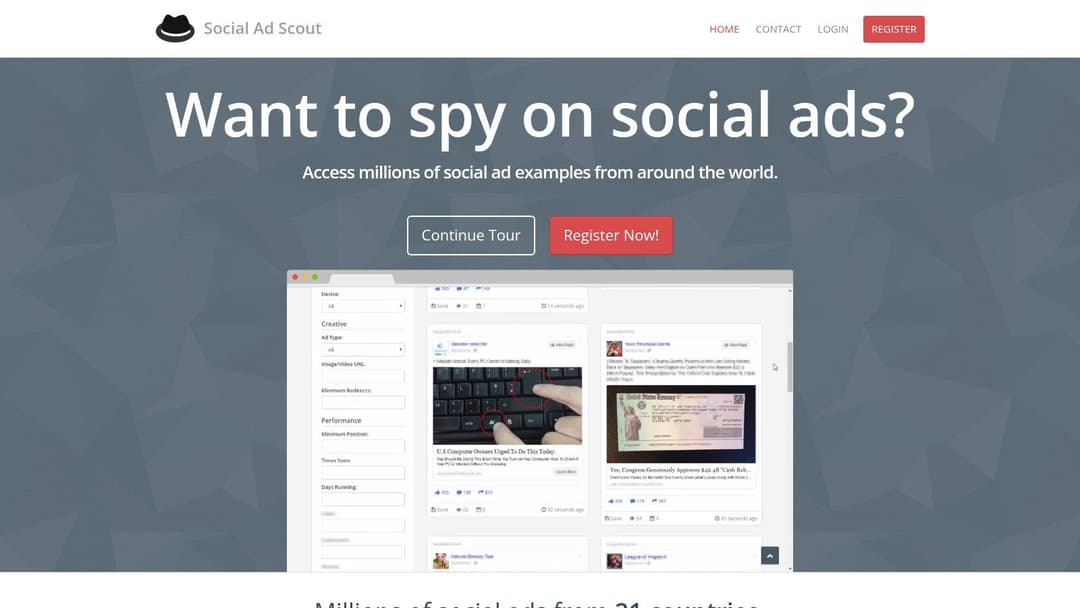
SocialAdScout excels at reverse-engineering competitor strategies. Instead of just seeing a competitor's video, you can trace the path from the ad to the landing page, analyze redirect chains, and see the exact funnels they are using to convert traffic. This level of detail is crucial for understanding the complete picture of how the best ads on Facebook are generating results.
Why It's Essential for Marketers
This tool is built for serious performance marketers who need to go beyond surface-level inspiration. By providing a view of the post-click experience, it helps answer critical questions about a competitor's offer, landing page design, and tracking implementation. It's less about finding a single pretty ad and more about deconstructing a profitable system.
- Deep Funnel Analysis: Search by redirect URLs and text on landing pages to see how different ads connect to specific offers. This helps you map out a competitor's entire sales funnel.
- Granular Targeting Filters: Filter ads by demographics, geo-location, device type, and even the ad's position on the page. This helps you understand who your competitors are targeting and how.
- Compliance and Lander Research: It's an excellent resource for checking how others navigate compliance rules in tricky verticals and for gathering ideas for high-converting landing page layouts.
Pros and Cons
| Pros | Cons |
|---|---|
| Granular Funnel Research: Goes beyond the ad to show landing pages and redirect paths. | Premium Pricing: Pricing is not publicly listed and is aimed at serious marketers with a budget. |
| Advanced Search Filters: Excellent for drilling down into specific campaign details. | Steep Learning Curve: The interface can be complex and may be overkill for casual browsing. |
| Historical Ad Data: View past campaigns and creatives for long-term strategic analysis. | Heavy on Direct Response: Focus is more on performance marketing than on brand-level creative. |
Ultimately, SocialAdScout is a professional-grade tool for marketers who need to win on the margins. It provides the deep, funnel-wide intelligence necessary to understand not just what a competitor’s ad looks like, but how their entire acquisition machine works. While its price point and complexity make it unsuitable for beginners, it offers a distinct advantage for those ready to dive deep into competitive analysis.
Website: https://socialadscout.com
7. Minea
For e-commerce and dropshipping marketers searching for the best ads on Facebook, Minea is a purpose-built intelligence tool. It goes beyond simple creative discovery by connecting ad performance with product viability, helping you find not just a winning ad, but a winning product-and-ad combination. It tracks ads across Facebook, TikTok, and Pinterest, making it a strong choice for cross-platform research.
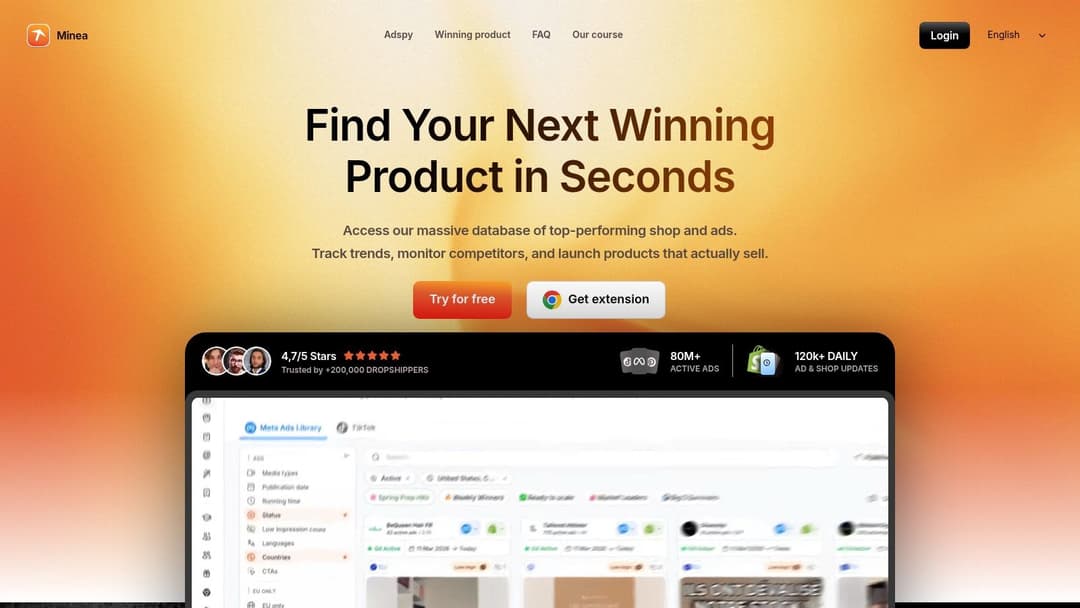
Minea’s core value lies in its e-commerce focus. Instead of just showing you an ad, the platform provides shop data, product information, and signals of success. This context is crucial for dropshippers and DTC brands who need to validate product demand before investing in inventory and ad spend. It helps answer the key question: "Is this product, promoted with this creative angle, actually working?"
Why It's Essential for Marketers
Minea is designed to reduce the guesswork in product sourcing and ad creation. Its curated "Success Radar" and top-product feeds highlight items gaining traction, saving you hours of manual research. By analyzing what's working on Facebook and TikTok, you can spot trends early and adapt your strategy.
- Product-Centric Research: Search for ads based on product niches, engagement, or even the e-commerce platform a store uses (e.g., Shopify). This helps you model your entire funnel after successful competitors.
- Multi-Platform Angles: See how a single product is being advertised across different formats, like Facebook feed ads and TikTok videos. This gives you a complete picture of a successful marketing angle.
- Trend Spotting: Identify breakout products and creative styles before they become saturated, giving you a first-mover advantage in a competitive market. Exploring the intersection of AI for Facebook Ads can further amplify these insights.
Pros and Cons
| Pros | Cons |
|---|---|
| E-commerce–First Insights: Excellent for pairing winning products with ad creatives. | Credit-Based Plans: Heavy research can become costly as credits are consumed. |
| Multi-Platform Tracking: Covers Facebook, TikTok, and Pinterest for a broader view. | Niche Focus: Less useful for marketers not selling physical products (e.g., SaaS, lead gen). |
| Curated Product Feeds: "Success Radar" helps identify trending products quickly. | Interface Can Be Busy: The amount of data can be overwhelming for new users. |
Minea operates on a subscription basis, with tiered plans that offer a certain number of research credits per month. It's a powerful tool for any e-commerce marketer looking to build a more data-driven process for finding and selling products. Its ability to connect the dots between an ad creative and a product’s market performance makes it a standout resource.
Website: https://en.minea.com
Top 7 Facebook Ad Tools — Comparison
| Tool | Implementation complexity | Resource requirements | Expected outcomes | Ideal use cases | Key advantages |
|---|---|---|---|---|---|
| Meta Ad Library | Low — web UI + API | Minimal — free public access (API for research) | Authoritative live creatives, transparency | Compliance checks, competitor validation, research ground truth | Direct access to live ads; official source |
| BigSpy | Low — quick web UI | Moderate — free tier + paid plans | Broad trending creatives and swipe files | Fast inspiration and competitor monitoring | Very wide multi-network coverage; usable filters |
| AdSpy | Low–Medium — fast search focused on Meta | Paid subscription (flat pricing) | Rapid identification of winning creative patterns | DTC and affiliate media buyers hunting winners | Large FB/IG archive with rapid filtering |
| MagicBrief | Medium — collaborative workflow tools | Higher entry price; team-oriented plans | Move from inspiration to production-ready briefs | Agencies and in-house creative teams standardizing ops | Integrates briefing, storyboarding, and collaboration |
| Foreplay | Medium — organization + AI features | Subscription-based, tiered plans | Organized swipe files, AI-generated scripts, testable ideas | Teams wanting collaborative discovery and testing | Collaboration tools + AI script generation; pulls from Meta |
| SocialAdScout | High — granular research tooling | Premium pricing; steeper learning curve | Deep funnel and landing-page reverse-engineering | Affiliates, compliance checks, advanced competitor analysis | Granular insights into landers, tracking, and funnels |
| Minea | Low–Medium — product+ad discovery focus | Credit-based plans; moderate cost for heavy use | E‑commerce product signals paired with creatives | E‑commerce and dropshipping product/creative discovery | Cross-network product signals and top-product feeds |
From Inspiration to Execution: Scale Your Best Ideas
We’ve dissected some of the best ads on Facebook, from the high-production polish of major brands to the raw, authentic user-generated content that dominates DTC. Across every example, from SaaS to e-commerce, a clear pattern emerges: success isn't about finding one magical ad. It's about building a system for continuous inspiration, rapid creation, and data-driven iteration.
The ad spy tools we've explored, like AdSpy, Minea, and the Meta Ad Library, are your starting point. They provide the raw material for your next breakthrough campaign by revealing what’s currently working for competitors and top advertisers in your niche. Analyzing their hooks, angles, formats, and value propositions gives you a massive head start.
Core Takeaways from Top-Performing Ads
Success leaves clues. Distilling the strategies from the best ads on Facebook reveals a repeatable framework for campaign development.
- Solve, Don't Sell: The most compelling ads focus on the customer's problem first. They lead with pain points, aspirations, or frustrations, and then introduce the product as the clear, simple solution.
- Visuals Stop the Scroll: Whether it's a dynamic UGC video, a shocking statistic in bold text, or a beautifully shot product image, the creative must earn the viewer's attention in the first three seconds. Bland, generic visuals get ignored.
- Clarity Beats Cleverness: Your message must be instantly understandable. Confusing copy or ambiguous offers create friction and kill conversions. Top advertisers state their value proposition directly and make the call to action impossible to miss.
- Test Everything, Assume Nothing: The biggest mistake a marketer can make is assuming they know what will work. Winning teams systemize their testing across every variable: hooks, body copy, headlines, creatives, CTAs, and audiences. Data, not opinion, dictates which ads get scaled.
Turning Inspiration into Actionable Campaigns
Observing great ads is one thing; creating your own is another. The bridge between insight and execution is a streamlined production workflow. You need to move from a winning idea found on a spy tool to a live test campaign as quickly as possible. This is where creative efficiency becomes your most significant competitive advantage. To efficiently turn inspiration into compelling campaigns, exploring resources for designing ad creatives is essential. Many platforms offer free ad templates that provide a solid foundation, saving you from starting every design from scratch.
Ultimately, your goal is to build a high-volume testing engine. Don't get attached to a single creative. Instead, build a process that allows you to launch dozens of variations, gather performance data quickly, and double down on the combinations that deliver the best ROAS or lowest CPA. This methodical approach is what separates amateurs from the pros who consistently scale their ad spend profitably. The tools and examples in this guide provide the roadmap; now it's time to execute.
Ready to stop manually building ad variations and start scaling what works? AdStellar AI automates the tedious work of creating, launching, and analyzing hundreds of ad tests directly from your Meta Ad Account. Focus on strategy while our AI finds your winning creative and audience combinations 10x faster. Learn how AdStellar AI can transform your Facebook advertising workflow.