You've checked the pixel, built a few interest stacks, and launched what looks like a sensible Facebook campaign. A week later, the dashboard is full of impressions and clicks, but purchases are thin. Meanwhile, a small retargeting audience is producing the conversions your carefully engineered prospecting ad sets couldn't find.
That pattern is common because how to target the right audience on Facebook is no longer mainly a question of finding the perfect interest. Facebook still provides an enormous advertising pool, with potential reach of about 2.28 billion people worldwide as of January 2025, according to independent reporting based on Meta's platform planning data. The performance challenge is finding the profitable segment inside that pool while giving Meta clean signals and enough room to optimize.
Why Most Facebook Audience Targeting Misses the Mark
A typical account audit starts with the same story. A team has stacked interests, behaviors, age filters, and exclusions until the audience looks impressively specific. The campaign feels controlled, but the delivery system has too little room to test different buyer profiles. The advertiser then blames the offer, the landing page, or the auction when the problem is that the account has restricted its own learning.
I've seen this happen after a team spends heavily on cold audiences while one warm segment generates nearly all the meaningful conversion activity. The lesson isn't that retargeting always wins. Warm users already have context, while cold users need stronger creative, clearer positioning, and more time to develop intent. The lesson is that an audience definition can look strategically advanced while contributing very little useful signal.
A useful audit usually uncovers four problems:
- Over-narrowed interests: Manual layers can reduce the available inventory until Meta struggles to find enough likely converters.
- Weak exclusion hygiene: Recent buyers, existing customers, and people already converted in another funnel continue receiving acquisition ads.
- Poor lookalike seeds: A list of low-intent leads or general visitors teaches the model to find more low-intent users.
- Duplicated prospecting pools: Several ad sets chase similar people, splitting spend and creating internal competition.
This practical breakdown of wasted ad spend from poor targeting is useful because it shifts the discussion away from campaign appearance and toward accountable delivery decisions.
Treat audience size as a data decision
Meta's documentation describes Lookalike Audiences as audiences built from advertiser-provided “seeds,” such as people already known to the business. That history matters. Meta's Lookalike Audience documentation shows the basic logic behind modern prospecting: provide a meaningful source audience, then let the platform identify similar people at scale.
The right choice between narrow and broad targeting depends on signal density. If an ad set generates fewer than 50 conversions per week, treat manual narrowing with suspicion. Once it reaches that level, compare broad and structured audiences using conversion data rather than personal preference. The audience isn't the strategy by itself. It's an input into a system that also includes creative, offer, event quality, budget, and landing-page experience.
Setting Up a Three-Bucket Campaign Structure
Separate audiences by funnel temperature before you start interpreting results. A clean structure makes it easier to see whether Meta is finding new prospects, converting people who already know you, or recovering users who showed immediate buying intent.
Start with three distinct buckets
Prospecting targets people who haven't purchased and usually haven't interacted meaningfully with the brand. Start with broad or Advantage+ delivery, while using strong purchaser or qualified-lead seeds where they're available. Keep recent buyers and active retargeting pools out of this bucket.
Warm retargeting should contain people who know the business but haven't purchased. Useful sources include recent website visitors, substantial video viewers, and people who engaged with Facebook or Instagram profiles. Meta's help guidance distinguishes engaged audiences from broader reach-to-new-audience settings, which supports separating interaction-based retargeting from cold geographic eligibility. Meta's audience targeting guidance provides the platform's current distinction between core controls and optional detailed targeting.
Hot re-engagement is narrower and more urgent. Use abandoned carts, recent product viewers, checkout starters, and other high-intent events. Existing customers should be excluded from acquisition campaigns and moved into a separate retention or cross-sell path.
A practitioner workflow recommends testing each bucket for at least 7 days, using at least 500 impressions per audience, and judging with CPA, ROAS, and conversion rate. The same Meta audience-targeting workflow suggests prospecting audiences around 500K to 5M people and retargeting pools with at least 1,000 users. These are operating guidelines, not guarantees, so use them as minimum conditions for interpretation rather than automatic launch settings.
| Bucket | Audience Source | Budget Share | Primary KPI | Min. Volume to Judge |
|---|---|---|---|---|
| Prospecting | Broad, Advantage+, purchaser or qualified-lead seeds | Largest share | CPA or ROAS | At least 7 days and 500 impressions per audience |
| Warm retargeting | Site visitors, substantial video viewers, profile engagers | Controlled share | Conversion rate and CPA | At least 7 days and 500 impressions per audience |
| Hot re-engagement | Cart abandoners, recent product viewers, checkout users | Smallest share | CPA and recovered revenue | At least 7 days and 500 impressions per audience |
Suppose a DTC brand spends $200 per day. Build the structure around the business's actual conversion volume, not a rigid percentage split. Allocate the largest portion to prospecting, a smaller controlled portion to warm retargeting, and the smallest portion to hot re-engagement. If the hot pool is too small to spend efficiently, don't force the budget into it. Let the campaign spend reflect available audience volume.
Practical rule: Don't cut a bucket because its first few days look weak. Check whether it has enough impressions, conversion events, and clean exclusions to support a decision.
Building Custom and Lookalike Audiences That Convert
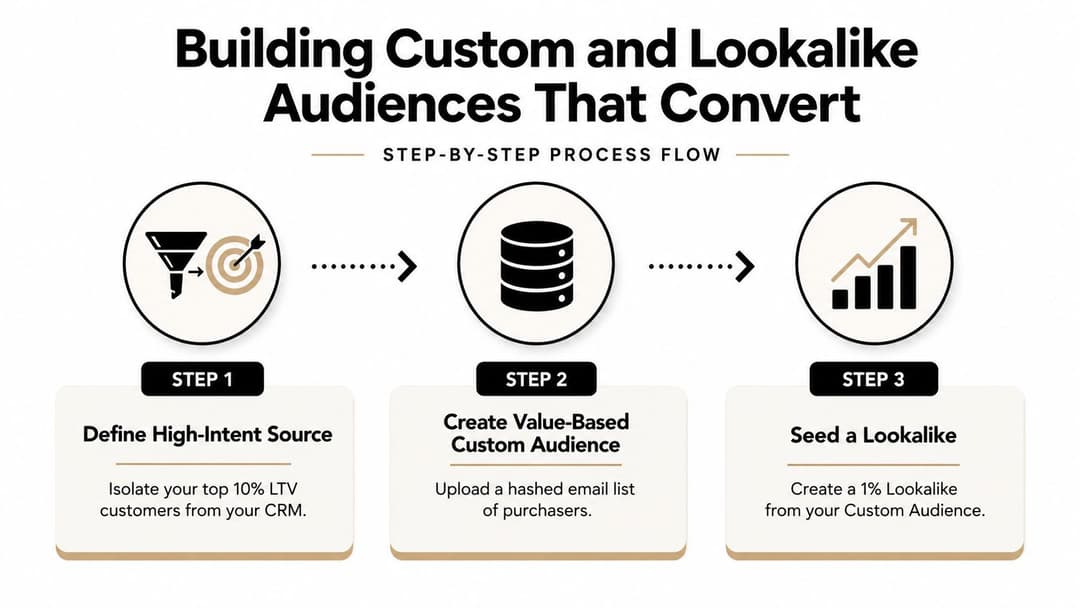
A Custom Audience is only as useful as the behavior it represents. A large list of people who opened a form or visited a general page may look impressive, but it can be a poor foundation for prospecting. Meta needs a source with a clear relationship to the outcome you want.
Build the source in this order:
- Purchasers: Use recent customer records and separate ordinary buyers from high-value customers when your CRM tracks value reliably.
- Qualified leads: Upload people who met your sales or qualification criteria, not every form opener.
- High-intent product users: Add meaningful add-to-cart or checkout activity where the event fires correctly.
- Deep video viewers: Use people who watched a substantial portion of a relevant video, such as 75% or more, when purchase data is limited.
The source should be fresh, consented, deduplicated, and tied to a clear event. For customer-list uploads, hash identifiers according to Meta's requirements and document permission status before activation. A CRM connection through the Conversions API can help pass offline purchases and downstream lead outcomes back into Meta, giving optimization a closer view of business quality than browser activity alone.
Seed similarity before you chase scale
Start performance prospecting with a 1% Lookalike from your strongest purchaser or qualified-lead Custom Audience. The source should contain enough distinct, recent records for Meta to model meaningful similarities. The practitioner guidance in the research recommends at least 1,000 people for Lookalike seeds, while website Custom Audiences should have at least 100 events before you expect a useful source. Those thresholds are operational safeguards, not promises of performance.
Expand to 2% or 3% only after the smaller source produces stable conversion data and the additional reach still meets your efficiency target. A broader Lookalike can provide scale, but it also relaxes similarity. Don't expand because the audience estimate looks attractive. Expand because the current audience is constrained, the offer can support more volume, and conversion quality remains acceptable.
For a detailed walkthrough of audience construction mechanics, the Growth 4 Trades Facebook guide offers a useful reference. You can also compare this approach with the deeper explanation of Meta Lookalike Audiences, especially when deciding whether a purchaser, lead, or engagement source reflects the outcome you want.
When Broad Targeting Actually Beats Narrow Targeting
Many advertisers still assume that more interests mean better targeting. That assumption made sense when manual audience controls did more of the delivery work. It's less reliable now. Meta's systems increasingly use conversion signals and automated audience discovery to find people who may not match the advertiser's selected interests but still resemble likely buyers.
A narrow stack can fail in three ways. It fragments budget across micro-segments, reduces impression volume, and gives the optimizer fewer opportunities to compare buyer patterns. A broad ad set can use the same creative and offer across a larger pool, then concentrate delivery around people who generate the chosen optimization event.
The comparison below is a decision aid, not a promise of a fixed result.
| Metric | Narrow Interest Stack | Broad / Advantage+ |
|---|---|---|
| Delivery | Constrained by selected attributes | More room for algorithmic discovery |
| Main risk | Audience starvation and overlap | Weak signal quality or unsuitable offer |
| Best input | Strict geography or qualification | Clean conversion events and strong creative |
| Evaluation | Conversion efficiency after sufficient volume | Conversion efficiency plus delivery stability |
| Typical use | Sparse data or tightly qualified offers | Mature conversion signals and scalable offers |
Independent analysis reports that broad targeting can produce higher average ROAS than Lookalikes while maintaining comparable CTR, challenging the assumption that the narrowest audience must win. See the analysis of Facebook Ads targeting approaches for the underlying comparison.
Use a simple decision rule
Start broad when the account has a dependable conversion signal and the offer can serve a wide market. Keep geography, age, or gender controls when they reflect genuine eligibility constraints, not because a smaller audience feels safer. Use detailed targeting when it materially improves relevance or qualification, then test expansion instead of treating the manual setup as permanent.
If the account has sparse conversion data, narrow targeting may help focus early learning, but it also limits discovery. The answer should come from the data generated by comparable tests. Hold creative, placement, budget logic, and optimization event as constant as possible, then compare CPA, ROAS, conversion rate, and lead quality.
Layering, Exclusions, and Audience Size Discipline
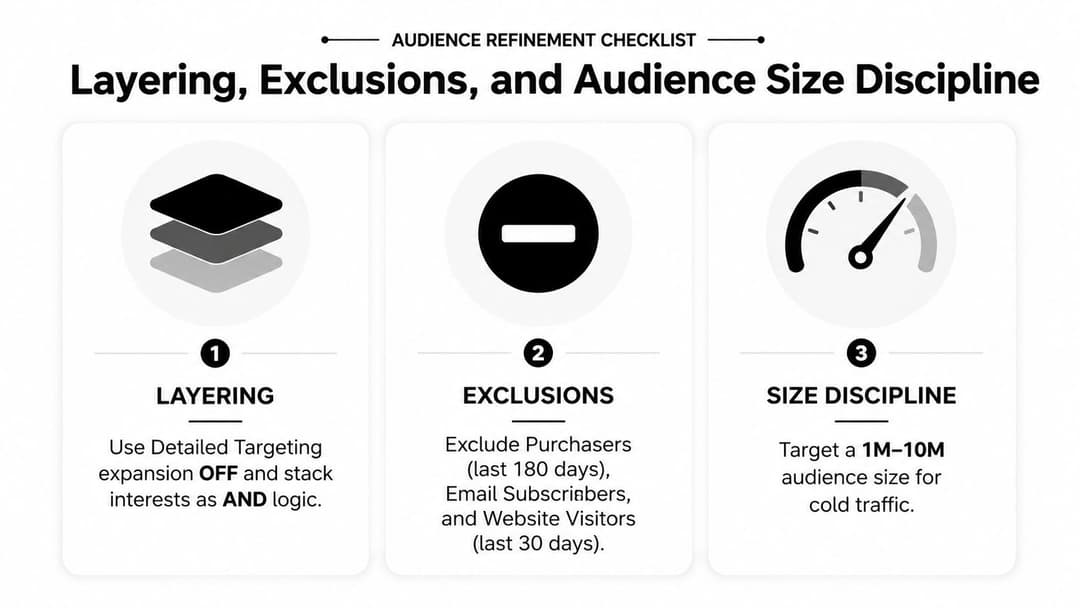
Detailed targeting only helps when each layer has a clear job. In Meta Ads Manager, use narrowing controls intentionally so the audience must meet the relevant conditions. Don't pile on attributes just because they're available. Each additional filter removes people who might have converted through a signal the platform can't fully observe.
Use layering for genuine qualification. For example, a specialist business might combine a relevant professional interest with a behavior that indicates the person is in a purchasing context. A local service can keep geography strict while leaving other attributes broad. The more specific the offer, the more defensible the additional layer becomes.
Build exclusions before launch
Exclusions protect both budget and measurement. At minimum, review whether the campaign should suppress:
- Recent purchasers: Keep buyers out of new-customer acquisition when the message is for first orders.
- Existing customers: Move them into retention, cross-sell, or loyalty campaigns.
- Other funnel converters: Remove people who completed the action promoted by another campaign.
- Active warm pools: Prevent prospecting and retargeting ad sets from competing for the same users.
A useful example is excluding customers who purchased recently and high-value customers from a campaign designed to acquire new buyers. The exact retention window should follow the product's repurchase cycle and consent framework, not a universal rule.
Don't confuse precision with control
Audience overlap can make several ad sets appear diversified when they're bidding for the same people. Review overlap before launch and consolidate duplicated prospecting structures where the same audience sources repeatedly intersect. Meta's current direction favors broader delivery for conversion campaigns, so an audience that looks less precise may provide better room for model-based discovery.
Use these qualitative guardrails:
| Objective | Starting discipline | Reason |
|---|---|---|
| Conversions | Broad enough to support consistent delivery | The optimizer needs room to find likely converters |
| Traffic | Wider reach than a tightly qualified conversion pool | Click volume and discovery matter more at this stage |
| Strict qualification | Smaller audience may be justified | Eligibility can matter more than scale |
For demographic constraints and their practical use, demographic ad targeting guidance can help teams separate real eligibility rules from arbitrary narrowing.
A small audience isn't automatically high quality. It's often just a small audience.
A/B Testing Audiences Against Real KPIs
Audience tests fail when advertisers change too many variables at once. If one ad set uses a broad audience, a different creative, a different placement mix, and a different budget, the result says little about targeting. Build the comparison inside one campaign, isolate each audience in its own ad set, and keep creative, placements, optimization event, and budget treatment consistent.
Choose the KPI based on funnel role:
- Bottom-funnel retargeting: Use CPA and conversion rate. ROAS can support the decision when order values vary.
- Middle-funnel Lookalikes: Use ROAS as the primary business measure, with MER as a broader efficiency check.
- Top-funnel broad testing: Watch CTR and CPM for delivery and message relevance, but don't declare a winner without downstream conversion evidence.
The test should run through at least two conversion cycles or until each variant reaches 50 conversions, based on the operating framework in the brief. A seven-day minimum is also useful because shorter windows can overreact to daily auction movement. Early CPM differences are not proof that one audience is better. A cheaper impression may still produce weaker buyers.
| Funnel Stage | Primary KPI | Secondary KPI | Min. Conversions per Variant |
|---|---|---|---|
| Bottom funnel | CPA | Conversion rate or ROAS | 50 |
| Middle funnel | ROAS | MER and conversion rate | 50 |
| Top funnel | CTR | CPM and downstream conversion rate | 50 |
Cut a loser when it has spent materially behind its peer and continues to trail on the agreed business KPI, not because it had a poor first day. Once a winner is clear, move it into a consolidated scaling campaign and introduce one challenger. Don't keep adding variants until the account becomes impossible to read.
For teams formalizing this process, this guide to split testing provides a useful framework for isolating variables and interpreting results.
Future-Proofing Audience Strategy for 2026 and Beyond
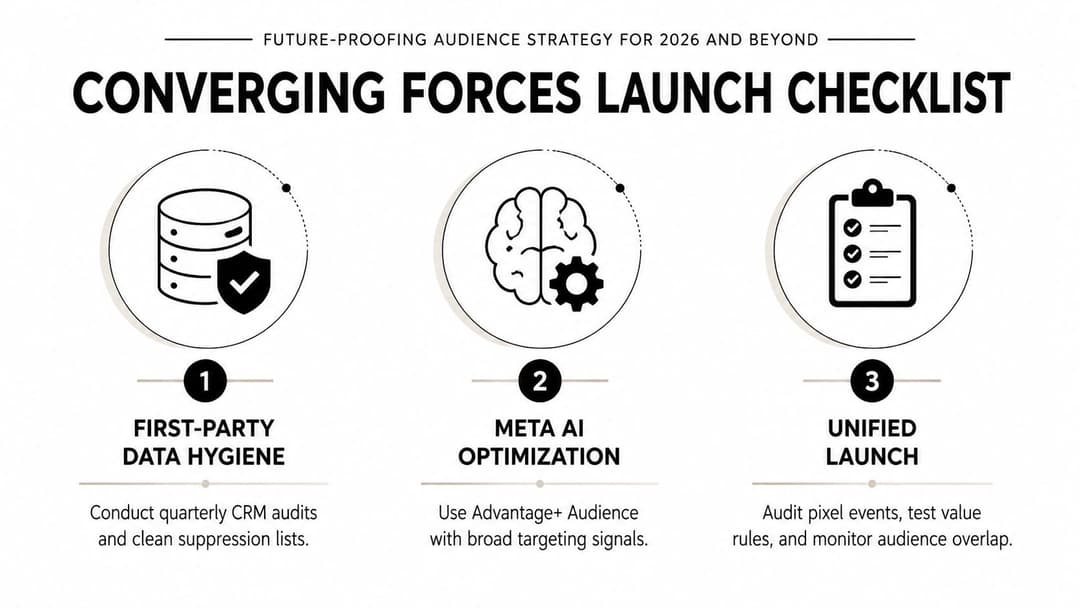
Audience strategy is becoming a data-engineering discipline. First-party data hygiene, Meta's AI-led delivery, and privacy requirements now shape what the platform can learn before an advertiser even chooses an audience setting.
Start every launch with three checks:
- First-party data hygiene: Clean CRM uploads, remove invalid or duplicated records, document consent, and maintain suppression lists for customers and converters.
- Meta signal quality: Confirm that pixel and Conversions API events are deduplicated, prioritized events represent real business outcomes, and offline purchases or qualified leads reach the account where applicable.
- Algorithmic structure: Test Advantage+ or broad delivery against the strongest manual structure instead of assuming either approach is universally superior.
Privacy changes make this discipline more important. Recent coverage describes tighter consent expectations for uploaded contact data and restrictions around overly personalized targeting, with regional differences affecting markets such as the UK and EU. The strategic implication is clear: a precise interest stack can't compensate for unreliable event data or unclear permission.
Apply a signal-first launch rule
If the pixel produces fewer than 50 weekly conversions, prioritize signal density before expanding reach. Improve CRM connections, pass qualified outcomes, refresh weak event definitions, and build seeds from meaningful customer actions. If the account exceeds that threshold, test Advantage+ against the best manual structure and let CPA, ROAS, conversion rate, and lead quality determine the direction.
Review the account quarterly. Check audience overlap, rotate stale Lookalike seeds, refresh suppression lists, and connect creative fatigue to audience frequency and conversion decline. Predictive audience targeting guidance can help teams think beyond static audience labels and toward signals that indicate future conversion potential.
The strongest Facebook advertisers don't treat targeting as a one-time setup. They maintain the inputs, test the platform's assumptions, and keep enough structure to protect measurement without blocking discovery.
AdStellar AI helps teams launch, test, and scale Meta campaigns by generating creative, copy, audience combinations, and performance insights from historical results. If you want to replace manual audience guesswork with a repeatable workflow tied to ROAS, CPA, or CPL, visit AdStellar AI and see how it can fit into your next campaign build.